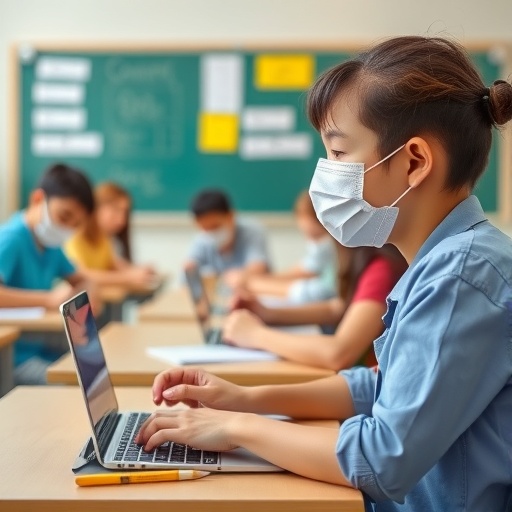
In the wake of the global COVID-19 pandemic, the education sector faced unprecedented upheaval as policymakers and educators scrambled to devise strategies capable of mitigating learning loss while safeguarding public health. A transformative study published recently in Nature Communications has taken a cutting-edge approach to understanding the effectiveness of elementary and secondary school policies implemented during this critical period. This research employs counterfactual evaluation techniques to dissect the complex dynamics of pandemic-era education strategies, revealing nuanced insights about their outcomes and offering a valuable blueprint for future crises.
The core innovation in this study lies in its use of counterfactual analysis—a rigorous method that estimates what could have happened in alternative scenarios where different policies were enacted. Unlike conventional observational studies that are often plagued by confounding factors, counterfactual evaluation draws from advanced statistical modelling to simulate hypothetical environments. This allows researchers to draw more causal inferences about the impact of diverse interventions, such as school closures, hybrid learning models, and targeted testing and quarantine protocols.
A pivotal challenge during the pandemic was balancing the imperative to curb viral transmission against the clear, detrimental academic and psychosocial costs of prolonged school closures. Early decisions were frequently driven by emergent epidemiological data but lacked comprehensive foresight on the educational ramifications. The study by Canfora, Escosio, Boldea, and colleagues fills this void by systematically simulating various policy trajectories and their consequences on learning outcomes, mental health metrics, and community transmission rates.
The authors leveraged large-scale datasets capturing school attendance, COVID-19 infection rates, socio-demographic variables, and remote learning accessibility across numerous regions. Through these rich data inputs, the model estimated the differential effects of policies such as complete lockdowns, rotational attendance schedules, enhanced sanitation protocols, and vaccination prioritization among school staff and eligible students. This granular approach helped untangle the trade-offs inherent in policy decisions, revealing which strategies minimized learning disruption while controlling viral spread most effectively.
One of the striking findings from the analysis is the demonstrable efficacy of phased reopening plans that integrated hybrid learning with robust testing and contact tracing measures. Schools adopting these blended models witnessed significantly lower learning losses compared to those enforcing outright closures, without appreciably exacerbating infection rates. This nuanced insight counters the binary narrative often prevalent in public discourse and underscores the value of adaptive, data-informed policymaking.
Moreover, the study illuminates the disproportionate impact of pandemic policies on socio-economically disadvantaged communities. Schools serving lower-income populations faced steeper challenges due to limited access to digital infrastructure and ancillary support systems, exacerbating educational inequities. The counterfactual simulations suggest that targeted resource allocation and customized policy interventions in these areas could have mitigated such disparities more effectively, pointing toward a more equitable framework for crisis education management.
A crucial technical aspect underpinning the research is its reliance on causal inference algorithms that incorporate time-varying covariates and dynamic treatment regimes. By modelling how policy effects evolve over time and differ across contexts, the study captures the multifaceted reality of a pandemic unfolding in waves. This temporal sensitivity enables a more faithful recreation of plausible alternative histories and strengthens the validity of the conclusions drawn.
In addition, the incorporation of psychosocial outcome metrics—such as anxiety and depression indicators derived from survey data—enriches the analysis beyond academic performance alone. The findings reveal that policies maintaining partial in-person attendance substantially alleviate mental health burdens among students compared to prolonged remote-only education. This multidimensional assessment highlights the intricate balancing act between epidemiological safety and holistic student well-being.
The authors also emphasize the role of vaccination coverage among educators and eligible students as a crucial moderator of policy effects. Simulations demonstrate that higher immunization rates significantly expand the feasibility of maintaining full or near-full in-person learning environments safely. This evidence feeds directly into ongoing discussions about vaccine mandates and prioritization strategies within educational settings.
Importantly, the study does not present a one-size-fits-all solution but rather advocates for contextually tailored approaches informed by local epidemiological and socio-economic conditions. Its comprehensive counterfactual framework provides policymakers with a decision-support tool capable of projecting the likely trajectories of various intervention mixes, enabling more agile and evidence-based responses in future public health emergencies.
The methodological rigor and broad applicability of this research make it a landmark contribution to the fields of educational policy and pandemic response. By quantifying both the direct and indirect consequences of school-related interventions during COVID-19, it offers an unparalleled synthesis that bridges epidemiology, education science, and social equity considerations.
Moving forward, the integration of such counterfactual evaluation methods into routine policy assessment processes holds immense promise. It encourages a proactive stance where potential outcomes are anticipated rather than merely reacted to, fostering resilience within educational ecosystems. Additionally, the approach is transferable to other sectors grappling with crisis management, such as healthcare and urban planning.
This study arrives at a critical juncture as nations continue to grapple with the long-term ramifications of the pandemic and seek sustainable strategies for future crises. Its findings underscore that nuanced, data-driven policies—grounded in rigorous causal analysis—are instrumental in safeguarding not just public health but also the educational trajectories and well-being of generations to come.
While the COVID-19 pandemic exposed stark vulnerabilities in global education systems, it also catalyzed innovation in policy evaluation methodologies. The counterfactual evaluation approach championed in this research exemplifies such innovation and sets a new standard for assessing complex, multi-dimensional interventions under uncertainty.
In sum, Canfora and colleagues provide an indispensable resource for governments, educational institutions, and researchers alike. As the world anticipates emerging public health threats and environmental challenges, equipping decision-makers with robust analytical frameworks like this will be crucial for crafting policies that are both effective and equitable, ensuring no student is left behind in the face of disruption.
Subject of Research: Evaluation of elementary and secondary school policies during the COVID-19 pandemic through counterfactual simulation methods.
Article Title: Counterfactual evaluation of elementary and secondary school policies in the COVID-19 pandemic.
Article References:
Canfora, B., Escosio, R.A., Boldea, O. et al. Counterfactual evaluation of elementary and secondary school policies in the COVID-19 pandemic. Nat Commun (2026). https://doi.org/10.1038/s41467-026-73344-1
Image Credits: AI Generated
Tags: balancing health and education COVID-19counterfactual analysis in educationCOVID-19 school policies evaluationelementary and secondary school interventionsfuture crisis education planninghybrid learning effectiveness pandemicmitigating learning loss COVID-19pandemic education strategiespsychosocial effects of school closuresschool closures impact on learningstatistical modeling in education policytargeted testing and quarantine schools