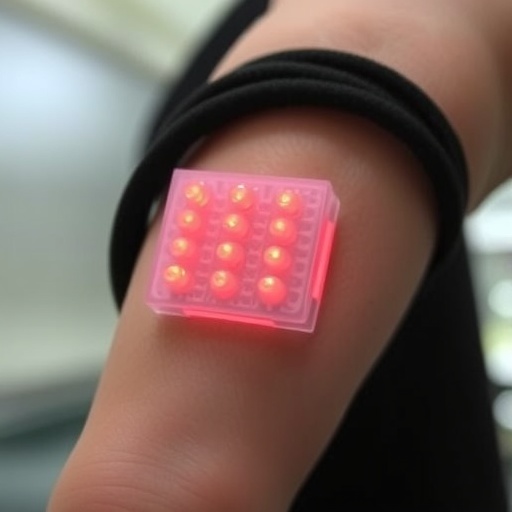
Flexible wearable electronics may soon become far less vulnerable to winter conditions, thanks to a cellulose-based hydrogel that continues to conduct ionic signals even after prolonged exposure to subzero temperatures. Researchers from Southwest Jiaotong University have developed a transparent, flexible and 3D-printable material that resists freezing, retains mechanical strength and can detect human motion under conditions that cause conventional hydrogel sensors to fail. The material could help expand wearable electronics into cold-weather healthcare, refrigerated environments, outdoor robotics and human-machine interfaces.
Hydrogel sensors are attractive because they are soft, stretchable and capable of conforming closely to the body. Their electrical behavior usually comes from mobile ions moving through a water-rich polymer network. That same water content, however, creates a serious weakness: when temperatures fall, water crystallizes into ice. Freezing can interrupt ion transport, stiffen the material, damage its internal network and reduce its ability to deform with the skin. In practical devices, these changes can produce weak, unstable or completely lost signals. The new research addresses the problem by using cellulose, a renewable polymer abundant in cotton, wood and agricultural materials, together with a carefully selected mixture of inorganic salts.
The team dissolved cotton-pulp cellulose in a binary molten salt hydrate containing zinc chloride and lithium bromide. The total salt-to-water molar ratio was maintained at 1:3, producing a strongly hydrated chemical environment capable of breaking apart cellulose’s normally resistant crystalline structure. Within approximately ten minutes, the salt system disrupted the hydrogen-bond network that holds cellulose microfibrils together. This rapid dissolution is important because cellulose is mechanically robust but notoriously difficult to process into uniform, high-performance soft materials without aggressive chemical treatment.
According to the researchers’ molecular simulations, the two salts play complementary roles during dissolution. Small, highly charged lithium ions are able to penetrate crystalline regions of cellulose and interfere with hydrogen bonds connecting neighboring molecular chains. Zinc ions, meanwhile, form stable hydration shells around the liberated cellulose chains. These shells help protect the polymer from hydrolytic degradation, a problem that can occur when cellulose is treated with concentrated zinc salts alone. After dissolution, the cellulose solution was cast into hydrogel structures and rinsed to produce the material identified as HZ0.3L0.7-C3.
The resulting hydrogel combines properties that are rarely found together in a single soft sensor. The optimized formulation achieved an ionic conductivity of 4.48 siemens per meter, allowing electrical signals to move efficiently through the hydrated network. It also tolerated compressive stress of up to 2.48 megapascals, giving it considerably more mechanical resilience than many conventional water-rich hydrogels. This balance between conductivity and strength is critical for wearable devices, which must repeatedly deform under pressure while maintaining a stable electrical response.
Its most striking feature is its resistance to ice formation. Differential scanning calorimetry measurements conducted between minus 80 and 20 degrees Celsius revealed no exothermic peak associated with water crystallization. In other words, the testing did not detect the thermal signature expected when free water freezes. The researchers attribute this behavior to the strong binding of water by the salt and cellulose network. When water molecules are coordinated with ions and confined within the polymer structure, they have far less freedom to organize into the crystalline lattice required for ice. The material therefore remains soft and ionically active at temperatures where ordinary hydrogels become rigid.
The low-temperature durability was demonstrated in an extended test at minus 25 degrees Celsius. After remaining at that temperature for 168 hours, the hydrogel sensor continued to produce clear and repeatable electrical signals when subjected to finger bending and fingertip pressing. This result suggests that the material does more than temporarily resist freezing during a brief laboratory demonstration. Its ability to preserve signal quality after a week of cold exposure could be relevant to wearable systems used in winter sports, polar research, cold-chain logistics and industrial facilities.
The hydrogel is also compatible with additive manufacturing. Its pronounced shear-thinning behavior means that it becomes less viscous when subjected to the force of flowing through a printer nozzle, then regains enough structural integrity to retain its shape after deposition. Using this property, the researchers printed detailed forms including five-pointed stars and maple leaves. Three-dimensional printing could allow sensors to be produced in custom geometries, enabling designers to match them to irregular body surfaces or integrate them directly into flexible electronic structures. This approach may reduce the need for complex cutting, assembly and molding steps.
For contact with skin, the researchers coated the hydrogel with polydopamine, a surface treatment inspired by the adhesive chemistry of mussels. The coating was intended to improve biocompatibility while preserving the material’s electrical performance. In a sandwich-structured sensor, the modified hydrogel responded to mechanical deformation in approximately 100 milliseconds and recovered in about 300 milliseconds. It maintained a stable output through 500 compression cycles at 30 percent strain, indicating that the ionic network and surrounding structure could withstand repeated use without rapid signal deterioration. Sensors attached to fingers, wrists, elbows and throats detected movements ranging from joint bending to subtle changes associated with speech and swallowing.
The researchers further demonstrated the technology in a data glove that translated hand movements into the real-time motion of a robotic model. Such an interface relies on the sensor’s ability to convert changes in pressure or deformation into electrical signals that can be interpreted by control software. Because the cellulose hydrogel is soft and conformable, it can remain in close contact with moving skin without the discomfort or mechanical mismatch associated with rigid electronic components. Combined with its resistance to freezing, the system points toward wearable controls that could function in environments where conventional sensors lose flexibility or conductivity.
The study’s broader significance lies in its combination of sustainability, manufacturing flexibility and environmental stability. Cellulose provides a renewable structural framework, while the zinc chloride–lithium bromide system supplies both ion transport and strong water-binding behavior. The result is not simply a hydrogel that survives the cold, but a platform that can be printed into customized shapes and incorporated into human-centered electronics. Challenges remain before commercial deployment, including long-term durability outside controlled laboratory conditions, salt retention, encapsulation, skin safety over extended periods and scalable manufacturing. Even so, the work offers a compelling strategy for overcoming one of soft electronics’ most persistent limitations: keeping water-based materials functional when the world around them turns to ice.
Subject of Research: Experimental study
Article Title: 3D Printable Ionically Conductive Cellulose Hydrogel Sensor with Robust Water Binding Property at Low Temperatures
Web References: https://doi.org/10.1016/j.jobab.2026.100285; Journal of Bioresources and Bioproducts
References: 10.1016/j.jobab.2026.100285
Image Credits: School of Chemistry, Key Laboratory of Advanced Technologies of Materials (Ministry of Education), Southwest Jiaotong University, Chengdu 610031, China
Keywords
Cellulose hydrogel, 3D-printable sensors, ionic conductivity, low-temperature electronics, freeze-resistant hydrogels, wearable sensors, flexible electronics, molten salt hydrate, motion sensors, robotic interfaces
Tags: 3D-printed hydrogels for cold environmentscellulose-based hydrogeldurable materials for refrigerated environmentsflexible wearable healthcare devicesfrozen temperature resilient sensorshuman–machine interface technologyhydrogel stability under freezing conditionsionic conductivity in low temperaturesoutdoor robotics with cold-weather sensorsrenewable polymers in wearable sensorssalt-infused cellulose hydrogelswearable electronics