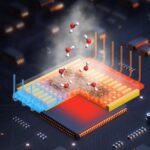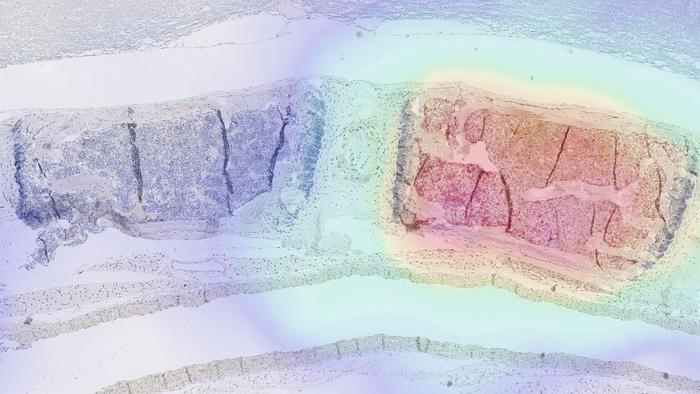


image: In the right half of this tissue section, engineered immune cells known as CAR T cells are attacking tumor tissue. A new method makes it possible to visualize them in the body using PET imaging, as shown here in the superimposed image.
view more
Credit: Volker Morath / TUM
In modern immunotherapy, modified immune cells are introduced into the body to attack tumors and other targets. Researchers at the Technical University of Munich (TUM) have developed a method for tracking these cells in the body. This new approach could deepen our understanding of cellular therapies and help make future treatments safer.
When standard treatments for diseases like cancer fail, custom-tailored cell therapies are increasingly becoming a viable option. A prominent example is CAR-T-cell therapy. In this approach, immune cells are taken from the patient and genetically engineered in the lab to carry a receptor that recognizes structures specific to the surface of cancer cells. These modified immune cells then multiply in the body and initiate an immune response against the tumor.
Physicians could greatly benefit from knowing exactly how these modified immune cells behave in the body: Do they migrate to where they are needed? Do they replicate sufficiently? Do they behave unpredictably and, in the worst-case scenario, attack healthy tissue? Currently, there are no clinically applicable methods to answer these critical questions.
An artificial receptor and a custom-designed marker
An interdisciplinary team at TUM and the TUM University Hospital has now proposed a solution. In simplified terms, a second artificial receptor is inserted into the modified immune cells. These cells can then be visualized using PET imaging and a specially developed, non-toxic radioactive contrast agent. When this so-called radioligand is injected into the body, it binds exclusively to the modified cells and their descendants, making them visible.
The technique relies on artificial proteins with specific binding properties, known as anticalins. These have been developed since the 1990s by Arne Skerra, Professor of Biological Chemistry at TUM and a pioneer in protein engineering. His work led to the creation of an anticalin that binds the ligand DTPA and has now been adapted as part of a cell surface receptor. A team led by Wolfgang Weber, Professor of Nuclear Medicine at TUM University Hospital, used this concept to engineer an artificial gene that causes cells to express the anticalin receptor “DTPA-R” on their surface. The project was spearheaded by Volker Morath and Katja Fritschle from the Department of Nuclear Medicine, who, along with their team, also developed the matching radioligand for DTPA-R: 18F-DTPA. The method was tested on CAR-T cells in collaboration with immunotherapy expert Dirk Busch, Professor of Medical Microbiology, Immunology and Hygiene at TUM.
Expectations met
In experiments with mice, the researchers were able to demonstrate that the modified cells indeed migrated to the affected diseased tissue and proliferated there. They also showed that the radioligand is rapidly excreted via the kidneys, binds exclusively to cells with the artificial receptor, and does not interfere with other processes in the body. Moreover, the study showed that this approach can also be used to monitor gene therapies in which viruses serve as tools to alter genetic information within cells.
“A valuable tool”
“For several years now, it has been clear that new medical applications like immunotherapies and gene therapies hold tremendous potential,” says Prof. Wolfgang Weber, who led the study. “We believe that we have created a valuable tool that can make such therapies safer by providing better insight into what happens inside the body.” The technique is still in its early stages. Before it can be used in human patients, its safety and efficacy must be verified in clinical trials . Further development toward clinical trial use and commercialization is currently ongoing.
Still, the researchers believe the method can already yield valuable insights for basic research. It is also intended to support animal welfare: If laboratory animals can be continuously monitored during experiments, their numbers could be significantly reduced in the development of new cell and gene therapies.
Publication:
Volker Morath, Katja Fritschle et al. “PET-based tracking of CAR T cells and viral gene transfer using a cell surface reporter that binds to lanthanide complexes.” Nature Biomedical Engineering (2025). DOI: 10.1038/s41551-025-01415-7
Further information:
This news item on tum.de:
The ongoing development of the approach is supported by the GO-Bio initial program of the German Federal Ministry of Research, Technology and Space and the UK-based National Centre for the 3Rs.
Also contributing significantly to the study was PD Dr. Katja Steiger from the Institute of Pathology at TUM.
Research into methods for tracking immune cells using imaging techniques is underway in many places. At TUM, for example, the start-up ImuVeo – which also has its roots in the Department of Nuclear Medicine and the Department of Medicine III at TUM University Hospital – has developed a technique that enables immune cell tracking.
Subject matter expert:
Prof. Wolfgang Weber
Technical University of Munich
TUM University Hospital
Department of Nuclear Medicine
Tel. +49 (89) 4140 2972
[email protected]
TUM Corporate Communications Center contact:
Paul Hellmich
Media Relations
Tel. +49 (0) 89 289 22731
[email protected]
www.tum.de
Journal
Nature Biomedical Engineering
DOI
10.1038/s41551-025-01415-7
Article Title
PET-based tracking of CAR T cells and viral gene transfer using a cell surface reporter that binds to lanthanide complexes
Article Publication Date
13-Jun-2025
COI Statement
V.M., K.F., A.S. and W.A.W. have applied for intellectual property rights on Anticalin-based reporter genes (WO 20022/101492 A1). A.S. is a co-founder and shareholder of Pieris Pharmaceuticals. The other authors declare no competing interests.
Media Contact
Paul Hellmich
Technical University of Munich (TUM)
Office: 89 289 22731
Journal
Nature Biomedical Engineering
DOI
10.1038/s41551-025-01415-7
Journal
Nature Biomedical Engineering
DOI
10.1038/s41551-025-01415-7
Article Title
PET-based tracking of CAR T cells and viral gene transfer using a cell surface reporter that binds to lanthanide complexes
.adsslot_UCy2pk5lcF{width:728px !important;height:90px !important;}
@media(max-width:1199px){ .adsslot_UCy2pk5lcF{width:468px !important;height:60px !important;}
}
@media(max-width:767px){ .adsslot_UCy2pk5lcF{width:320px !important;height:50px !important;}
}
ADVERTISEMENT Article Publication Date
13-Jun-2025
COI Statement
V.M., K.F., A.S. and W.A.W. have applied for intellectual property rights on Anticalin-based reporter genes (WO 20022/101492 A1). A.S. is a co-founder and shareholder of Pieris Pharmaceuticals. The other authors declare no competing interests.
Keywords
/Health and medicine
/Applied sciences and engineering/Engineering/Bioengineering/Biomedical engineering
/Health and medicine/Health care
/Health and medicine/Human health
/Health and medicine/Medical specialties
/Health and medicine/Pharmaceuticals
/Life sciences/Cell biology/Cells
/Life sciences/Immunology
/Health and medicine/Clinical medicine/Medical treatments
/Health and medicine/Diseases and disorders/Cancer/Cancer immunology/Cancer immunotherapy
/Life sciences/Cell biology/Cells/Cancer cells
/Health and medicine/Diseases and disorders/Cancer
/Health and medicine/Diseases and disorders/Cancer/Cancer immunology
/Health and medicine/Medical specialties/Oncology
/Research methods/Imaging/In vivo imaging
/Research methods/Imaging/Medical imaging
/Research methods/Imaging/Molecular imaging
/Research methods/Imaging/Tomography
/Research methods/Imaging/Medical imaging/Positron emission tomography
/Research methods/Imaging/Medical imaging/Clinical imaging
/Social sciences/Philosophy/Science philosophy/Scientific method/Experimentation/Animal experimentation
/Applied sciences and engineering/Engineering/Bioengineering
/Applied sciences and engineering/Engineering/Bioengineering/Biotechnology
bu içeriği en az 2000 kelime olacak şekilde ve alt başlıklar ve madde içermiyecek şekilde ünlü bir science magazine için İngilizce olarak yeniden yaz. Teknik açıklamalar içersin ve viral olacak şekilde İngilizce yaz. Haber dışında başka bir şey içermesin. Haber içerisinde en az 12 paragraf ve her bir paragrafta da en az 50 kelime olsun. Cevapta sadece haber olsun. Ayrıca haberi yazdıktan sonra içerikten yararlanarak aşağıdaki başlıkların bilgisi var ise haberin altında doldur. Eğer yoksa bilgisi ilgili kısmı yazma.:
Subject of Research:
Article Title:
News Publication Date:
Web References:
References:
Image Credits:
Keywords
Tags: advancements in cancer immunologycancer treatment methodologiesCAR T cell trackingcellular therapy innovationsengineered immune cellsimmune cell labeling techniquesimmunotherapy advancementspersonalized medicine in oncologyPET imaging in cancer treatmentTechnical University of Munich researchtumor targeting techniquesvisualizing immune responses