
James Watson, PhD, died last week. He was 97 years old. He co-discovered the structure of DNA and helped to launch the Human Genome Project in 1990. He served as director and president of the Cold Spring Harbor Laboratory (CSHL) for 35 years.
Seven years ago, the Nobel laureate was seriously injured in a car crash, his car plummeting down a 20-foot ditch near his home on the CSHL campus on the north shore of Long Island, New York. But the scientific reputation of the man who pieced together the building blocks of life in 1953—literally named “Watson-Crick” base pairing—was about to tumble much deeper.
In January 2019, PBS broadcast a candid, revealing documentary called Decoding Watson in the long running American Masters series. The film was highlighted by warm scenes of Watson at home with his wife, Elizabeth, and his son, Rufus, who has suffered from a form of schizophrenia since childhood.
In the closing minutes of the film, Watson was asked about his infamous racist statements given to a British journalist in 2007. Back then, Watson had issued a short apology that managed to quench his reputational damage. All that benefit of the doubt dissolved when he reneged on his apology at the end of the PBS documentary. The difference in IQ between Whites and Blacks was genetic, he said. Nature was more important than nurture. His words and their implications reverberated long after the closing credits rolled.
This time, Watson could not claim he was misquoted or off the record. Following the broadcast, I heard from a source close to Watson that the PBS producers had offered Watson the chance to re-record his closing interview. He willfully declined. It was the final straw for CSHL, which stripped Watson of all his remaining titles and unceremoniously removed his oil painting that had hung for years in CSHL’s Grace auditorium.
Reflections
This essay is not an obituary—I suggest those interested start with a piece written by the great science writer Sharon Begley, prepared before her own death in 2021. Rather, what follows are some personal reflections on a few encounters with Watson.
I first sat down with Watson in 2003 at a press conference at the Miami Winter Symposium to mark the 50th anniversary of the double helix. I ended the press conference by asking Watson about the excellent BBC drama Life Story, in which Watson was portrayed by a young Jeff Goldblum. Who would you suggest to play you in a remake, I asked? Watson replied: John McEnroe or Ben Stiller.
In 2011, I was invited by officials at the American Society of Human Genetics to moderate the opening plenary session at the annual conference in Montreal. As if hosting a plenary session was not nerve-wracking enough, we had to follow a performance by Cirque du Soleil!
![In May 2007, Jim Watson received his personal genome on a portable hard drive from 454 Life Sciences founder, Jonathan Rothberg, PhD. [Baylor College of Medicine]](https://www.genengnews.com/wp-content/uploads/2025/11/Rothberg-300x227.jpg)
Watson was the guest of honor, as the first person to have his genome sequenced using next-gen sequencing. Among the other three guests was a Dutch geneticist named Marjolein Kreik, MD, PhD, who had the distinction of being the first woman to have her genome sequenced. Marjolein said she had been selected for the excellent reason that her surname sounded like “Crick.”

As we left the stage, I nervously handed Watson a signed copy of my new book, The $1,000 Genome. He was quickly escorted off to some VIP party. I assumed that would be my last contact with him, barring the occasional chance meeting at a CSHL conference, where he remained a popular figure with a reserved front-row seat.
A few months later, however, his secretary called me to request my presence at a dinner with Jim on a Sunday evening at the Charles Hotel in Harvard Square. My first instinct was that I had somehow maligned him in the book. Instead, he handed me a copy of DNA, a book he had published in 2004 with Harvard lecturer Andrew Berry, PhD. Andrew was too busy to undertake a full rewrite for the second edition, so would I be interested in writing a couple of new chapters and updating the rest?
Like so many scientists, I had been electrified reading The Double Helix at an impressionable age. Many distinguished scientists, including Nobel laureate Jennifer Doudna, PhD, credit Watson’s best-selling account as igniting their interest in scientific research. The book had its critics, including Crick, who strongly opposed publication beforehand but subsequently changed his mind once he appreciated the importance of reaching a wider audience.

As we put the second edition of DNA together, I met Watson and Berry a few times in the Manhattan offices of Knopf, the book’s publisher. I urged Watson to address his treatment of Franklin in a new paragraph at the end of the second chapter. After some minor wordsmithing, Watson eventually agreed to this:
“I have been widely criticized for my characterization of Rosalind Franklin in my account of these events, The Double Helix, published in 1968. While Rosalind refused for a long time to countenance the idea that DNA was a helix, her work provided data that was absolutely critical to ours. Happily today, her contribution is properly appreciated, including by me in my afterword to The Double Helix. Brenda Maddox wrote a lovely biography… and no less an actress than Nicole Kidman delivered a mesmerizing performance as Rosalind in the 2015 West End production of the play Photograph 51… Rosalind had set [the photograph] aside in May 1952, but Maurice [Wilkins] only showed it to me in January 1953. Admittedly he did so without telling her. But that’s about as cloak-and-dagger as things got.”

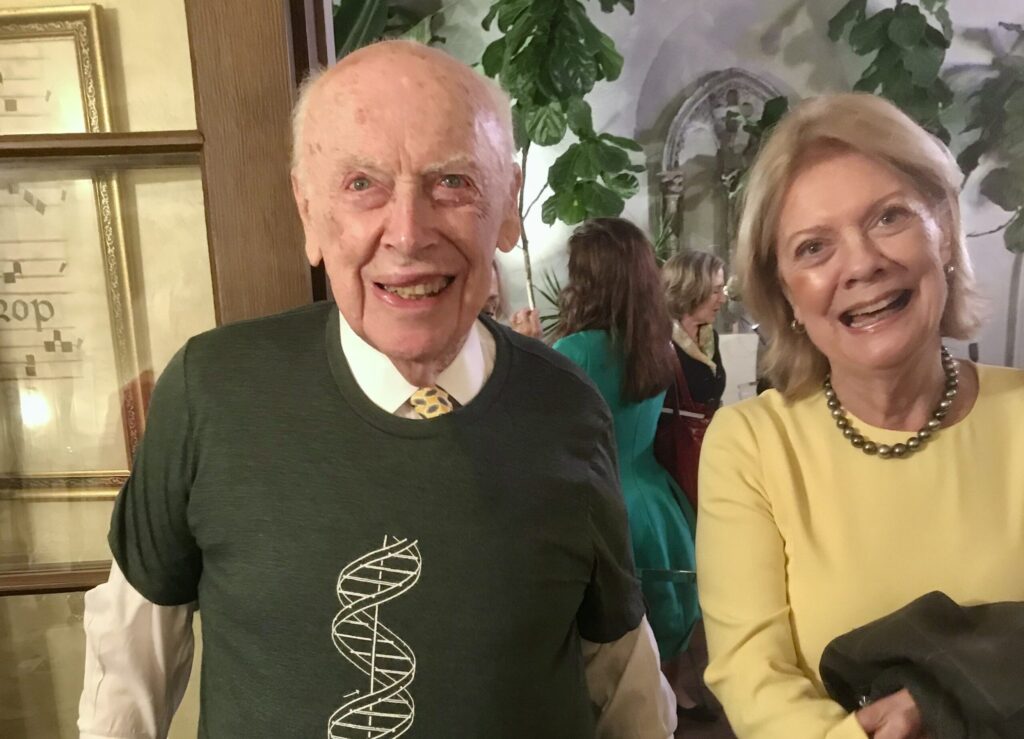
Six months later, I got invited to a dinner party that some of Watson’s well-heeled friends in Boston were throwing to celebrate his 90th birthday. Feeling awkward about showing up without a gift, I ordered a T-shirt from a friend’s company featuring the iconic double helix, meticulously drawn by Crick’s wife Odile, that featured in the duo’s 1953 Nature paper. Watson immediately removed his jacket and gleefully put the shirt on, while his wife Elizabeth looked on.
Striking out
Watson acknowledged that he was not the intellect that Crick was. While Crick remained “a thinker” in his later years studying consciousness and the brain, Watson said he became more of a manager, running CSHL for decades and delighting in the numerous “home runs” hit by the lab’s designated hitters. But his legacy has been tarnished by allegations that he was a thief, a misogynist, and a racist.
It has become popular in recent years to accuse Watson and Crick of stealing Rosalind Franklin’s X-ray data to build the double helix. As Matthew Cobb makes plain in his new book CRICK, published this week, this is far from the truth. Leaving aside the small detail that it was Franklin’s PhD student, Raymond Gosling, who took the infamous photograph 51, the photo itself was irrelevant when it came to piecing together the structure of DNA. Of far greater significance was an MRC report, including a page of Franklin’s unpublished experimental data, that Max Perutz shared with Crick.
Interviewed years later by Horace Freeland Judson, the author of The Eighth Day of Creation, Crick praised Franklin for being “a great experimentalist” but someone who suffered by not having a confidant nearby with whom to exchange ideas. “She blew it,” Watson said bluntly. “She did not have someone like Francis to talk to.” Crick added that in her final few years before her untimely death in 1958 from ovarian cancer, Franklin did some of her best work, aided by the presence and counsel of Aaron Klug.
There is no evidence that Franklin harbored any resentment to Crick and Watson, despite their token acknowledgement of her contributions in a footnote to their classic Nature paper. She befriended both and following major operations after her cancer diagnosis, spent weeks recuperating with the Cricks at their home in Cambridge.
Decoding Watson, the 2019 PBS documentary, ends with Watson saying:
“After I’m dead, I’ll be more famous than I am now, because DNA gets more famous! DNA is not over-rated. Some things come and go; DNA won’t come and go.”