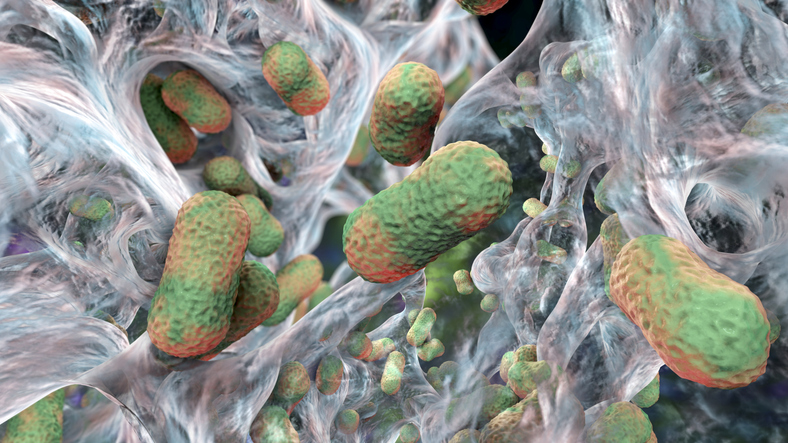
In an unexpected finding, researchers have discovered bacteria present inside the most common type of kidney stone, revealing a previously unrecognized component involved in their formation.
The findings, published in PNAS in the paper, “Intercalated bacterial biofilms are intrinsic internal components of calcium-based kidney stones,” point to a possible therapeutic target that could be used for prevention and treatment for the millions of people who are affected by the frequently painful condition.
“This breakthrough challenges the long‑held assumption that these stones develop solely through chemical and physical processes, and instead shows that bacteria can reside inside stones and may actively contribute to their formation,” said Kymora Scotland, PhD, an assistant professor of urology at the David Geffen School of Medicine at UCLA. “By uncovering this novel mechanism, the study opens the door to new therapeutic strategies that target the microbial environment of kidney stones.”
Cases of kidney stones—composed of clumps of small crystals—have risen globally in recent years; today about one in 11 people will get them in their lifetime. Risk factors include family history, metabolic syndrome, and low fluid intake. The stones start forming when crystals grow in urine and become large enough that they can’t be washed out with normal urine flow.
There are several subsets of kidney stones and while one rare stone type is known to contain bacteria, the most common stone is calcium oxalate (CaOx), comprising almost 80% of kidney stone cases, which have not been previously known to contain bacteria.
But now, researchers report unexpectedly detecting live bacteria as well as biofilms of bacteria integrated into the crystals. The observation occurred while examining data from electron and florescence microscopy.
“We found a new mechanism of stone formation that may help to explain why these stones are so common,” Scotland said. “These results may also help to explain the connections between recurrent urinary tract infections and recurrent kidney stone formation, and provides insights on potential future treatment for these conditions.”
The study focuses on calcium-based stones. How other, less common, stones form is still in question. The findings suggest that bacteria could also be involved in other kidney stone types. More studies are needed to fully understand how bacteria and calcium-based kidney stones interact, the researchers conclude.
“Our multi-institutional team is currently performing studies to determine how bacteria and calcium-based kidney stones interact. We want to understand exactly what makes some patients particularly susceptible to recurrent stone formation, and what it is about these particular species of bacteria that allows them to nucleate these stones,” Scotland said.