In the vast expanse of life’s evolutionary history, the transition from aquatic photosynthetic organisms to land plants represents a crucial leap. Recent research from Osaka Metropolitan University provides compelling insights into this pivotal change through the structural and functional study of a light-harvesting complex unique to primitive green algae. This study unravels how photosynthetic machinery has evolved to adapt from the dimly lit underwater environments to the diverse light conditions on terrestrial landscapes.
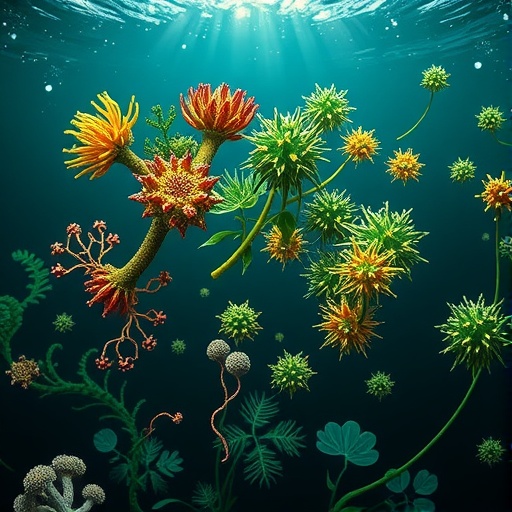
Before the rise of terrestrial plants, the oceans teemed with primitive green algae, which were among the earliest organisms capable of photosynthesis. These microscopic life forms thrived in an environment where sunlight was scarce, especially at depths where blue-green wavelengths penetrate most effectively. To survive and optimize energy conversion, these algae developed specialized pigment-protein complexes that could capture sunlight with remarkable efficiency.
Central to this discovery is the light-harvesting complex called Lhcp, found in a group of early algae known as prasinophytes. Unlike the well-studied LHCII complex in land plants, Lhcp exhibits unique structural features that enable it to absorb light differently. By employing cryo-electron microscopy, the researchers have visualized the three-dimensional architecture of this complex in Ostreococcus tauri, one of the smallest known eukaryotic organisms.
The foundational protein scaffold of Lhcp shares similarities with LHCII, suggesting a conserved evolutionary framework. However, the detailed arrangement of pigments and the configuration of protein loops differ significantly. These disparities alter how light energy is absorbed and transferred within the complex, tailoring the photosynthetic apparatus to suit the algae’s marine habitat.
One of the groundbreaking findings involves the trimeric structure of Lhcp. This three-part formation is stabilized not only by pigment-protein interactions but also through novel pigment-pigment adjacencies. Notably, a distinct carotenoid molecule interlocks subunits within the trimer, an arrangement absent in the terrestrial counterparts. This carotenoid is instrumental in enhancing the complex’s ability to harvest blue-green light prevalent in deeper aquatic zones.
The structural stabilization conferred by the carotenoid not only secures the assembly of the light-harvesting complex but optimizes its functional efficiency under underwater conditions. This adaptation exemplifies how pigment-protein complexes can evolve to meet the environmental demands of their hosts. Such evolutionary refinements highlight the biochemical ingenuity that preceded the colonization of land.
Crucially, the research demonstrates that Lhcp balances conservation and innovation. While it retains core elements of the ancestral protein framework compatible with LHCII, it incorporates unique pigment arrangements that tweak its light absorption profile. This delicate balance may underpin the evolutionary shift that led early plants to abandon their marine origins for terrestrial ecosystems.
The implications of this study extend beyond evolutionary biology. Understanding how different pigment-protein configurations influence light-harvesting efficiency can inform the design of artificial photosynthetic systems and improve crop productivity through bioengineering. This molecular insight lays groundwork for applied research targeting sustainable energy solutions.
Associate Professor Ritsuko Fujii, leading the research, emphasizes that deciphering the molecular underpinnings of Lhcp and LHCII could illuminate the timing and selective pressures that guided plants during their monumental evolutionary leap. Learning why land plants favored LHCII over Lhcp enhances our grasp on plant adaptation and resilience.
Examining the comparative structural biology of these complexes sheds light on how photosynthetic organisms have tuned their photochemical machinery in response to shifting light environments— from the spectral qualities of oceanic depths to the full spectrum of sunlight on land. This adaptive versatility is a testament to photosynthesis’s pivotal role in life’s success.
This investigation represents a milestone in photosynthesis research by combining cutting-edge cryo-electron microscopy with evolutionary biology to reveal the fine structural nuances of pigment arrangements. As the scientific community continues to explore the interplay between light capture and energy conversion, studies like this offer a blueprint for understanding nature’s innovations.
The broader relevance of this work extends to ecological and environmental sciences, offering molecular insights into how photosynthetic organisms may respond to changing light environments amidst climate change. The structural principles uncovered here can help predict how photosynthetic efficiency might evolve in future ecological scenarios.
In conclusion, the distinctive pigment-protein landscapes that characterize Lhcp underscore a fundamental evolutionary narrative—how early photosynthetic complexes bridged the aquatic and terrestrial worlds. By decoding these molecular signatures, we gain profound appreciation for the adaptability and innovation inherent in the natural world’s energy-harvesting machinery.
Subject of Research: Not applicable
Article Title: Distinctive and functional pigment arrangements in Lhcp, a prasinophyte-specific photosynthetic light-harvesting complex
News Publication Date: 17-Nov-2025
References: DOI: 10.1038/s42003-025-08977-x
Image Credits: Osaka Metropolitan University
Keywords: Photosynthesis, Light-Harvesting Complex, Lhcp, LHCII, Prasinophytes, Algae, Evolution, Cryo-Electron Microscopy, Carotenoids, Energy Transfer, Structural Biology, Plant Evolution
Tags: adaptive mechanisms in photosynthetic organismsalgae evolution to land plantscryo-electron microscopy in biological researchenvironmental adaptations of early algaeevolution of photosynthetic machinerylight-harvesting complex in algaemolecular insights into photosynthesisphotosynthetic efficiency in low light conditionsprasinophytes and their significancerole of pigments in algae photosynthesisstructural biology of primitive algaetransition from ocean to terrestrial ecosystems