
The connection between hypoxia and glucose metabolism has been established, showing that individuals in higher altitudes with lower oxygen levels have lower blood glucose levels. Epidemiological studies show that humans living at higher elevations not only have lower blood glucose levels, but also present with better glucose tolerance and reduced diabetes risk.
A research team led by Isha Jain, PhD, at the Gladstone Institutes, Arc Institute, and University of California, San Francisco, aimed at clarifying the mechanism underlying this connection and tracking the fate of glucose in hypoxic animals.
“The most traditional explanation would have been insulin signaling, which tells muscle and fat cells to pull glucose out of the blood,” wrote Jain with first author Yolanda Martí-Mateos, PhD, also from Gladstone Institutes. “But surprisingly, PET/CT scans showed that even after analyzing all major organs, 70% of the increased glucose clearance in hypoxic mice remained unaccounted for. Something else was going on.”
Their work was published in a paper entitled, “Red blood cells serve as a primary glucose sink to improve glucose tolerance at altitude” in Cell Metabolism.
“We began to suspect glucose was being consumed by a cell within the blood itself,” they shared.
Glucose in the blood
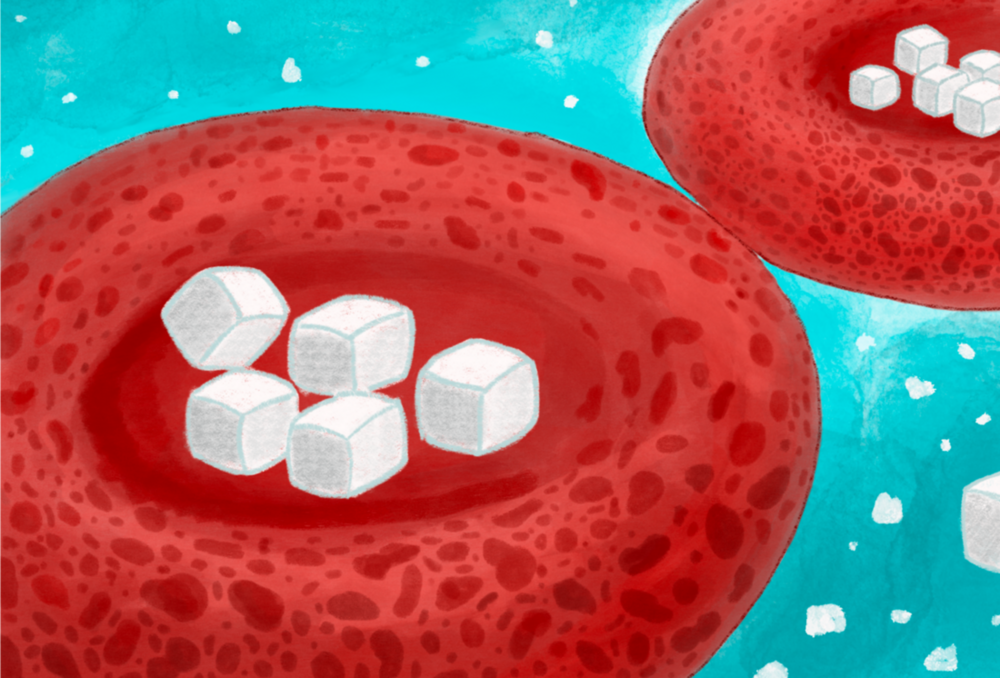
Though red blood cells (RBC) are the most abundant cells in circulating blood, and they rely on glucose for energy as they do not have the cellular mechanisms for oxidative metabolism, they were also an unlikely regulator of blood glucose levels.
Though unlikely, the team pursued this “provocative idea” and used “some ‘old-school’ techniques to see if RBCs were truly the missing piece of the puzzle.”
Using mice, the team controlled RBC levels—which typically increase during hypoxic events—by repeatedly drawing blood from hypoxic mice to maintain a normal RBC range. The reduced RBC count normalized blood glucose levels and reversed hypoxia induced hypoglycemia.
A complementary experiment, infusing RBCs to increase levels to match hypoxic boosts, in mice breathing normal air led to hypoglycemia. Both experiments suggested that RBCs themselves were an intrinsic component of hypoxia induced blood glucose reduction.
Using flow cytometry, it was confirmed that RBCs from hypoxic mice had significantly higher levels of GLUT1 glucose transporter. As RBCs lack nuclei, the researchers examined RBC precursors in bone marrow from hypoxic mice.
To test this, they labeled all pre-existing RBCs with biotin for three consecutive days, then moved the mice to hypoxia. New RBCs maturing from hypoxic bone marrow would not be labeled. Blood was drawn from mice after four weeks in hypoxic conditions and the RBCs were separated based on biotin marking and GLUT1 levels were measured.
GLUT1 was upregulated only in the unlabeled RBCs. “This told us that once RBCs mature and enter circulation, they keep whatever glucose uptake capacity they were born with, but hypoxia reprograms the bone marrow to churn out a new, glucose-hungry population of RBCs,” Jain and Martí-Mateos wrote.
Identifying the mechanism
The final step to understanding where blood glucose was going was to track it directly. “To find out, we injected labeled glucose into mice and tracked its conversion in RBCs. The hypoxic RBCs metabolized glucose much faster than normal RBCs, converting it within minutes to 2,3-DPG (2,3-diphosphoglycerate). This molecule binds to hemoglobin and helps it release oxygen to tissues—exactly what the body needs at higher altitude.”
They identified a metabolic switch in binding ability of a protein called Band 3. Normally, this protein binds to glycolytic enzymes, like GAPDH. In a hypoxic environment, hemoglobin in RBCs change shape and competitively bind to Band 3, freeing the glycolytic enzymes allowing them to produce more 2,3-DPG.
Therapeutic possibilities
Utilizing diabetes models in mice, the researchers tested therapeutic options based on their newly identified mechanism. “Three approaches reversed hyperglycemia in mouse diabetes models: exposing diabetic mice to hypoxia, transfusing RBCs into diabetic mice at normal oxygen, and treating high-fat diet mice with HypoxyStat—a small molecule our lab developed that causes tissue hypoxia in normal oxygen environments by increasing hemoglobin’s oxygen affinity,” they wrote.
While the first two options, maintained hypoxia in diabetic mice or regular RBC transfusions, are not necessarily sustainable options, the experiments do open other therapy options. “The findings suggest potential directions such as engineering RBCs to be more glucose-avid or targeting RBC turnover to shift populations toward younger, more metabolically active cells.”
This work both explored potential alternative options for therapies to treat diabetes but also illuminate the necessity of diving deeper into understanding potentially overlooked mechanisms of established physiological understanding.
“Overall, this journey taught us the courage to chase ‘crazy’ hypotheses and reminded us that, sometimes, truth is hiding in plain sight,” concluded Jain and Martí-Mateos.