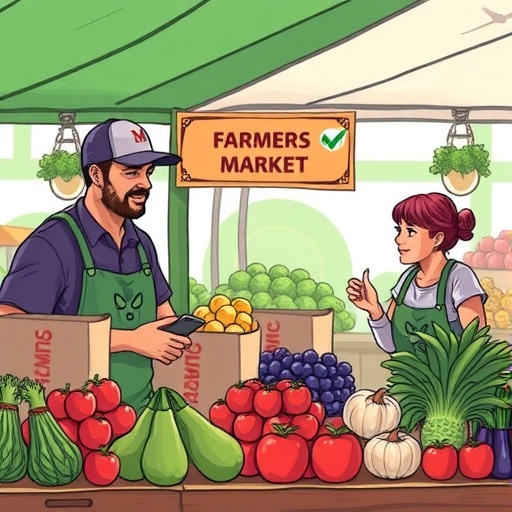
In the evolving landscape of digital education and food safety, a novel interactive platform has emerged aimed at empowering small and medium-sized farmers market vendors with critical knowledge to enhance public health outcomes. Released in early February, “Market, Set, Go!” is an innovative online simulation game that engages players in the dynamic management of a farmers market stand, blending entertainment with rigorous food safety education grounded in scientific research.
Drawing inspiration from the classic “SimCity” series, this game introduces a complex yet accessible environment where players assume the role of farmers market vendors tasked not only with commercial success but also with navigating and solving food safety challenges. The gameplay is designed around managing up to ten stands, each offering diverse products—ranging from leafy vegetables to artisanal dog treats—and interactive activities such as face painting, reflecting the vibrant realities of farmers markets.
What sets “Market, Set, Go!” apart is its foundation in extensive multidisciplinary research funded by the USDA’s National Institute of Food and Agriculture (NIFA), which allocated $550,000 to a consortium of universities to address identified gaps in food safety training among grassroots vendors. Researchers began by collecting comprehensive data from local food producers, assessing knowledge deficits and safety practice misunderstandings that often undermine public health safeguards at markets nationwide.
The game’s development is a collaborative effort spearheaded by experts from New Mexico State University’s Learning Games Lab and Arkansas Agricultural Experiment Station. The team integrated state-of-the-art instructional design principles and cutting-edge digital media production to ensure the educational content is not only scientifically accurate but also delivered through engaging, multi-modal formats—incorporating visual cues, interactive problem-solving, and narrative feedback mechanisms to reinforce key food safety concepts such as cross-contamination prevention and temperature control.
Players encounter various scenarios where correct application of food safety principles is rewarded with resources that facilitate market stand expansion. This mechanic serves as both a motivational tool and a practical illustration of how adherence to best practices correlates with business success and consumer trust. The iterative design process incorporated continuous content validation by subject-matter experts to ensure the representation of food safety challenges remains realistic, relevant, and up to date with current regulatory standards.
Importantly, the game eschews the need for app downloads by being hosted on a mobile-responsive website, promoting accessibility across devices and enabling vendors to engage with training opportunistically during their market operations. This format supports just-in-time learning, aligning with contemporary educational theories that endorse microlearning and contextualized practice as most effective for adult learners in professional settings.
Beyond gameplay, the platform houses an extensive repository of curated practical resources. These include guides on constructing effective handwashing stations and strategies for maintaining cold chains in the absence of powered refrigeration—acknowledging infrastructural disparities among markets and providing feasible solutions that vendors can implement to elevate their hygiene standards.
The pedagogical strategy underpinning “Market, Set, Go!” recognizes the importance of experiential learning through safe, simulated practice. By allowing players to experiment with food handling practices without real-world risk, the game cultivates deeper understanding and retention of safety protocols. This approach is especially vital given documented misconceptions among vendors about critical control points in food safety.
Future plans include rigorous evaluation of the game’s educational impact through analytics tracking player engagement and knowledge acquisition, positioning the platform not only as a training tool but also as a research instrument to further refine food safety education strategies. The project exemplifies the potent intersection of science, technology, and community outreach by transforming abstract safety principles into an interactive narrative that resonates with users and drives behavior change.
In summary, “Market, Set, Go!” represents a significant advancement in leveraging digital games for applied food science education. By synthesizing scientific rigor with interactive design and accessible technology, the platform offers an innovative solution to persistent gaps in food safety knowledge at the grassroots level, potentially reducing foodborne illnesses linked to farmers market transactions and enhancing vendor livelihoods through informed best practices.
Subject of Research:
Food safety education for farmers market vendors through gamified digital learning.
Article Title:
“Market, Set, Go!”: Gamified Food Safety Training Empowers Farmers Market Vendors
News Publication Date:
February 4, 2024
Web References:
https://marketsetgogame.org/
https://www.uaex.uada.edu/media-resources/news/2022/october/10-28-2022-ark-food-safety-game-grant.aspx
https://aaes.uada.edu/
https://uada.edu/
https://uaex.uada.edu/
Image Credits:
Image courtesy Matheus Cezarotta, New Mexico State University
Keywords:
Food science, Games, Scientific approaches
Tags: agricultural education technologydigital education for small businessesfarmers market management gamefarmers market vendor educationfood safety challenges in marketsfood vendor safety knowledge gapsinteractive simulation gamemultidisciplinary food safety researchonline food safety trainingpublic health education toolssmall-scale food producer trainingUSDA NIFA funded projects