
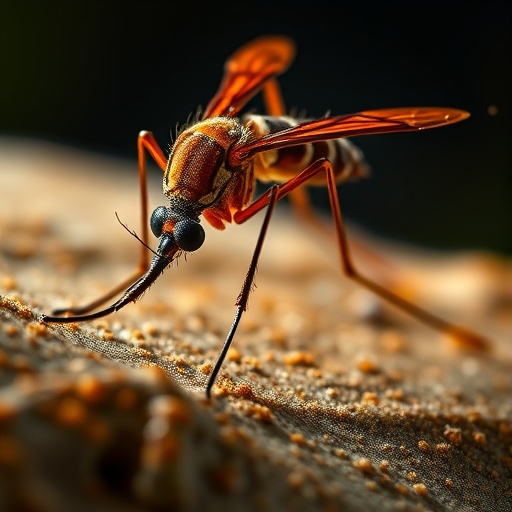
The evolutionary history of mosquito feeding preferences has long captivated scientists, particularly due to its profound implications for the spread of infectious diseases such as malaria. A groundbreaking study recently published in Scientific Reports offers compelling genetic and evolutionary evidence suggesting that the arrival of early hominins in Southeast Asia was a pivotal driver in the development of a thirst for human blood in some species of the Anopheles leucosphyrus group. This research sheds light on how the behavior of one of humanity’s deadliest disease vectors may have been shaped by our distant ancestors’ migration patterns nearly two million years ago.
Mosquitoes are among the deadliest animals on Earth, not because of their direct physical threat, but due to their ability to transmit life-threatening pathogens. Among the vast catalog of over 3,500 documented mosquito species, only a handful exhibit a preference for feeding on humans. This rare trait is consequential because it dramatically elevates a mosquito’s capacity to act as a vector for diseases that primarily infect human populations. The Anopheles genus is notorious for harboring species capable of transmitting malaria, a scourge that has afflicted humans and their predecessors for millennia.
The team, led by researchers Upasana Shyamsunder Singh and Catherine Walton, embarked on an ambitious phylogenetic and genomic analysis by sequencing the DNA of 38 mosquitoes spanning 11 species within the Leucosphyrus subgroup. These specimens were collected across Southeast Asia over nearly three decades, from 1992 to 2020. By comparing genetic variations across these species using state-of-the-art bioinformatics pipelines and molecular clock models, the researchers reconstructed the evolutionary trajectories that led to the emergence of human blood-feeding behavior.
Their data estimates that the proclivity for humans as hosts evolved once within the Leucosphyrus lineage between approximately 2.9 and 1.6 million years ago. This evolutionary window coincides with the geological region known as Sundaland—a biogeographically rich area encompassing modern-day Malay Peninsula, Borneo, Sumatra, and Java. Prior research suggested that before this temporal juncture, ancestral mosquitoes in this group predominantly fed on non-human primates, leaving open the question of what ecological changes could have triggered the host shift.
Importantly, this timing dovetails intriguingly with paleontological evidence pinpointing the arrival of early hominin species, particularly Homo erectus, in Southeast Asia roughly 1.8 million years ago. These hominins would have represented a newly abundant and energetically rich blood source, distinct from the non-human primates previously exploited. The coincidence of these two events strongly implicates early hominin colonization as a selective pressure driving mosquito adaptation toward anthropophily—an ecological shift toward human blood consumption.
For context, the study also contrasts these findings with the evolution of human-feeding preferences among the African malaria vectors Anopheles gambiae and Anopheles coluzzii, whose adaptation to humans happened considerably later, between about 509,000 and 61,000 years ago. This discrepancy illustrates independent evolutionary events in geographically isolated lineages, underscoring the complexity and repeated nature of such host shifts in mosquito evolution.
At the molecular level, it is now understood that alterations in mosquito olfactory receptor genes critically influence host preference, as these receptors detect body odor compounds essential to host recognition. The research team proposes that the emergence of a human-specific odor preference in Leucosphyrus required both the presence of early hominins in sizable populations and a suite of genetic modifications. These modifications affected receptors sensitive to volatile organic compounds unique to human skin microbiomes, facilitating targeted blood feeding.
This investigation contributes a novel, non-archaeological line of evidence corroborating the sparse fossil record for early hominin presence in Southeast Asia. The molecular clock assessments gleaned from mosquito DNA provide an independent temporal anchor that supports theories of a 1.8-million-year-old hominin footprint in the region—one of the oldest outside Africa.
Furthermore, this research profoundly enhances our understanding of vector-pathogen-host co-evolution. By revealing how human evolutionary history may have sculpted mosquito behavior at the genomic level, it elucidates the intricate interplay of ecological and evolutionary forces behind vector-borne diseases. Moreover, these insights may guide the development of future vector control strategies by pinpointing genetic targets linked to host-seeking behavior.
In sum, this study depicts an evolutionary scenario where the biological and ecological expansion of early hominins not only transformed their own trajectory but also reshaped the lives of other species intimately connected to them. The adaptation of mosquitoes to humans highlights the unintended consequences of species migration and environmental change—an important reminder as modern human activity continues to drive unprecedented ecological shifts.
Emerging from nearly three decades of painstaking collection and genomic sequencing, this research stands as a testament to the power of combining molecular biology, evolutionary theory, and computational modeling. As vector-borne diseases remain a pressing global health challenge, elucidating the deep evolutionary mechanisms behind mosquito host preference offers a hopeful avenue toward innovative control approaches.
Through meticulous reconstruction of phylogenetic relationships, mutation rate estimations, and behavioral ecology, the authors illuminate a profound chapter in human and mosquito co-evolution. Their findings not only emphasize the evolutionary adaptability of mosquito species but also reinforce the complex biological interdependencies that have shaped the natural history of disease transmission.
This landmark work invites further research, particularly focused on identifying the specific genes responsible for host odor detection and the ecological contexts driving their selection. Understanding these dynamics at even finer granularity promises to unlock new insights into how vectors may respond to future environmental and anthropogenic pressures.
Ultimately, this synthesis of evolutionary genetics and paleoanthropology underscores the far-reaching impact of human evolution on the natural world, illustrating how our ancestors’ movements triggered adaptive changes in disease vectors that continue to influence human health millennia later.
Subject of Research: Evolution of human blood-feeding preference in Anopheles leucosphyrus mosquitoes in relation to early hominin arrival in Southeast Asia.
Article Title: Early hominin arrival in Southeast Asia triggered the evolution of major human malaria vectors
News Publication Date: 26-Feb-2026
Web References:
10.1038/s41598-026-35456-y
Keywords: Anopheles leucosphyrus, malaria vectors, human blood feeding, mosquito evolution, Homo erectus, Southeast Asia, phylogenetics, molecular clock, host preference, olfactory receptors, vector-borne disease, evolutionary biology

