In a groundbreaking development in the assessment and monitoring of Parkinson’s disease, researchers have unveiled a sophisticated video-based system that offers interpretable and granular quantification of motor function during the classic finger-tapping test. This advancement is poised to redefine neurological diagnostics by harnessing innovative computer vision and machine learning techniques to deliver unprecedented levels of detail and understanding of motor impairments associated with Parkinson’s disease.
Parkinson’s disease, a progressive neurodegenerative disorder characterized primarily by motor symptoms such as tremors, rigidity, and bradykinesia, affects millions worldwide. Traditionally, clinicians have relied on subjective assessments and scales such as the Unified Parkinson’s Disease Rating Scale (UPDRS) to evaluate motor dysfunction. However, these methods hinge on clinician expertise and are prone to variability, potentially limiting their sensitivity in detecting subtle motor changes. The new approach promises to overcome these challenges by providing objective, quantifiable metrics derived directly from video data recorded during standardized motor tests.
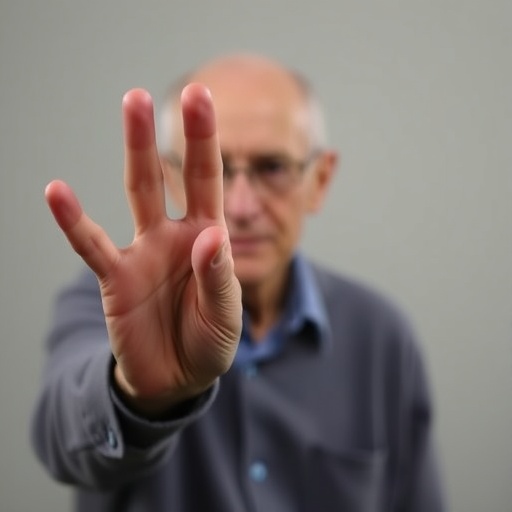
Central to this advancement is the finger-tapping test, a long-established clinical tool used to assess motor speed, rhythm, and coordination by instructing patients to alternately tap their index finger and thumb as rapidly and regularly as possible. While the test itself is simple, its detailed motor dynamics have been challenging to quantify numerically. The researchers have now managed to extract and analyze these motor characteristics at a highly granular level through automated video analysis, thereby transforming a qualitative clinical evaluation into a robust, data-driven biomarker.
The system employs state-of-the-art computer vision algorithms capable of accurately tracking the finger and thumb positions frame-by-frame in high-resolution video recordings. Through this tracking, multiple kinematic parameters are computed, including tap frequency, inter-tap interval variability, amplitude, velocity, and rhythm irregularities. These parameters collectively construct a rich motor profile that can elucidate the presence and extent of motor impairments specific to Parkinson’s pathology.
One of the most innovative aspects of this technology lies in its interpretability. Most machine learning pipelines suffer from the “black box” problem, where predictions are difficult to understand or trace back to clinical features. Here, the researchers have prioritized transparency, ensuring that each quantified feature correlates with meaningful clinical motor characteristics. This interpretability provides clinicians with intuitive, actionable insights, facilitating better decision-making and more personalized patient management.
The ability to measure motor features in a consistent and objective manner opens the door for more accurate disease staging and monitoring of progression over time. Given Parkinson’s heterogeneity, having access to fine-grained motor data may enable stratification of patients based on their unique motor profiles, leading to tailored therapeutic interventions. Furthermore, this system can be utilized to detect subtle motor fluctuations that may precede clinical worsening, offering the possibility of proactive treatment adjustments.
Beyond its clinical implications, the technology embodies a shift toward digital phenotyping in neurology, where high-dimensional datasets collected via sensors and imaging are used to characterize disease states with unprecedented detail. Such digital biomarkers have the potential to accelerate drug development by providing sensitive endpoints for clinical trials and to democratize access to specialized neurological assessment through remote and at-home testing.
Deploying this system requires only a standard video camera, making it highly accessible and scalable. This aspect is crucial for reaching underserved populations and resource-limited settings where expert neurological evaluation is scarce. Patients could perform the finger-tapping test at home while being recorded with a smartphone, transmitting the data securely for automated analysis. This scenario not only enhances patient convenience but also facilitates more frequent monitoring without burdening healthcare facilities.
Another compelling advantage lies in capturing motor function in a naturalistic setting. Traditional clinical assessments may be subject to anxiety-induced variations or observer bias. Video-based quantification automatically standardizes the evaluation environment and provides repeatability, thereby increasing reliability and reducing variability across multiple sessions and raters.
The research team has also addressed challenges inherent to video analytics, such as variations in lighting, background clutter, and occlusions. By integrating robust preprocessing pipelines and advanced pose estimation models, the system maintains accuracy across diverse recording conditions and patient demographics. This robustness is essential for real-world applicability where controlled laboratory environments are not always feasible.
Preliminary validation on patient cohorts has shown promising correlations between the video-derived metrics and established clinical scales. Moreover, the technique has demonstrated sensitivity to detect motor alterations even in early-stage Parkinson’s disease, where traditional assessments may fall short. This sensitivity enhances early diagnosis and timely intervention, which are critical for improving long-term outcomes.
Future directions include integrating additional motor tasks to build comprehensive motor assessments and combining video data with wearable sensor outputs for multimodal analysis. Longitudinal studies are underway to evaluate how these granular motor features evolve with disease progression and respond to therapeutic interventions. Such longitudinal data will yield deeper insights into Parkinson’s pathophysiology and treatment effects.
Ethical considerations, such as data privacy and informed consent, have been carefully incorporated into the system design. Data anonymization and secure transmission protocols ensure patient confidentiality, a vital factor when deploying digital health technologies at scale. Patient and clinician feedback on usability have also guided iterative refinements to optimize the user experience.
This advancement occupies a pivotal position at the intersection of neurology, computer science, and digital health. It demonstrates the powerful synergy achievable when cutting-edge AI methodologies are tailored to address pressing clinical challenges. By bringing objectivity, granularity, and interpretability together, the research signifies a vital leap forward in the digitization of neurological care.
As Parkinson’s disease continues to impose a significant global healthcare burden, innovations like this video-based quantification platform illuminate a path toward more efficient, precise, and personalized care paradigms. The implications extend beyond Parkinson’s, as similar frameworks could be adapted to quantify motor dysfunction in other neurodegenerative and movement disorders, heralding a new era in objective neurological assessment.
In summary, the interpretable and granular video-based approach to analyzing the finger-tapping test has the potential to transform Parkinson’s disease management, offering clinicians a powerful new tool for diagnosis, monitoring, and personalized care. By leveraging AI-driven computer vision and maintaining clinical interpretability, this work exemplifies the future of digital neurology—where data-rich, patient-centered insights foster improved outcomes and quality of life.
Subject of Research: Quantitative analysis of motor characteristics in Parkinson’s disease using video-based methods.
Article Title: Interpretable and granular video-based quantification of motor characteristics from the finger-tapping test in Parkinson’s disease.
Article References:
Zarrat Ehsan, T., Tangermann, M., Güçlütürk, Y. et al. Interpretable and granular video-based quantification of motor characteristics from the finger-tapping test in Parkinson’s disease. npj Parkinsons Dis. (2026). https://doi.org/10.1038/s41531-026-01307-w
Image Credits: AI Generated
Tags: bradykinesia measurement techniquescomputer vision in neurologydigital biomarkers for Parkinson’sfinger-tapping test analysismachine learning for motor symptomsmotor impairment quantification methodsneurological disorder video analysisobjective Parkinson’s diagnosticsParkinson’s disease motor assessmentquantitative motor function evaluationUnified Parkinson’s Disease Rating Scale alternativesvideo-based Parkinson’s monitoring