Engineers at the University of Oxford have unveiled a groundbreaking method for fabricating soft robotic actuators that dramatically reduces cost and production time while democratizing access to soft robotics research. Published in the prestigious journal Advanced Science, this innovative technique leverages everyday lab equipment and commercially available materials to produce programmable soft actuators in under ten minutes for less than ten cents each. This rapid, ultra-low-cost fabrication approach promises to accelerate innovation and broaden participation in a field traditionally constrained by expensive and specialized manufacturing processes.
Soft robots, constructed from compliant materials that mimic the flexibility and deformability of living organisms, are transforming diverse sectors, from delicate manipulation in manufacturing to life-saving search-and-rescue operations. However, conventional methods for producing these robots—such as silicone molding, advanced 3D printing, and complex textile lamination—are typically resource-intensive, time-consuming, and require specialized expertise and equipment, hindering widespread adoption and rapid prototyping.
The team from Oxford’s Department of Engineering Science introduces a streamlined process that uses simple thermoplastic vacuum-sealable pouches combined with precision laser cutting. By evacuating air between thermoplastic layers before laser processing, the researchers simultaneously seal and sculpt inflatable actuator geometries in a single step. This vacuum-laser fusion technique avoids the intricacies and costs associated with traditional molding or 3D printing workflows, enabling highly accurate fabrication with minimal material waste.
At its core, the method requires only three components readily available in many laboratories worldwide: commercially sourced vacuum seal pouches costing under $0.10 per unit, a standard vacuum sealing machine to expel air and seal the pouches, and a laser cutter or desktop laser engraver for precision cutting. This simplicity not only reduces production costs drastically but also compresses fabrication time to less than ten minutes per actuator, empowering rapid iterative design and experimentation.
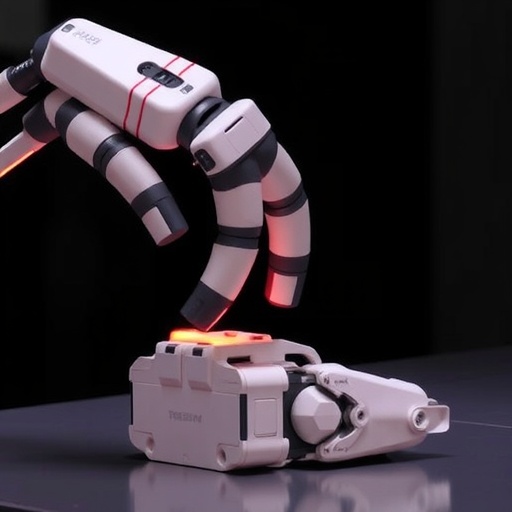
Once fabricated, the inflatable actuators exhibit highly programmable bending motions when pressurized. The researchers demonstrated their technique through a robust soft robotic gripper capable of lifting objects 25 times its own weight, as well as ultra-light crawling and swimming robots. The ability to generate substantial force output at relatively low internal pressures highlights the mechanical efficiency and performance reliability of these thermoplastic soft actuators.
The Oxford team’s leader, Professor Antonio Forte, explains that this approach significantly lowers both financial and technical barriers, opening doors for researchers, startups, and educational institutions to explore soft robotics without the constraints imposed by costly machinery or protracted manufacturing processes. Such democratization not only accelerates technological advances but encourages creative applications spanning science, engineering, and arts.
In a compelling demonstration of the method’s versatility, the researchers produced inflatable animal-inspired models, including turtles and cranes, that serve both as functional robotic platforms and as educational tools. Lead author Ashkan Rezanejad emphasizes the value of this balance between rigorous engineering and creative exploration, noting its potential to attract and inspire the next generation of soft robotics researchers and enthusiasts.
Beyond initial fabrication, the team subjected their devices to rigorous mechanical performance assessments, validating durability through extensive inflation-deflation cycling—surpassing 100,000 cycles without significant degradation. This durability ensures that these soft actuators maintain performance longevity, essential for practical deployment in real-world applications where repetitive operation is inevitable.
Complementing the physical fabrication innovation, the researchers developed a sophisticated computational design framework enabling users to “program” how actuators bend by adjusting the geometry of internal structures. This software-driven approach allows for precise modulation of shapes, facilitating the generation of complex, predictable bending profiles such as spirals, letterforms, and other bespoke configurations crucial for customized robotic tasks.
Soft robotics continues to expand its footprint into transformative applications, including minimally invasive surgical devices, wearable assistive technologies, adaptive tools for manufacturing, and robotic explorers operating in hazardous or inaccessible environments. By drastically simplifying soft actuator manufacturing, this new method could shorten design cycles and ease scalability, thereby hastening the translation of soft robotic innovations from concept to real-world impact.
Looking ahead, the Oxford researchers express intent to explore broader classes of thermoplastic materials compatible with the vacuum-laser method. Expanding the material palette may unlock enhanced mechanical properties or enable new actuation modes such as twisting and multi-directional movements, enriching the repertoire of soft robotic motions achievable with this facile fabrication technique.
This pioneering work not only sets a new standard in cost-effective, accessible soft robotics manufacturing but also represents a significant stride toward sustainable and scalable robotic systems. By empowering labs without extensive resources and fueling cross-disciplinary collaboration, the vacuum-laser fabrication technique could accelerate the emergence of next-generation soft robots worthy of wide-ranging scientific, industrial, and societal benefits.
Subject of Research: Soft robotics fabrication, programmable soft actuators, rapid low-cost manufacturing
Article Title: Vacuum–laser fabrication of programmable soft actuators
News Publication Date: March 8, 2026
References: Rezanejad et al., 2026, Advanced Science
Image Credits: Rezanejad et al., 2026
Keywords
Soft robotics, programmable actuators, vacuum sealing, laser cutting, rapid prototyping, low-cost fabrication, inflatable soft robots, mechanical durability, computational design, Oxford University, soft robotic grippers
Tags: accessible soft robotics researchdemocratizing soft robotics technologyflexible soft robot materialslaser cutting for soft roboticslow-cost soft robotics manufacturingprogrammable soft robotic actuatorsrapid soft robot prototypingsoft robot actuator innovationsoft robotics fabrication methodsthermoplastic vacuum-sealable pouchesultra-low-cost soft actuatorsvacuum-laser fusion technique