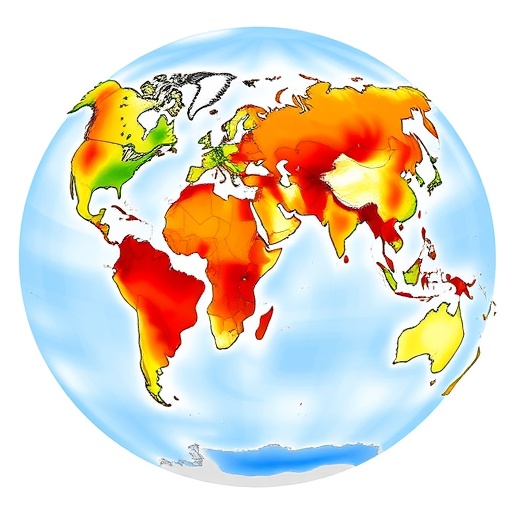
In the rapidly evolving field of climate science, the integration of advanced Earth System Models (ESMs) with forward-looking scenario analyses has become a cornerstone for understanding the complex responses of regional climates to global environmental changes. A recent study published in Nature Communications by Sieber, Karger, Zimmermann, and colleagues has set a new benchmark by exploring the climate response to Nature Future scenarios using a sophisticated regional Earth System Model. This groundbreaking work unlocks critical insights into the interplay between human activities and natural systems, providing policymakers and scientists with an indispensable tool for envisioning plausible climatic futures at regional scales.
At the heart of this research lies the Nature Future initiative, a comprehensive framework designed to generate multiple scenarios that integrate biodiversity conservation, ecosystem services, and climate policies simultaneously. These scenarios aim to capture the multidimensional facets of sustainable development, offering alternatives that differ vastly in their assumptions about human behavior, land use, and global cooperation. Implementing these scenarios within a regional ESM marks a significant advancement because it allows for the disentanglement of climate feedbacks and regional heterogeneities that global models often obscure.
The regional Earth System Model employed in this study incorporates cutting-edge atmospheric, terrestrial, and oceanic components, finely tuned to simulate processes at the scale of a specific region while maintaining consistency with global dynamics. This approach addresses a critical limitation of previous climate projections, which often rely on coarse-resolution outputs from global models and thereby miss out on localized climate drivers and ecosystem responses. By nesting high-resolution regional models within the broader Earth System framework, Sieber et al. provide a more granular, nuanced picture of how nature-driven policies could shape future climate trajectories.
Central to the study’s novelty is the coupling of land use dynamics and biogeochemical cycles under the Nature Future scenarios. These scenarios feature diverse pathways of human land management, ranging from aggressive conservation efforts to extensive agricultural expansion. The model simulates how these divergent land use patterns affect regional climate variables, such as temperature extremes, precipitation regimes, and carbon fluxes, elucidating the feedback loops between terrestrial ecosystems and the atmosphere. Notably, the work underscores how proactive biodiversity policies can amplify carbon sequestration potentials and mitigate warming at localized scales.
Sieber and colleagues also highlight the role of ecosystem services in shaping climate outcomes within the Nature Future framework. Ecosystem services, including pollination, water regulation, and soil fertility, are dynamically linked with climate processes in the model, allowing an integrated assessment of co-benefits and trade-offs between biodiversity conservation and climate mitigation. This holistic approach is critical for real-world policy applications where goals often span multiple sectors and disciplines, demanding comprehensive understanding rather than isolated metrics.
One of the standout findings from the simulations is the demonstration that regional climate responses to global change drivers are highly sensitive to the assumed socio-economic pathways. For example, scenarios prioritizing nature conservation lead to markedly different precipitation patterns compared to those emphasizing intensive land use. These differences persist even under identical greenhouse gas concentration trajectories, signaling the powerful influence of land management decisions on regional climates independently of global mitigation efforts. Such insights argue strongly for integrating land use policy as a core component of climate action strategies.
The methodological rigor of this study is underscored by its thorough validation against observational datasets, ensuring that model outputs reliably replicate current climate patterns and land-atmosphere interactions. Additionally, the authors adopt an ensemble modeling approach, running multiple simulations to quantify uncertainty and increase confidence in their projections. This practice of embracing uncertainty is essential in communicating realistic expectations to stakeholders and fosters robustness in climate adaptation planning.
Beyond the technical aspects, the study charts new territory in advancing regional climate science toward actionable knowledge. By interfacing Nature Future scenarios with regional Earth System dynamics, it creates a platform for experimenting with alternative futures that explicitly account for ecological, societal, and climatic interdependencies. This framework enables exploration of how different conservation and development pathways might alter not only temperature and precipitation regimes but also ecosystem resilience and human well-being under changing environmental conditions.
A particularly compelling dimension of the research revolves around feedback mechanisms involving vegetation-atmosphere exchanges. Changes in forest cover and soil conditions not only affect carbon stocks but also influence surface albedo, evapotranspiration rates, and thus local energy balances. The model captures these nuances, demonstrating that preserving natural vegetation can yield cooling effects regionally by modifying surface properties, an effect often underestimated in broader assessments. This revelation potentially elevates ecosystem protection as a viable climate mitigation strategy with localized climate moderation benefits.
Moreover, the paper tackles the challenge of temporal scales in regional climate responses. By projecting several decades into the future, it reveals how short-term interventions and policies may yield variable climate outcomes depending on timing, scale, and intensity. The dynamic feedbacks captured emphasize that sustainability efforts must be adaptive, informed by continuous monitoring and modeling, to optimize long-term climate and biodiversity benefits. This forward-looking perspective aligns tightly with global sustainable development agendas demanding integrated climate and nature solutions.
Importantly, the study situates its results within the broader discourse on climate equity and justice. The regional focus emphasizes how climate responses and nature-based solutions affect human populations differently depending on geography and socio-economic context. By providing location-specific projections, the model informs targeted adaptation measures that can reduce vulnerabilities, especially in ecologically sensitive or marginalized regions. Thus, this research transcends academic theory by offering practical pathways to harmonize climate mitigation with social equity priorities.
Technological advancements in Earth System modeling underpinning this study are themselves a testament to interdisciplinary collaboration. Combining expertise in atmospheric physics, ecology, data science, and policy analysis, the authors harness the latest computational frameworks and high-resolution datasets. This fusion enables simulation of complex interactions with unprecedented detail, illustrating the growing capacity of climate science to tackle multifaceted challenges using integrated, systems-based approaches. The modular nature of their regional ESM also paves the way for iterative improvements as new data and understanding emerge.
The implications of Sieber et al.’s findings extend into policymaking spheres, emphasizing the urgency and potential of incorporating nature-centric scenarios into climate action plans. The study foregrounds that integrating ecosystem preservation into climate strategies can have meaningful impacts on regional climate stabilization, reinforcing calls for embedding biodiversity goals into national and international climate frameworks. As global stakeholders move toward post-2025 environmental agreements, this work demonstrates the scientific foundation necessary to align conservation and climate mitigation more tightly.
To encapsulate, the pioneering investigation conducted by Sieber and colleagues delivers a compelling narrative about the intertwined fate of nature and climate at regional scales. By leveraging an innovative Earth System Model populated with sophisticated Nature Future scenarios, it illuminates how land management choices reverberate through atmospheric processes, ultimately determining climatic conditions experienced by human and natural systems alike. This visionary research not only advances scientific frontiers but also equips decision-makers with vital insights to craft policies that safeguard planetary health in an uncertain future.
As climate change continues to pose existential threats, studies such as this underscore the power of integrated modeling approaches to unravel complexity and inform smarter, more sustainable pathways. The call to action is clear: investing in nature-based solutions supported by rigorous science can substantially alter the trajectory of regional climates for the better. Looking ahead, the continued refinement of regional Earth System Models and enrichment of scenario frameworks promise deeper understanding and stronger, evidence-based responses to the grand challenge of climate change.
The comprehensive modeling framework developed in this research also encourages further exploration of cross-sectoral interactions, including agriculture, urbanization, and water resources, within the regional Earth System paradigm. Such expansions will be essential to fully capture the multiplicity of factors influencing climate futures, thereby enhancing the relevance and applicability of model projections. This study lays the groundwork for a new generation of climate science that is both highly localized yet globally informed, empowering action at scales where it matters most.
In sum, the integration of Nature Future scenarios with a regional Earth System Model marks a critical evolution in climate research. It offers an unprecedented window into the diverse possible outcomes of human-nature interactions amidst global environmental change. The insights offered are not only scientifically robust but also urgently needed to guide the stewardship of Earth’s ecosystems and climate amidst the challenges of the 21st century and beyond.
Subject of Research: Climate response to integrated biodiversity and land use scenarios in a regional Earth System Model
Article Title: Climate response to Nature Future scenarios in a regional Earth System Model
Article References:
Sieber, P., Karger, D.N., Zimmermann, N.E. et al. Climate response to Nature Future scenarios in a regional Earth System Model. Nat Commun (2026). https://doi.org/10.1038/s41467-026-70284-8
Image Credits: AI Generated
Tags: advanced atmospheric and oceanic modelingbiodiversity conservation in climate modelingclimate policy simulations at regional scaleclimate scenario analysis in regional modelsdisentangling regional climate heterogeneitiesecosystem services in earth system modelsimpact of human activities on regional climateintegrating land use in climate projectionsnature future climate scenariosregional climate feedback mechanismsregional earth system models for climate responsesustainable development scenarios in earth system models