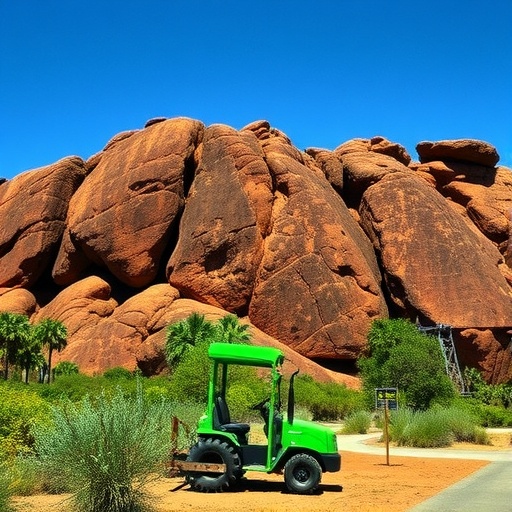
In a groundbreaking new study, researchers have uncovered alarming evidence detailing the detrimental effects of industrial emissions on the ancient rock art of Murujuga, Western Australia. This research highlights the tangible risks that modern industrial activities pose to cultural and natural heritage sites, blending environmental science with archeological conservation in a pioneering way. The exquisite petroglyphs—carved millennia ago by Indigenous Australians—are facing unprecedented threats not only from natural weathering but increasingly from airborne pollutants associated with nearby industrial operations.
Murujuga, also known as the Burrup Peninsula, is home to one of the world’s richest concentrations of petroglyphs, featuring tens of thousands of motifs created by the Ngarluma and Yaburara peoples. These impressive rock carvings span back over 30,000 years and serve as a crucial record of human history and ancient cultural expression. However, urban expansion and industrial development—including petrochemical plants, liquefied natural gas facilities, and mining operations—have transformed the environment around these sacred sites, introducing potentially corrosive pollutants into the atmosphere.
The study employed a sophisticated array of environmental monitoring techniques combined with chemical and mineralogical analyses to assess how emissions from nearby industrial activity impact the rock surfaces. Researchers focused particularly on the deposition of sulfur and nitrogen oxides, compounds known to promote acidification and accelerate weathering processes. Advanced spectroscopy methods revealed that these pollutants catalyze the dissolution of key minerals composing the rocks, directly threatening the preservation of the engravings.
Moreover, aerosol samples collected from the vicinity showed elevated levels of fine particulate matter adhered to the petroglyph surfaces. These particles, often rich in heavy metals and other toxic constituents, not only obscure the intricate patterns but may also contribute to chemical reactions eroding the rock substrate. The synergistic effect of acid rain and particulate deposition creates a harsh microenvironment, undermining the stability of the quartz-rich sandstone that forms the canvas of Murujuga’s rock art.
One of the most striking revelations from the research was the observation that even trace atmospheric gases can significantly alter weathering rates when accumulated over time under semi-arid conditions characteristic of the Burrup Peninsula. This sensitizes the ecosystem to industrial pollutants, emphasizing the vulnerability of such heritage sites within emerging industrial zones. It also illustrates the complexity of interactions between anthropogenic emissions and natural geochemical cycles at a micro-scale rarely measured before.
The implications of these findings resonate on multiple fronts. From a cultural perspective, the deterioration of Murujuga’s petroglyphs would mean the irreversible loss of an irreplaceable human legacy, erasing a silent narrative engraved in stone for tens of thousands of years. Environmentally, it challenges current industrial emission regulations and highlights the necessity of more stringent pollution controls to safeguard cultural assets. The study calls for a reassessment of land-use policies that balance economic growth with heritage preservation.
Importantly, the research underscores the need for ongoing, interdisciplinary monitoring of Murujuga. By integrating archeology, atmospheric chemistry, and conservation science, stakeholders can develop targeted mitigation strategies. These may include the implementation of buffer zones, emission reduction technologies, and regular condition assessments to track changes in the petroglyph integrity over time. Such proactive intervention could serve as a model for safeguarding other vulnerable rock art sites globally.
A key dimension of the study involved collaborative engagement with local Indigenous communities, recognizing their traditional knowledge and custodianship over Murujuga. The researchers stress that effective preservation efforts must be rooted in partnership with those whose ancestors created the carvings. This collaborative framework not only enriches scientific understanding but also promotes respect and acknowledgment of Aboriginal cultural values intertwined with environmental stewardship.
The methodological innovations presented in this research offer new paradigms for assessing industrial impact on archaeological sites. Utilizing a combination of non-destructive environmental sampling and state-of-the-art analytic technologies, the team has demonstrated how to detect subtle chemical alterations that precede visible decay. These techniques may revolutionize how heritage sites are monitored worldwide, enabling early intervention before irreversible damage occurs.
Furthermore, this study reveals a disturbing trend—that industrial pollution’s cultural consequences are often underestimated in environmental impact assessments. While air quality guidelines primarily focus on human health effects, the indirect consequences on artistic and historic landmarks require equal attention. The nuanced understanding of pollutant-rock interactions pioneered here argues for integrating cultural heritage indicators into environmental regulatory frameworks.
The authors also discuss the broader geopolitical context, noting that Murujuga’s industrial precinct is emblematic of many regions globally where economic development coexists precariously with archaeological treasures. As industrial hubs expand, ensuring sustainable coexistence becomes imperative. The data-driven insights from this study provide a scientific foundation to advocate for policy reforms that respect cultural heritage alongside economic priorities.
Amid these challenges, the research team emphasizes that the Murujuga rock art continues to persist resiliently despite centuries of exposure. However, this resilience may be eroding more rapidly than previously believed due to accelerating industrial impacts. The urgency to act is highlighted by projected increases in local industrial activities, which could exponentially exacerbate pollutant burdens. Immediate policy action, informed by scientific evidence, is crucial to prevent catastrophic loss.
In conclusion, this pioneering research marks a vital step forward in understanding how modern industrial emissions interact with ancient cultural landscapes. The detailed chemical and environmental analyses reveal a grim picture of accelerating degradation at Murujuga’s petroglyphs, offering both caution and hope. With informed intervention and cooperation among governments, industries, scientists, and Indigenous custodians, the protection of this priceless heritage can be secured for future generations.
This work not only brings to light the intricate vulnerabilities of rock art but also exemplifies the power of interdisciplinary study to shape preservation strategies. It challenges society to rethink the footprint of industrialization and highlights that protecting cultural heritage is a complex but essential task—one that requires continued vigilance and action now more than ever. The rock carvings of Murujuga remain silent witnesses to human history; it is our collective responsibility to ensure their stories endure.
Subject of Research:
Impacts of industrial emissions on the preservation and degradation mechanisms affecting ancient petroglyphs at Murujuga, Western Australia.
Article Title:
Impacts of Industrial Emissions on Rock Art at Murujuga, Western Australia
Article References:
Evans, K.A., O’Leary, B., Tacchetto, T. et al. Impacts of industrial emissions on rock art at Murujuga, Western Australia. Sci Rep (2026). https://doi.org/10.1038/s41598-026-44180-6
Image Credits: AI Generated
DOI: 10.1038/s41598-026-44180-6
Keywords: Industrial emissions, rock art preservation, petroglyph degradation, Murujuga, environmental impact, atmospheric chemistry, cultural heritage conservation
Tags: airborne pollutants and cultural heritageBurrup Peninsula archaeological threatschemical analysis of rock weatheringenvironmental monitoring of rock art sitesIndigenous Australian petroglyph conservationindustrial development and heritage site risksindustrial emissions impact on petroglyphsmining operations environmental impactMurujuga rock art preservationpetrochemical pollution effects on ancient carvingsprotecting ancient cultural expressionssulfur and nitrogen oxide corrosion on stone