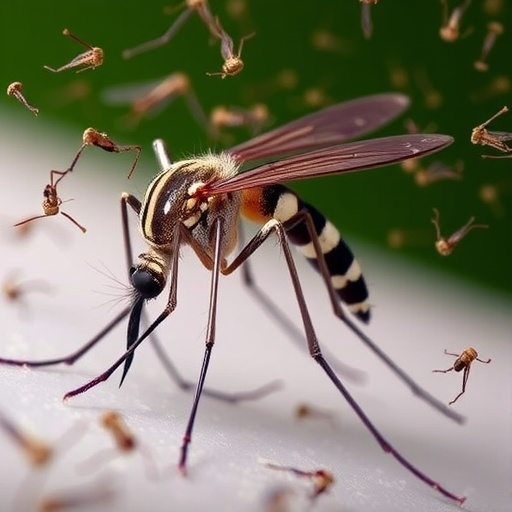
In a groundbreaking interdisciplinary study, researchers from Georgia Institute of Technology and the Massachusetts Institute of Technology have unveiled a pioneering mathematical model designed to predict the intricate flight behavior of female Aedes aegypti mosquitoes around humans. After meticulously tracking millions of datapoints derived from hundreds of mosquito encounters with a human subject, this research sheds light on the previously elusive dynamics that govern mosquito trajectories. The study not only advances our scientific understanding of mosquito behavior but also paves the way for the development of more effective vector-control strategies targeting these disease-carrying insects.
Mosquitoes are notorious vectors of severe diseases such as malaria, yellow fever, and Zika virus, collectively responsible for over 700,000 deaths annually worldwide. Understanding their behavioral patterns in relation to human hosts is therefore a paramount public health objective. The focal species, Aedes aegypti, colloquially known as the yellow fever mosquito, is prevalent across the southeastern United States and globally distributed in tropical and subtropical regions. Despite extensive research on mosquito attraction cues, the precise mechanisms governing mosquito flight paths in response to stimuli have remained ambiguous until now.
The research team employed state-of-the-art three-dimensional infrared camera setups within controlled mosquito chambers to visualize and record the precise flight trajectories of mosquitoes. By manipulating visual environments—such as varying the color of target objects worn by a human participant—and modulating the presence of carbon dioxide (CO₂), a primary olfactory attractant released by humans, they were able to discern the relative contribution of these sensory inputs in guiding mosquito movement. These controlled experiments generated an unprecedented dataset exceeding 20 million individual tracking points, providing rich fodder for mathematical and computational modeling.
According to the researchers, mosquitoes demonstrate independent, non-swarming flight behavior, attracted individually by sensory cues rather than by following conspecifics. This finding challenges the common presumption that mosquitoes form swarms through social or collective navigation. Lead investigator David Hu of Georgia Tech analogized the phenomenon to patrons entering a bustling bar: each patron is drawn by similar environmental stimuli—music, lighting, and ambiance—without direct interaction or chaining behind a leader. Similarly, mosquitoes appear to navigate towards stimuli such as visual contrasts and CO₂ plumes independently, often converging on the same spatial coordinates due to shared attraction points.
The study encompassed three distinct experimental conditions: initially, a simple black sphere served as a visual stimulus attracting mosquitoes, but only during their approach phase; once arriving at the sphere, mosquitoes did not linger, frequently passing by without prolonged interaction. Secondly, introducing a white visual target combined with elevated CO₂ concentrations generated hesitant behavior, where mosquitoes appeared to perform “double takes,” reassessing their approach before settling. The most compelling mosquito aggregation occurred when a black sphere was paired with CO₂ release, effectively replicating the visual and olfactory cues associated with a human host, eliciting persistent swarming and host-seeking behavior.
Christopher Zuo, a master’s student at Georgia Tech and a key contributor to the research, described the mosquitoes as “little robots” that rely on a set of internal rules integrating multisensory information to navigate complex environments. Experimental trials involving Zuo himself entering the mosquito chamber wearing different clothing arrangements revealed the nuanced role of color and motionless visual cues. Dressed in black, mosquitoes clustered densely around his head and shoulders—the species’ typical target zones—whereas white clothing appeared to offer partial visual camouflage, reducing the frequency of bites.
Importantly, this revelation portrays mosquito host-seeking as a multisensory, dynamic process where visual and chemical cues synergistically modulate flight trajectories. The collected data enabled collaboration with MIT partners who employed Bayesian dynamical systems learning—a sophisticated probabilistic modeling approach—to elucidate the underlying decision rules governing these flight behaviors. The model predicts mosquitoes’ maneuvering patterns such as turning angles, acceleration, and deceleration in response to fluctuating gradients of visual contrast and CO₂ concentration, offering a powerful tool for anticipating mosquito-host encounter probabilities in naturalistic settings.
Complementing the technical achievements, the team launched an interactive, publicly accessible website where users can visualize simulated mosquito flight patterns under various environmental conditions. This platform allows real-time toggling of visual stimuli, CO₂ presence, and even the upload of custom images to serve as attractant targets, democratizing access to the research insights and enhancing educational outreach.
Besides its fundamental scientific impact, this research has profound implications for practical pest control measures. Conventional mosquito suction traps often rely on constant emission of CO₂ or unvarying light sources to attract mosquitoes. However, data from this study suggest that intermittent triggering of these signals, synchronized with the activation of suction mechanisms, may enhance capture efficiency by exploiting the mosquitoes’ behavioral tendencies to disengage when the stimuli are decoupled or static.
Co-authorship extends to Soohwan Kim, a Ph.D. candidate in mechanical engineering at Georgia Tech, as well as MIT collaborators Chenyi Fei and Alexander Cohen, and Ring Carde from the University of California, Riverside. Their collective expertise underscores the interdisciplinary nature of this achievement, combining mechanics, biology, and computer science.
The study, published in the prestigious Science Advances journal, marks a significant leap in entomological research and vector control technology. By decoding the complex “language” of mosquito flight behaviors through rigorous experimentation and advanced modeling, the research not only enriches theoretical ecology but also equips public health initiatives with potent new strategies for mitigating mosquito-borne diseases. As mosquitoes continue to pose global health threats, such integrated technological advances herald a new era of informed, precision-targeted vector management.
Subject of Research: Animals
Article Title: Predicting mosquito flight behavior using Bayesian dynamical systems learning
News Publication Date: 18-Mar-2026
Web References:
Interactive Mosquito Flight Visualization
Image Credits:
Georgia Tech/MIT
Keywords
Mosquito behavior, Aedes aegypti, vector control, flight trajectory, carbon dioxide, visual cues, Bayesian dynamical systems, computational modeling, infectious disease prevention, pest control technology
Tags: advanced mosquito monitoring technologyAedes aegypti mosquito flight behaviordisease vectors malaria yellow fever Zikainterdisciplinary mosquito behavior studymathematical modeling of insect trajectoriesmosquito attraction to humansmosquito swarming behavior researchmosquito tracking with infrared camerasmosquito-borne disease prevention methodsmosquito-host interaction dynamicspublic health impact of mosquito behaviorvector-control strategies for mosquitoes