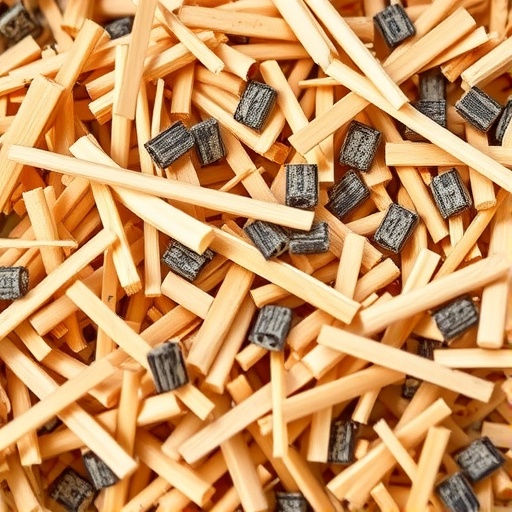
In a groundbreaking advance at the intersection of sustainable materials science and fire safety, researchers at ETH Zurich and Empa have unveiled a novel approach to repurposing sawdust into a high-performance, fire-retardant composite. This new material, fortified with the mineral struvite, not only enhances fire resistance but also pioneers a truly circular lifecycle for wood-derived products, potentially transforming interior construction materials and contributing to carbon footprint reduction.
Sawdust, a ubiquitous byproduct of timber processing, accumulates globally in the millions of tonnes each year. Traditionally, this abundant biomass is combusted for energy recovery, inadvertently releasing stored carbon dioxide back into the atmosphere, exacerbating greenhouse gas emissions. The ETH Zurich and Empa team has developed an innovative consolidation method that shifts the fate of sawdust from combustion to reincorporation into sustainable building materials via mineralization with struvite—ammonium magnesium phosphate—a crystalline compound renowned for its fire-retardant properties.
A technical hurdle previously stood in the way of melding struvite with lignocellulosic sawdust: incompatible crystallization behavior resulted in ineffective binding. Addressing this, the team employed an enzyme extracted from watermelon seeds to chemically steer the crystallization process of struvite from an aqueous precursor suspension of newberyite, a related mineral. This enzymatically guided growth results in sizable struvite crystals that infiltrate sawdust interstices, effectively cementing particles into a coherent composite matrix after a pressing and ambient drying regimen.
Remarkably, the mechanical properties of this composite surpass those of raw spruce wood, particularly in compression perpendicular to the grain, as elucidated by doctoral researcher Ronny Kürsteiner. The synergy between the mineral binder and wood fibers yields a structurally resilient panel optimized for internal architectural applications, where fire safety is paramount. The fire-resistant performance is primarily attributed to struvite’s unique thermal decomposition pathway; when exposed to heat, it liberates water vapor and ammonia, both of which absorb thermal energy and dilute combustible gases, mitigating combustion and fostering rapid charring.
Experimental validation using a cone calorimeter test — an industry standard for assessing material flammability — demonstrated impressive gains: untreated spruce rapidly ignited within approximately 15 seconds under simulated external heat flux, whereas the struvite-sawdust composite exhibited ignition delay times over threefold longer. This superior behavior underscores the composite’s ability to undergo self-protective char layer formation, rich in inorganic residues, that acts as a barrier to further thermal degradation.
Beyond fire retardancy, the mineral binder’s incorporation enhances sustainability credentials relative to traditional cement-bonded particleboards. Conventional boards, widely implemented for fire protection in interiors, typically contain 60 to 70 percent cement by weight, a material notorious for its substantial energy consumption during manufacture and consequent carbon emissions. The struvite composite achieves comparable fire performance with roughly 40 percent mineral binder content, culminating in a substantially lighter product with a markedly reduced embodied energy profile.
An additional virtue of this composite lies in its recyclability. Upon the conclusion of its service life, the panels can be mechanically pulverized and thermally treated at mild temperatures just above 100°C to release ammonia gas and segregate the sawdust fraction. The reclaimed mineral phase, initially precipitated as newberyite, can thereafter be reconstituted in fresh sawdust batches, closing the loop and enabling the material to participate repeatedly in the circular economy. This closed-loop approach minimizes landfill waste and fossil resource consumption.
Furthermore, the potential utility of both recovered struvite and sawdust extends beyond construction. Struvite’s phosphorus content and slow-release characteristics position it as an effective, sustainable fertilizer option for agriculture, offering controlled nutrient delivery that aligns with environmental stewardship objectives. This dual-purpose applicability highlights the multifunctionality of the research, reinforcing its impact across diverse sectors.
The researchers are actively focused on scaling up production techniques and refining the enzymatic crystallization process to enhance manufacturing viability. A critical factor influencing commercial adoption is the cost differential between struvite and conventional binders such as polymers and cement. Notably, struvite aggregates naturally in sewage treatment plants, frequently clogging pipelines—a challenge that may offer an untapped source of raw material for mineral recovery, potentially lowering costs and integrating waste treatment with sustainable material manufacturing cycles.
This pioneering development showcases an elegant confluence of bioengineering, mineral chemistry, and materials science, positioning mineralized sawdust composites as a compelling candidate for next-generation sustainable construction applications. The synergy of superior fire resistance, mechanical robustness, lightweight design, circularity, and agricultural co-benefits establishes a transformative paradigm for wood product utilization with profound environmental implications.
As the global construction industry grapples with sustainability mandates and safety demands, this technology offers a beacon of innovation. Future steps will include comprehensive large-scale fire safety assessments, economic analyses, and lifecycle environmental impact studies to pave the way for market entry. If these prove favorable, mineral-binder reinforced sawdust panels could redefine standards and contribute meaningfully to carbon-neutral building infrastructures worldwide.
—
Subject of Research:
Development of a fire-retardant, recyclable composite material combining sawdust and mineral struvite through enzyme-mediated crystallization.
Article Title:
Enzyme-mediated consolidation of lignocellulosic materials with a flame-retardant and fully recyclable mineral binder
News Publication Date:
26-Jan-2026
Web References:
https://doi.org/10.1016/j.checir.2025.100004
References:
Kürsteiner R, Vivas Glaser D, Ritter M, Parrilli A, Garemark J, Maddalena L, Schnider T, Dreimol CH, Carosio F, Burgert I, Panzarasa G: Enzyme-mediated consolidation of lignocellulosic materials with a flame-retardant and fully recyclable mineral binder. Chem Circularity 2026, 100004. DOI: 10.1016/j.checir.2025.100004
Image Credits:
Dan Vivas Glaser / from Kürsteiner R et al. Chem Circularity 2026, CC BY 4.0
Keywords
Sawdust, Struvite, Fire retardant, Mineral binder, Circular economy, Sustainable construction, Enzymatic crystallization, Recyclable composite, Lignocellulosic materials, Newberyite, Flame resistance, Bioinspired materials
Tags: ammonium magnesium phosphate in fire safetybio-based fire-retardant compositescircular economy in timber industryenzyme-guided crystallization processesfire-resistant lignocellulosic compositesinnovative biomass consolidation methodsreducing carbon footprint with biomass reusesawdust recycling for constructionstruvite mineralization in wood productssustainable fire-retardant composite materialssustainable interior construction materialswatermelon seed enzymes in material science