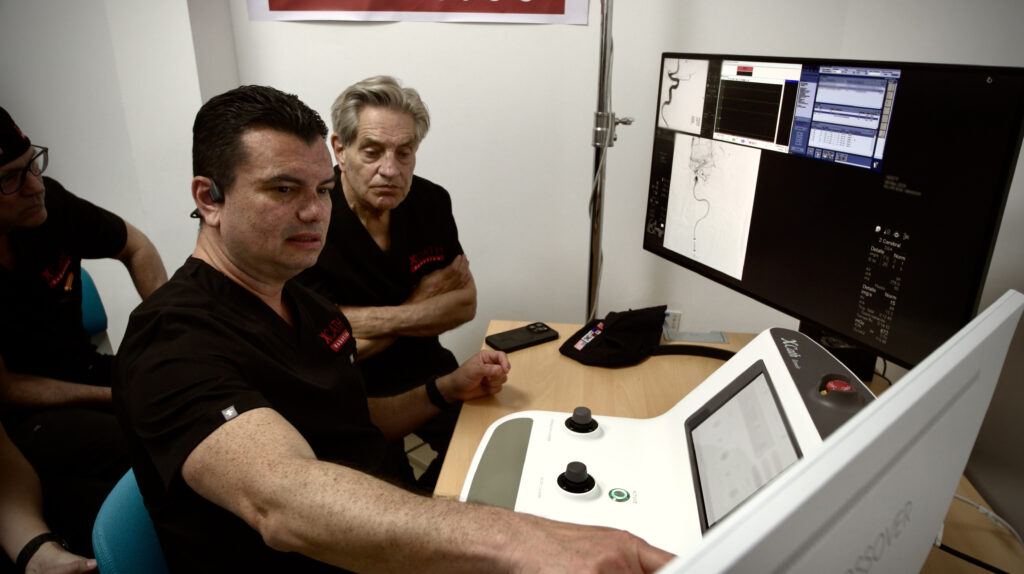
Endovascular robot developer XCath said it has successfully completed its first remotely operated stroke procedure, linking a neurosurgeon with a patient more than a hundred miles away.
The company’s Iris system was able to perform a mechanical thrombectomy to remove a severe blood clot from the brain of a patient in Panama City—while Vitor Mendes Pereira, M.D., operated the hardware from a clinic across the country in Santiago.
“The world’s first telerobotic neurosurgery was made possible by an exceptional team working alongside more than 60 physicians across five hospitals, all united around a single priority: patients,” Eduardo Fonseca, CEO of Houston-based XCath, said in a statement. “The true legacy of this moment will be measured in the millions of lives that could be saved each year as stroke treatment reaches patients who today have no access to it.”
Related
According to XCath, a male patient in his late 60s arrived at a nearby referring hospital with acute symptoms of stroke, with brain scans confirming a large vessel occlusion in the initial and widest segment of his left middle cerebral artery. While the patient was being transferred to The Panama Clinic—a process taking about 15 minutes—clinicians prepared the procedure room and connected the bedside Iris robot to its operator.
Pereira was able to navigate image-guided catheters through the patient’s vessels and deliver a stent retriever alongside balloon occlusion, while providing dual aspiration. XCath said the offending clot was removed on the first pass, with no visible lag while operating the system, and the patient is expected to make a full recovery.
“Mechanical thrombectomy is proven to reduce mortality and disability in patients with ischemic stroke but unfortunately access to the procedure is extremely low. The work XCath has done with the Iris System is a giant step toward broadening access to mechanical thrombectomy for patients around the world,” said Pereira, who is also on the neurosurgery faculty at the University of Toronto and St. Michael’s Hospital.
“The experience of performing the first-in-human procedure matched the successful simulated procedures we previously performed with the team, with imperceptibly low latency and no disruptions to the surgical workflow. It is the highlight of my career to be involved in this historic achievement,” he added.
Related
Assisting in the procedure at The Panama Clinic were local neurosurgeon Anastasio Ameijeiras Sibauste, M.D., and robotic technologist Nicole Cancelliere. Pereira also worked with XCath’s system in Panama late last year to perform interventions in patients with complex brain aneurysms—and previously conducted a simulated mechanical thrombectomy in 2024, operating a system in South Korea from his location in Abu Dhabi.
“Panama is honored to be the birthplace of a medical breakthrough that will save countless lives around the world,” the president of Panama, José Raúl Mulino, said in a statement.
“XCath’s Operation Robo Angel demonstrates the extraordinary potential that emerges when visionary leadership meets the dedication of our Physicians and institutions. This historic achievement reflects the spirit of Panamanian collaboration and our nation’s commitment to advancing healthcare for humanity,” said Mulino. “On behalf of the people of Panama, we proudly celebrate this milestone and the global hope it represents for patients and families affected by stroke.”
XCath estimates that 1 in 4 adults will have a stroke in their lifetime, with 5 million deaths annually and millions more living with disabilities, while global access to mechanical thrombectomy amounts to less than 3% of cases. The company said telerobotic platforms like Iris can increase the procedure’s reach and shorten time to treatment by virtually bringing the surgeon to wherever the patient may be.
Related
Earlier this month, XCath raised $30 million in venture capital financing for its development efforts, co-led by robotic surgery pioneer Fred Moll, M.D., who serves as chair of the company’s board of directors. The series C round was also headlined by Crescent Enterprises and brings XCath’s lifetime fundraising total to $92 million since its founding in 2017.
“XCath has accomplished what no other company has achieved in stroke care: a successful remote robotic mechanical thrombectomy delivering lifesaving treatment to a patient that would have otherwise not been able to receive treatment. It was a privilege to be present in this historic moment,” said Moll, who previously helped found Intuitive Surgical and Auris Surgical Robotics. “I believe that the XCath system will help create a new standard of care for stroke patients around the world.”