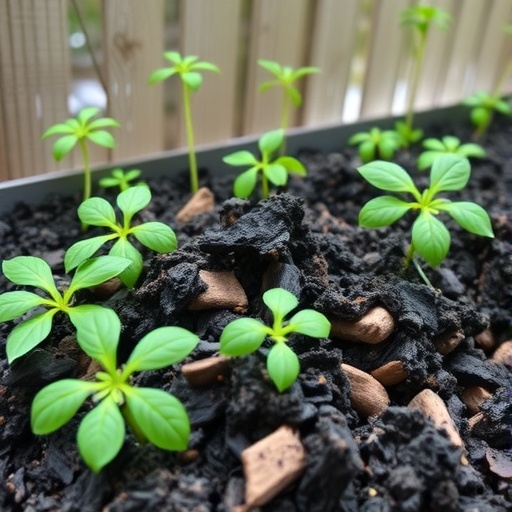
Food waste management is a critical concern in the shift toward a sustainable circular bioeconomy, yet innovative solutions remain elusive. A remarkable breakthrough has been achieved by scientists investigating the transformative potential of biochar derived from hardwood materials. This recent study reveals that the temperature applied during the pyrolysis process profoundly influences biochar’s ability to conserve nitrogen during the composting of food waste digestate — a nutrient-rich but notoriously challenging byproduct of anaerobic digestion. By judiciously optimizing this temperature, researchers have dramatically reduced nitrogen losses and mitigated harmful emissions, setting a new paradigm for eco-friendly waste treatment and nutrient retention.
The pivotal role of pyrolytic temperature emerges as not merely a production parameter but a decisive factor that governs the interplay between biochar’s physico-chemical properties and the microbial ecosystem within composting environments. Biochar, often perceived simply as an absorbent carbonaceous material, is now understood to be an active modulator that fosters specific microbial populations integral to nitrogen cycling. Such ecological engineering is crucial to balancing nitrogen transformation pathways that dictate whether nitrogen remains within the compost or escapes into the atmosphere as air pollutants.
Food waste digestate, enriched with nitrogen compounds, presents opportunities and challenges for sustainable nutrient recycling. Uncontrolled composting typically leads to significant nitrogen losses, primarily through ammonia volatilization and nitrous oxide emissions. Ammonia release not only diminishes fertilizer value but also contributes to atmospheric pollution and particulate matter formation. Even more concerning is nitrous oxide, a greenhouse gas with a global warming potential hundreds of times greater than carbon dioxide. Addressing these losses requires an intricate understanding of microbial nitrogen dynamics influenced by biochar amendments.
In controlled experiments, hardwood biochar was synthesized at three discrete pyrolytic temperatures — 300°C, 400°C, and 800°C — to delineate their effects on compost nitrogen conservation. Each temperature regime imparted distinct surface chemistry and pore structure attributes to the biochar, shaping microbial habitat conditions and adsorption capabilities. Scientific inquiry into nitrogen speciation, emission fluxes, and microbial community profiling revealed nuanced mechanisms behind nitrogen retention and loss.
Low-temperature biochar (300°C) excelled in curbing ammonia volatilization, achieving a reduction exceeding 39%. This efficacy is attributable to its abundant oxygen-containing functional groups such as carboxyl and hydroxyl moieties, which enhance ionic ammonium adsorption capacity. Additionally, these functional groups create favorable microenvironments that stimulate ammonia-oxidizing bacteria activity, catalyzing nitrification and converting ammonia into more stable nitrate forms, thus preventing gaseous loss.
Conversely, biochar produced at high temperature (800°C) demonstrated superior performance in mitigating nitrous oxide emissions by nearly 48%. Its development of a highly porous and oxygen-permeable structure facilitated improved oxygen diffusion within the compost matrix, repressing anaerobic microbial pathways responsible for incomplete denitrification — the primary source of nitrous oxide. This physical attribute effectively alters redox conditions, steering microbial metabolism away from greenhouse gas production.
Striking a delicate balance between these two nitrogen loss mechanisms, the medium-temperature biochar crafted at 400°C outperformed other treatments by reducing total nitrogen loss by 46.3%. This intermediate pyrolytic condition provides a synergistic effect: it maintains sufficient functional groups for ammonium adsorption and microbial nitrification while preserving structural qualities that enhance oxygen availability and reduce nitrous oxide emissions. The dual microbial modulation affirms the profound interdependence between biochar physicochemistry and ecological functioning.
Microbial ecology analyses underscored biochar’s role as a selective niche for key nitrogen-transforming organisms. Ammonia-oxidizing bacteria and nitrite-oxidizing bacteria populations flourished in the presence of medium-temperature biochar, fostering efficient conversion of nitrogenous compounds into stable, less volatile states. The findings emphasize that biochar acts not merely as a sorbent but as a bioreactor component intricately shaping microbial community assembly and activity, with significant implications for nutrient cycling and greenhouse gas dynamics.
Beyond the realm of composting efficiency, these advancements translate into broad environmental and agronomic benefits. By curbing nitrogen losses, biochar amendments can enhance nutrient retention in agroecosystems, potentially reducing reliance on synthetic fertilizers and associated environmental footprints. Moreover, the concurrent suppression of ammonia and nitrous oxide emissions aligns with global climate mitigation objectives, underscoring biochar’s potential in integrated sustainable waste and nutrient management strategies.
From an applied perspective, the feasibility of implementing medium-temperature biochar production is underscored by its moderate energy requirements and cost-effectiveness relative to extreme pyrolysis conditions. This balance of performance and practicality paves the way for scaling the technology in agricultural, industrial, and municipal waste management settings. The insight that precise control over pyrolysis temperature can fine-tune microbial pathways offers a powerful tool for designing holistic and environmentally sound compost interventions.
The research thus advances a compelling framework that elevates biochar from a passive amendment to an engineered material capable of steering biochemical processes within waste treatment. It exemplifies the fusion of material science, microbiology, and environmental engineering necessary for next-generation solutions to global challenges such as waste valorization and climate change. Furthermore, it opens avenues for tailoring biochar properties to target specific environmental outcomes, including enhanced carbon sequestration and pollutant mitigation.
Anticipated future directions include scaling up biochar-enhanced composting systems, refining temperature modulation algorithms, and elucidating long-term impacts on soil health and crop productivity. The integration of high-resolution microbial genomics and metabolomics could further unravel the intricate pathways by which biochar interfaces with nitrogen cycling microbes. Collectively, this research signals a transformative approach to sustainable waste management with far-reaching implications for ecological resilience and agricultural sustainability.
In summary, the study delineates a nuanced, temperature-driven strategy for maximizing nitrogen conservation during food waste digestate composting through hardwood biochar amendments. By optimizing pyrolysis temperature to 400°C, it is possible to harmonize ammonia and nitrous oxide emission reductions, enrich beneficial microbial communities, and enhance compost quality and environmental performance. This innovation heralds a critical step toward harnessing engineered carbon materials in circular bioeconomy frameworks, with promising impacts on climate mitigation, resource management, and agricultural sustainability.
Subject of Research: Nitrogen conservation mechanisms in biochar-amended food waste digestate composting influenced by pyrolytic temperature.
Article Title: Nitrogen conservation by hardwood biochar during food waste digestate composting: pyrolytic temperature dictates microbial mechanisms
News Publication Date: 11 March 2026
Web References:
Biochar Journal
References:
Li, D., Zhou, J., Liang, J. et al. Nitrogen conservation by hardwood biochar during food waste digestate composting: pyrolytic temperature dictates microbial mechanisms. Biochar 8, 75 (2026). DOI: 10.1007/s42773-026-00588-x
Image Credits: Dongyi Li, Jun Zhou, Jialin Liang, Qiuxiang Xu, Jiayu Zhang, Wenhua Xue & Jonathan W. C. Wong
Keywords
Biochar, Nitrogen conservation, Food waste digestate, Pyrolysis temperature, Microbial ecology, Composting, Ammonia emission reduction, Nitrous oxide mitigation, Hardwood biochar, Sustainable waste management, Circular bioeconomy, Greenhouse gas reduction
Tags: biochar temperature optimizationcircular bioeconomy waste solutionseco-friendly food waste treatmentfood waste digestate managementhardwood biochar propertiesmicrobial modulation in compostingnitrogen conservation in compostingnitrogen cycling in biochar systemsnitrogen retention in anaerobic digestion byproductspyrolysis temperature effectsreducing nitrogen emissionssustainable nutrient recycling