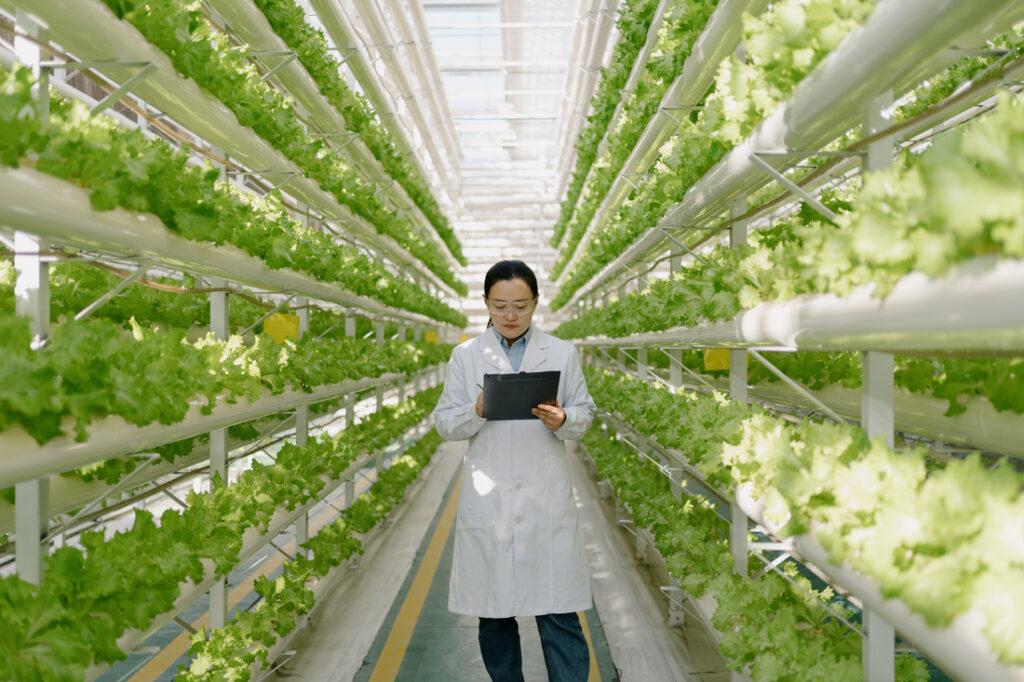
Plant molecular farming (PMF) may seem like a bold option for companies accustomed to mammalian or microbial systems, but recent advances have transformed plant-based bioproduction into serious, scalable biomanufacturing platforms able to produce even complex biologics cost-effectively.
“A major advantage is sustainability,” Marco P.C. Marques, PhD, associate professor, University College London (UCL), tells GEN. This comes at a time when “…regulators and global initiatives are putting real pressure on industry to reduce environmental footprint(s). Because plants grow using low energy inputs rather than stainless steel reactors or energy-intensive systems, they can bring down operating costs, reduce carbon emissions, and provide more flexible manufacturing options.”
Additional benefits include PMF systems’ ability to support eukaryotic protein-folding and post-translational modification pathways, their lack of human pathogens, minimal biosafety risks, and compatibility with distributed manufacturing.
PMF reached its current state because sensors, host plant engineering, AI-enabled models, and related technologies have become more mature, reliable, and predictable in the past few years. Consequently, “PMF platforms can deliver consistent, good manufacturing practice (GMP)-compatible performance while needing far less infrastructure, [which] allows much faster setup than conventional approaches,” Marques says.
Robust, economic, responsible
In a recent paper, he and first author Teresa Iucci, PhD, a bioprocessing scientist at Sapienza University of Rome and UCL, cite 13 companies that are using or have used plants to produce a variety of proteins, including antibodies, enzymes, and peptides, for vaccines and other biologics. Many are at clinical or commercial scale.
Those examples show “that controlled cultivation, advanced transient-expression systems, and more refined downstream workflows can overcome many of the technical and regulatory hurdles historically associated with plant-based biomanufacturing.” In particular, they note substantial improvements in host plant engineering. Now, they point out, Nicotina plants can produce mAbs and Fc-fusion proteins that closely match those derived from CHO cells.
However, “Realizing the full value of these biological innovations will depend on aligning PMF with contemporary digital manufacturing principles,” Iucci and Marques stress.
“There is a lot of scope for continued innovation…particularly on the molecular biology side, where further gains in expression, stability, and product quality are very achievable,” Marques elaborates. “Downstream processing could also be better tailored to plant-based hosts,” to lower costs further.
The benefits of PMF are well-recognized, but biomanufacturers also need clear, streamlined regulatory pathways and the internal determination that PMF is worth sustained investment.
For biomanufacturers, “A good starting point is simply to treat PMF as a genuine production platform rather than an interesting alternative,” he says. To be able to compare PMF products with those derived from traditional mammalian or microbial cultures, he calls for the industry to standardize unit operations and generate regulatory-grade datasets, and then to run comparability studies and pilot-scale campaigns.
Running such campaigns is becoming increasingly practical with the conjunction of sensors and data-driven processors. In vertical farming facilities, for example, every parameter critical for plant growth is tightly monitored and controlled using digital sensors to enable precise, real-time environmental adjustments.
Ultimately, this allows producers to select the optimal timing of such events as infiltration and harvest at levels not possible in conventional greenhouses. “The long-term objective is a semi-continuous, digitally regulated PMF production line that links infiltration, extraction, and purification into a coherent, self-correcting workflow,” Iucci and Marques write.
Transitioning from mammalian or microbial systems to PMF, “is easier said than done…especially when companies already have well-established mammalian or microbial platforms with validated processes and established supply chains,” Marques acknowledges. “In many respects, it would be simpler to design a PMF-based approach from scratch than to retrofit it into an existing operation…but with the right incentives (such as additional revenue streams from side processes), application cases, and evidence, we may well see more companies prepared to make that shift.”