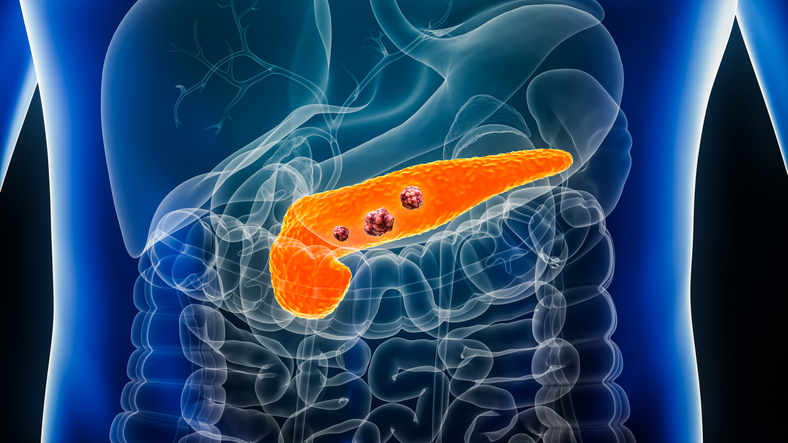

Earlier this week, Revolution Medicines reported positive results from a global Phase III trial of its RAS‑targeting inhibitor daraxonrasib (RMC-6236) in metastatic pancreatic ductal adenocarcinoma (PDAC). In the RASolute 302 trial, patients receiving daraxonrasib achieved longer progression‑free survival (PFS) and overall survival (OS) than those on standard cytotoxic chemotherapy.
The RASolute 302 trial enrolled patients with pancreatic tumors harboring a wide range of RAS variants, including those with RAS G12 mutations (such as G12D, G12V, and G12R), as well as those without an identified RAS mutation. The primary endpoints of the trial were PFS and OS in patients with tumors harboring RAS G12 mutations. Secondary endpoints assessed PFS and OS in all enrolled patients (the intent-to-treat population), including those with tumors with and without (wild type) an identified RAS mutation.
Daraxonrasib patients achieved a median OS of 13.2 months versus 6.7 months for chemotherapy. The drug was generally well tolerated, with a manageable safety profile and with no new safety signals.
“With these unprecedented results, daraxonrasib has the potential to achieve our goal of bending the mortality curve in pancreatic cancer. Unlike chemotherapy, daraxonrasib is a RAS-targeted medicine that targets RAS in its active ‘ON’ state, shutting down a key signaling pathway that drives aggressive tumor growth. This is especially important in pancreatic cancer, which is among the most RAS-driven cancers, with more than 90% of tumors harboring a RAS mutation that is the driver of the cancer,” asserted Mark A. Goldsmith, MD, PhD, CEO and chairman of Revolution Medicines.
Pancreatic cancer carries one of the highest mortality rates of any solid tumor, a consequence of late-stage diagnosis and resistance to standard chemotherapy. In the United States, recent estimates point to roughly 60,000 new cases and nearly 50,000 deaths each year. With most PDAC tumors driven by RAS alterations, the early success of emerging RAS‑targeted strategies hints at how much more may be possible as this therapeutic space continues to expand.
RAS is the key oncogenic driver of pancreatic cancer. Nearly all RAS mutations occur at KRAS position G12, but RAS mutations in other isoforms and at KRAS positions G13 and Q61 are also observed. Daraxonrasib works by suppressing RAS signaling through inhibition of the interaction between both wild-type and mutant RAS(ON) proteins and their downstream effectors.
Pancreatic cancer is the most RAS-addicted of all major cancers, with more than 90% of patients harboring tumors driven by mutations in RAS proteins. These mutations span a range of RAS variants that fuel aggressive tumor behavior. Daraxonrasib, a multi-selective inhibitor of RAS(ON) proteins, is the first investigational agent in a novel class of RAS inhibitors designed to address a diverse and broad spectrum of oncogenic RAS drivers.
“For patients with metastatic pancreatic cancer, new treatment options are urgently needed to increase survival time and improve quality of life,” said Brian M. Wolpin, MD, MPH, professor of medicine at Harvard Medical School, director of the Hale Family Center for Pancreatic Cancer Research at Dana-Farber Cancer Institute, and principal investigator for the RASolute 302 trial. “The widely anticipated results of this study indicate that daraxonrasib provides a clear and highly meaningful step forward for patients with pancreatic cancer who have experienced progression on prior treatment, typically chemotherapy. I believe that this new approach is a very important advance for the field that I expect will be practice-changing for physicians and improve the care for patients with previously treated metastatic pancreatic cancer.”
Revolution Medicines now intends to submit the drug for approval by regulatory authorities, including the U.S. Food and Drug Administration as part of a future New Drug Application, and for presentation at the 2026 American Society of Clinical Oncology Annual Meeting.