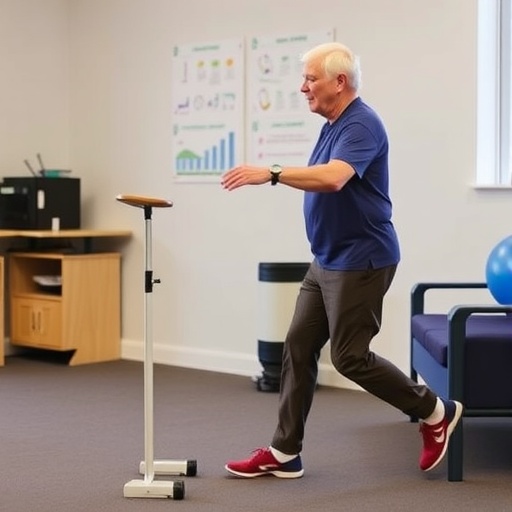
In a groundbreaking exploration into the complexities of Parkinson’s disease (PD), a recent study sheds light on the nuanced relationship between sedentary behavior and the efficacy of balance rehabilitation therapies. Parkinson’s disease, a progressive neurodegenerative disorder characterized by motor and non-motor symptoms, often leads to pronounced impairments in balance and mobility, substantially elevating the risk of falls and associated morbidity. The study spearheaded by Albrecht, Conklin, Hooyman, and colleagues, published in npj Parkinson’s Disease, provides compelling evidence that sedentary lifestyles can significantly modify how patients respond to balance rehabilitation, a cornerstone intervention aimed at mitigating falls and enhancing quality of life.
Balance rehabilitation plays an indispensable role in managing Parkinson’s disease, focusing on retraining postural control mechanisms to counteract the deterioration caused by basal ganglia dysfunction. Typically, these interventions involve physiotherapeutic exercises tailored to improve stability, coordination, and gait. However, intrinsic variability in treatment outcomes has spurred investigations into underlying factors that might influence responsiveness. This new research interrogates sedentary behavior—a factor increasingly recognized for its deleterious effects on musculoskeletal and neurological health—as a potential modifier of rehabilitation outcomes.
The investigators utilized a robust cohort of Parkinson’s patients, systematically assessing their baseline sedentary time through wearable activity monitors that provided objective, continuous measurements. Balance function was meticulously quantified using a combination of clinical scales and instrumented posturography, enabling a precise characterization of postural control. Crucially, the study introduced the concept of balance discordance, defined as a disjunction between perceived and actual balance abilities, a phenomenon that can exacerbate fall risk by fostering either undue caution or reckless confidence.
Data analysis revealed a compelling interaction between sedentary behavior levels and the magnitude of improvement following balance rehabilitation. Patients exhibiting higher amounts of sedentary time demonstrated a significantly blunted response to therapeutic interventions compared to their more active counterparts. This finding underscores that the deleterious effects of prolonged inactivity extend beyond general health detriments to directly impair neuroplastic potential and functional recovery in PD patients undergoing rehabilitation.
Delving deeper into the potential mechanisms, the authors discuss how prolonged sedentary behavior could lead to diminished proprioceptive feedback, weakened musculature, and altered sensory integration—all key components of postural control. Furthermore, inactivity may exacerbate neurodegenerative processes through metabolic and inflammatory pathways, thereby hampering neural substrates essential for adapting to balance training stimuli. This multifactorial interference represents a critical barrier to achieving optimal rehabilitation outcomes, highlighting the need for integrated interventions.
The implications of the study are profound. Rehabilitation programs may require customization based not only on the phenotypic expression of PD but also on lifestyle variables such as sedentary behavior. Interventions designed to reduce sitting time and increase light physical activity could potentiate the benefits of balance training by priming the neuro-musculo-skeletal system for enhanced plasticity and functional gains. This paradigm shift advocates for a holistic approach encompassing both targeted therapy and lifestyle modification.
Importantly, the study’s longitudinal design allowed the team to observe that the negative impact of sedentary behavior was not simply a correlational artifact but appeared to mediate the trajectory of balance recovery over time. Participants who adopted more active daily routines concurrent with rehabilitation showed accelerated and sustained improvements. This temporal association strengthens the argument for proactive behavioral interventions as adjuncts to traditional rehabilitation strategies.
The authors also emphasize the clinical importance of evaluating balance discordance in PD patients. By identifying discrepancies between perceived and actual balance control, clinicians can better tailor educational and psychological interventions aimed at recalibrating patient awareness, thereby reducing fall risk. The study’s findings suggest that sedentary behavior exacerbates this discordance, potentially by dulling sensory feedback mechanisms and cognitive processing related to self-perception.
Methodologically, the study exemplifies the integration of advanced wearable technology and rigorous clinical assessment, providing a framework for future research aiming to dissect lifestyle factors influencing neurological rehabilitation. The precision and granularity of data obtained underscore the transformative potential of digital health tools in personalizing therapy regimens and tracking patient progress with unprecedented fidelity.
From a broader perspective, this investigation contributes to a growing body of literature that recognizes lifestyle factors as modifiable determinants of disease progression and treatment responsiveness in chronic neurological disorders. It challenges the traditional siloed approach to rehabilitation, advocating for interdisciplinary strategies that combine neurology, physiotherapy, behavioral science, and public health.
Equally noteworthy is the potential policy impact. Health systems and caregivers might reconsider resource allocation and intervention design to incorporate sedentary behavior reduction programs alongside rehabilitation. Such integrative models could optimize outcomes and potentially reduce healthcare costs associated with fall-related injuries and hospitalizations among PD patients.
While the study provides compelling evidence, it also calls for further research to unravel the causal pathways linking sedentary behavior, neuroplasticity, and functional recovery. Animal models, neuroimaging studies, and molecular analyses may yield insights into the neuronal and systemic changes induced by physical inactivity in the context of neurodegeneration.
In conclusion, the findings by Albrecht et al. redefine our understanding of balance rehabilitation in Parkinson’s disease, revealing sedentary behavior as a critical modulator of therapeutic efficacy. Their work advocates for a multidimensional approach that harmonizes physical activity promotion with targeted rehabilitation to overcome balance discordance and mitigate fall risk. As the Parkinson’s community continues to seek innovative strategies to enhance patient quality of life, this study stands as a beacon, illuminating the path toward more effective, personalized, and holistic care paradigms.
Subject of Research: The study investigates how sedentary behavior influences the effectiveness of balance rehabilitation in individuals with Parkinson’s disease, focusing on the phenomenon of balance discordance.
Article Title: Sedentary behavior modifies the effect of balance rehabilitation on balance discordance in Parkinson’s disease.
Article References:
Albrecht, F., Conklin, S.J., Hooyman, A. et al. Sedentary behavior modifies the effect of balance rehabilitation on balance discordance in Parkinson’s disease. npj Parkinsons Dis. 12, 98 (2026). https://doi.org/10.1038/s41531-026-01357-0
Image Credits: AI Generated
DOI: https://doi.org/10.1038/s41531-026-01357-0
Tags: basal ganglia dysfunction treatmentgait and stability exercises Parkinson’simproving quality of life in Parkinson’smotor symptom management Parkinson’sneurodegenerative disease fall riskParkinson’s disease balance rehabilitationphysiotherapy for Parkinson’spostural control in Parkinson’ssedentary behavior impact on Parkinson’ssedentary lifestyle effects on neurorehabilitationvariability in Parkinson’s rehab outcomeswearable activity monitors Parkinson’s study