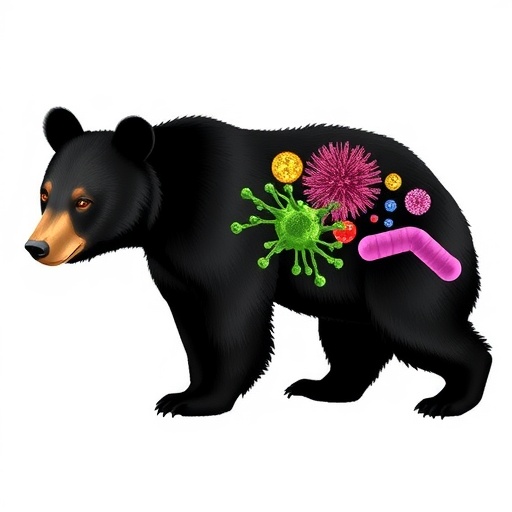
A groundbreaking study on the gut microbiome of American black bears (Ursus americanus) in eastern North Carolina has opened new frontiers in our understanding of microbial ecosystems in omnivorous mammals. Conducted by a team of ecologists and microbiologists from several universities, this research reveals that bear gut microbiomes are not only highly diverse but may also serve as vital indicators of environmental health. Intriguingly, the study also highlights the surprising role that bears could play in spreading antibiotic-resistant pathogens, shedding light on ecological and public health intersections previously unrecognized.
American black bears possess a relatively simple digestive tract, characterized by a rapid passage of ingested food through the gut. According to Erin McKenney, assistant professor of applied ecology at North Carolina State University and the study’s corresponding author, this swift digestive transit limits the immune system’s ability to modulate the gut’s microbial community. Unlike many other mammals that select or suppress specific microbes, the bears’ microbiomes are shaped more passively by their environment and diet. This suggests a complex, dynamic microbial landscape that mirrors the bears’ surroundings and foraging habits.
The bear’s omnivorous lifestyle, encompassing an exceptionally broad diet that includes berries, insects, small mammals, and carrion, contributes to the astonishing variability observed in their microbial profiles. The research team hypothesized that given such dietary diversity and the lack of gut microbial regulation, the composition of the black bear gut microbiome could serve as an ecological “readout” of local environmental conditions. Testing this hypothesis involved collecting and analyzing gut samples from wild bears across eastern North Carolina, a region experiencing ecological shifts due to changing land use and climate.
Researchers obtained 48 wild black bear gut samples, harvested under strict regulatory oversight by local hunters. The samples consisted of both small intestine and large intestine sections—nine from the former and 39 from the latter. Using advanced genetic sequencing techniques, the scientists identified the microbial genera present and quantified their relative abundances in each sample. Moreover, they employed bioinformatics tools to predict the functional roles these microbes play within the bear gut ecosystem, linking taxonomy to metabolic potential.
Unsurprisingly, the bear gut microbiota exhibited enormous taxonomic variability from individual to individual. Each bear’s gut harbored a complex assemblage of microbial taxa that varied widely across the population. Yet, despite differences in microbial composition, functional predictions revealed remarkable consistency in metabolic pathways across the samples. This suggests that although the microbial cast differs, the essential ecological functions necessary for bear digestion and health remain conserved. The stability of these functional roles amidst taxonomic flux underscores the resilience and adaptability of the gut microbiome in fluctuating environmental contexts.
An unforeseen discovery emerged when researchers detected significant levels of antibiotic-resistant pathogenic bacteria within the bear gut communities. Predators are known to harbor pathogens, but the prevalence of antibiotic-resistant strains was particularly alarming. This finding indicates that bears may act as vector species, facilitating the dissemination of resistance genes in the wild, raising concerns about the broader ecosystem and the interface between wildlife and human health. Such revelations call for further surveillance and integrated One Health approaches to managing antimicrobial resistance beyond clinical settings.
Adding another layer of intrigue, the most dominant microbial genus identified across all bear samples is one associated in humans with infection and obesity. While obesity is typically considered problematic in human populations, in bears this microbial relationship may confer a survival advantage. Bears prepare for hibernation by accumulating thick fat reserves, critical for overwintering when feeding ceases. Thus, microbial species that promote fat deposition could be beneficial symbionts, supporting bears’ unique physiological adaptations. This paradox highlights the complex evolutionary interplay between host metabolism and gut microbiota.
The study reinforces the concept of bears as “living biosensors” embedded within their ecosystems. Their gut microbiomes provide an integrated record of dietary diversity, environmental exposures, and physiological states, offering researchers a unique window into ecosystem health. Diana Lafferty, co-author and associate professor of biology at Northern Michigan University, emphasizes that the insights from gut sampling can be extended to fecal microbiome analyses—noninvasive methods that facilitate ongoing monitoring of bear populations and their habitats, especially as their range expands across North America.
Importantly, black bears are progressively inhabiting diverse landscapes, including urban-edge environments, and understanding their microbiome dynamics is crucial for conservation and management. The microbiome’s composition may reflect environmental stressors such as pollution, habitat alteration, or exposure to human-derived pathogens, enabling wildlife biologists to detect ecosystem perturbations early. This sentinel role could be pivotal in anticipating and mitigating ecological disruptions and zoonotic disease emergence, bridging wildlife ecology with public health imperatives.
Methodologically, the study’s use of high-throughput genetic sequencing technologies—such as 16S ribosomal RNA gene sequencing combined with predictive metabolic profiling—represents cutting-edge approaches in wildlife microbiome research. These techniques allow for unparalleled resolution in characterizing microbial communities, facilitating the identification of taxa at the genus level and inference of functional capabilities. Integrating these tools within observational field studies underscores the value of multidisciplinary research in unraveling complex biological phenomena.
Despite the breadth of insights gained, this research raises important questions warranting further exploration. How do seasonal dietary shifts influence bear microbiomes? What are the transmission pathways for antibiotic-resistant bacteria within ecosystems? Can microbiome profiles serve as early warning systems for environmental change? Answering these queries will cement the role of gut microbiome studies in wildlife ecology and environmental science, informing policies that balance species conservation with ecosystem integrity.
This pioneering work was made possible through collaboration among a diverse team, including university researchers, wildlife officials, and students. Their coordinated effort highlights the growing importance of cross-institutional partnerships in tackling multifaceted ecological challenges. Supported by funding from the North Carolina Wildlife Resources Commission and the Northern Michigan University College of Arts and Sciences, the project exemplifies the synergistic potential of combining academic research with applied conservation goals.
Published in the open-access journal PLOS One, this landmark study titled “Gut site and sex-specific enrichment of bacterial taxa and predicted metabolic pathways in wild American black bear (Ursus americanus)” sets a new standard for investigating mammalian gut microbiomes in natural settings. Its findings promise to influence a broad spectrum of disciplines—from microbiology and ecology to public health—underscoring the intricate connections between wildlife, environment, and human society. As bears continue to expand their footprint, understanding their microbial companions becomes ever more critical for safeguarding planetary health.
Subject of Research: Animals
Article Title: Gut site and sex-specific enrichment of bacterial taxa and predicted metabolic pathways in wild American black bear (Ursus americanus)
News Publication Date: 20-Apr-2026
Web References:
– https://journals.plos.org/plosone/article?id=10.1371/journal.pone.0345317
– http://dx.doi.org/10.1371/journal.pone.0345317
Keywords: black bear, gut microbiome, microbial diversity, antibiotic resistance, environmental biosensor, Ursus americanus, microbiota function, wildlife disease, metagenomics, ecological monitoring
Tags: antibiotic resistance spread in ecosystemsantibiotic-resistant bacteria in wildlifebear gut microbes and pathogen resistanceecological impact of black bear dietenvironmental health indicators in mammalsenvironmental microbiome and public healthgut microbiome diversity in black bearsmicrobial transmission from wildlife to humansNorth Carolina wildlife microbiology studyomnivorous mammal gut microbiotarapid digestive transit effects on microbiomeUrsus americanus microbial ecosystems