Recent advancements in sustainable agriculture reveal a promising method to combat the pervasive challenge of soil salinity through the use of halotolerant plant growth-promoting bacteria (PGPB). A groundbreaking study, published in the journal Engineering, presents compelling evidence that delivering these beneficial microorganisms via drip irrigation not only mitigates salt stress but also significantly enhances crop productivity and fruit quality. This innovative approach tackles key shortcomings of conventional PGPB application techniques, which often fail to achieve stable bacterial colonization and reliable plant growth benefits under saline conditions.
Soil salinity is a critical barrier to agricultural productivity worldwide, especially in arid and semi-arid regions where irrigation-driven salt accumulation hampers plant development. Traditional inoculation methods for PGPB—such as seed coating, soil basal application, or foliar spraying—demonstrate limited efficacy because these strategies do not maintain sufficient bacterial populations throughout the entire growth cycle, leading to suboptimal plant-microbe interactions. This study pioneers a continuous delivery system, applying PGPB through drip irrigation directly to the root zone, thereby ensuring sustained bacterial presence during crucial developmental stages.
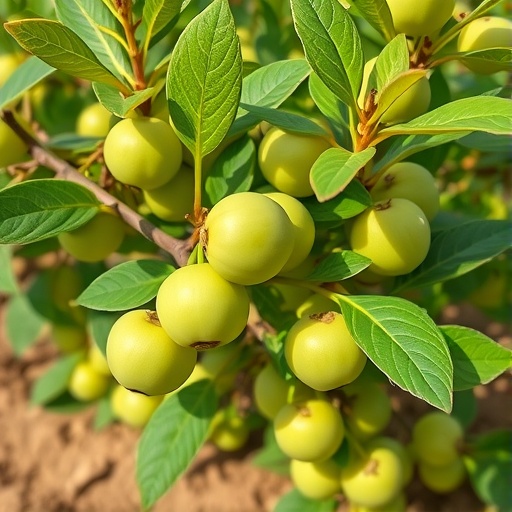
Conducted over two years on commercially valuable jujube trees in China’s saline agricultural soils, the study deployed seven strains of halotolerant PGPB using frequent, low-volume doses via fertigation equipment. This methodology harmonizes with existing irrigation infrastructure, offering a cost-effective and scalable solution for farmers. The researchers meticulously tracked soil and plant physiological parameters across distinct phases including flowering, fruit enlargement, white ripening, and full ripening, thereby assessing the temporal impact of PGPB inoculation under realistic field conditions.
The results unequivocally demonstrate that bacterial delivery through drip irrigation substantially reduces soil pH and electrical conductivity (EC), two pivotal indicators of salinity stress. Reduction in EC directly correlates with decreased ionic toxicity and osmotic imbalance, facilitating improved water and nutrient uptake by plants. These physicochemical soil improvements provide a more hospitable rhizosphere environment, crucial for both microbial community dynamics and root function.
Among the halotolerant bacterial strains tested, Bacillus licheniformis and Bacillus mucilaginous emerged as the most efficacious, elevating jujube yields by 23% and vitamin C content by 22% relative to untreated controls. This remarkable enhancement in fruit quality underscores the dual benefit of microbial inoculants—not merely stimulating growth but enriching nutritional attributes. These bacteria function as biofertilizers and biostimulants, mediating physiological pathways that underpin plant vigor.
A pivotal aspect of the study is the mechanistic elucidation of how PGPB bolster plant resilience. The inoculated plants exhibited significantly increased activities of antioxidant enzymes such as superoxide dismutase (SOD), peroxidase (POD), and catalase (CAT). These enzymes play a critical role in detoxifying reactive oxygen species (ROS) generated under salt-induced oxidative stress, thereby protecting cellular integrity and metabolic function. This antioxidative defense is fundamental to maintaining homeostasis and sustaining growth under adverse environmental conditions.
Soil nutrient profiles also responded favorably to PGPB treatment, with notable increments in available nitrogen, phosphorus, potassium, and organic matter. These changes suggest that halotolerant PGPB enhance nutrient cycling and availability, possibly through nitrogen fixation, solubilization of phosphates, and decomposition of organic substrates. This improved nutrient status synergistically supports enhanced plant metabolic activities and growth rates.
Advanced 16S rRNA gene amplicon sequencing served to profile the rhizosphere microbial communities, revealing that PGPB inoculation increased alpha diversity as indicated by higher Richness and Shannon indices. Such microbial diversity is often correlated with ecosystem stability and resilience. The study highlighted an enrichment of beneficial bacterial phyla including Cyanobacteria and Nitrospirota, as well as genera such as Psychrobacter, Flavobacterium, and Steroidobacter, all known for their roles in nutrient cycling and plant health.
Furthermore, bacterial co-occurrence network analysis depicted more complex interactions within the PGPB-treated soils, indicated by augmented node and link counts. This suggests a more intricate and stable microbial consortium, potentially fostering functional redundancy and cooperative behavior that underpins efficient nutrient turnover. Keystone taxa identified in these networks are implicated in critical soil processes, emphasizing the role of microbial community structure in mediating soil fertility.
Functional predictions using FAPROTAX provided deeper insight into metabolic alterations induced by PGPB application. Pathways associated with nitrate respiration, plant pathogen suppression, and degradation of aromatic compounds were diminished, while those tied to nitrogen fixation, nitrate reduction, fermentation, and nutrient mineralization were enhanced. These functional shifts suggest a microbiome optimized for nutrient provision and plant defense, highlighting a holistic improvement in soil ecosystem services.
The research team further employed structural equation modeling (SEM) to integrate multifactorial data, confirming that drip-applied halotolerant PGPB orchestrate a multi-tiered impact. They suppress soil salinity, improve nutrient availability, and enhance plant antioxidant systems, all mediated through reshaped bacterial community composition and interactions. This integrated perspective affirms the complex interplay underpinning crop improvement facilitated by microbial inoculants.
Importantly, the study evaluates the pragmatic implications of drip irrigation as a delivery mechanism. It confirms that this technique is compatible with existing farm fertigation infrastructure and does not contribute substantially to emitter clogging over prolonged use. This finding addresses a major practical constraint and paves the way for adoption of PGPB fertilization in saline agriculture on a commercial scale.
This groundbreaking work ultimately demonstrates that employing halotolerant PGPB via drip irrigation delivers multidimensional benefits for sustainable agriculture. It offers a viable, technology-driven solution to soil salinity challenges while enhancing crop yield and nutritional quality. Such integrated bioengineering approaches are poised to revolutionize farming practices in salt-affected landscapes, contributing to global food security.
The implications extend beyond jujube cultivation; this innovative strategy holds promise for a wide array of crops afflicted by salinity stress. Future research focused on optimizing strain combinations, application frequencies, and soil types will further refine this approach, accelerating its translation into diverse agricultural systems worldwide.
Subject of Research: Halotolerant Plant Growth-Promoting Bacteria (PGPB) application via drip irrigation for enhancing crop performance and soil health in saline soils.
Article Title: Halotolerant PGPB Delivered by Drip Irrigation Improve Crop Yield and Quality Through Changes in the Soil Bacterial Community
News Publication Date: 17-Feb-2026
Web References:
DOI link
Journal Engineering Website
Image Credits: Yunpeng Zhou, Bernard R. Glick et al.
Keywords: Halotolerant PGPB, Soil Salinity, Drip Irrigation, Crop Yield, Jujube, Antioxidant Enzymes, Microbial Diversity, Soil Nutrients, Rhizosphere, Sustainable Agriculture
Tags: agricultural biotechnology for salt tolerancebacterial community modulation in soilcontinuous bacterial inoculation methodsdrip irrigation for saline soilsenhancing fruit quality in saline environmentsfertigation delivery of PGPBhalotolerant plant growth-promoting bacteriajujube crop yield improvementplant-microbe interactions under salt stresssaline soil microbial ecologysoil salinity management techniquessustainable agriculture in arid regions