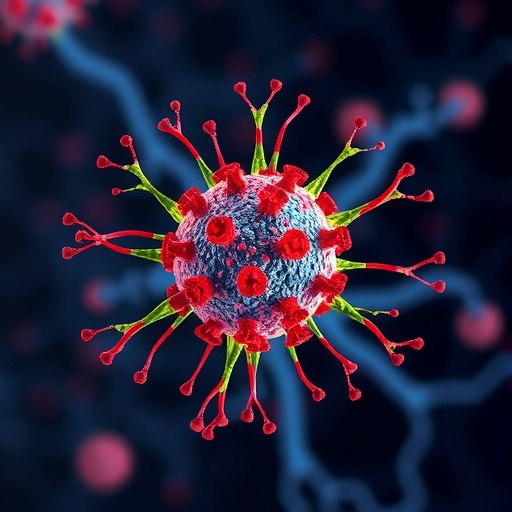
In a groundbreaking study published in the prestigious journal Gene Therapy, researchers have unveiled intricate details about the behavior of adeno-associated virus serotype 2 (AAV2) capsids within the central nervous system (CNS). This research sheds critical light on the mechanisms underpinning viral vector clearance and neuronal trafficking, phenomena central to the safety and efficacy of gene therapy applications targeting neurodegenerative diseases and other CNS disorders.
For years, AAV2 has been a favored tool in neurogenetics due to its capacity to transduce neurons efficiently with minimal immunogenicity. However, the dynamics of how the virus interacts with neuronal cells post-delivery remained insufficiently clarified. This study bridges that knowledge gap by using advanced imaging and molecular tracing techniques to track the fate of AAV2 capsids after administration in vivo, revealing a nuanced narrative of viral processing within neural environments.
The investigators employed state-of-the-art in vivo fluorescence microscopy combined with quantitative biochemical assays to monitor the temporal and spatial distribution of AAV2 capsids following intracerebral injection in rodent models. Their results indicate that capsid clearance occurs through a multifaceted pathway involving microglial phagocytosis and proteasomal degradation. These pathways collaboratively function to reduce capsid persistence, underscoring the CNS’s intrinsic immune surveillance mechanisms.
Intriguingly, the study delineated not only how AAV2 capsids are cleared but also their dynamic trafficking within neuronal compartments. The viral particles demonstrated a propensity to be internalized by neurons with subsequent axonal transport along microtubules. This intracellular movement was found to be bidirectional, facilitating widespread gene delivery beyond the initial inoculation site, which has significant implications for designing therapies with enhanced CNS penetration.
Further molecular analysis revealed that capsid ubiquitination plays a pivotal role in targeting AAV2 for degradation. The researchers posited that modulating these post-translational modifications might be a viable strategy to prolong capsid half-life within neurons, potentially improving transgene expression duration. Conversely, enhancing clearance pathways could mitigate adverse immune reactions, balancing safety with therapeutic potency.
The researchers also compared the clearance kinetics of AAV2 to other AAV serotypes, noting distinct temporal profiles that suggest serotype-specific interactions with the neuronal environment. Specifically, AAV2 showed more rapid clearance compared to serotypes with modified capsids designed for extended persistence. This finding accentuates the necessity of tailoring vector serotypes to the biological context of the targeted tissue.
This comprehensive characterization was supported by sophisticated computational modeling, which simulated capsid trafficking patterns within neuronal networks. The models aligned with empirical observations and provided predictive insights into how capsid distribution might be optimized in future gene therapy delivery paradigms. Such integrative approaches underscore the evolving landscape of neuroscience research, where experimental data and computational tools unify to inform clinical innovation.
The implications of this study are vast. Understanding capsid trafficking and clearance at this granular level informs the development of next-generation viral vectors. Engineering capsids that evade rapid degradation yet retain their ability to navigate intracellularly could result in gene therapies with improved efficacy, particularly for chronic neurodegenerative diseases that require sustained transgene expression within the CNS.
Critically, the identification of microglial involvement in viral clearance unveils new intersections between virology and neuroimmunology. Microglia, traditionally viewed as brain-resident immune sentinels, not only surveil but actively modulate gene therapy vector persistence. Manipulating microglial activation states might, therefore, constitute an adjunct therapeutic avenue to optimize viral gene delivery.
The study also prompts reconsideration of dosing strategies employed in CNS gene therapy. The rapid capsid clearance observed suggests that current dosing regimens might need recalibration to achieve therapeutic thresholds without eliciting deleterious immune responses. Precision dosing could mitigate off-target effects while maximizing on-target transduction efficiency, heralding a new era of personalized gene vector administration.
Beyond therapeutic applications, these findings may extend to fundamental neuroscience by providing tools to map neuronal connectivity via engineered viral tracers, which rely on controlled intracellular transport. Enhanced comprehension of AAV2 dynamics might refine such neuroanatomical tracing techniques, facilitating deeper exploration of brain circuitry.
Moreover, the research raises important questions regarding the long-term fate of viral genomes once the capsid has been cleared. While capsid proteins are subject to degradation, the persistence of vector genomes and their transcriptional activity within neurons is crucial to therapeutic outcomes. Follow-up studies are anticipated to explore this genomic persistence and the mechanisms that regulate it.
An equally pivotal aspect of this research is its translational potential. By elucidating the parameters governing vector stability and distribution in CNS cells, it sets the stage for clinical trials that incorporate these insights, potentially enhancing treatment options for patients with diseases such as Parkinson’s, Huntington’s, and spinal muscular atrophy.
Ultimately, this landmark study by Gullapalli et al. serves as a beacon for scientists and clinicians alike. It demystifies complex viral-host interactions within the CNS, emphasizing that the success of gene therapy hinges not only on vector design but also on the intricate biology of neuronal trafficking and immune clearance. As gene therapy edges closer to becoming a mainstay in neuromedicine, such rigorous foundational research is indispensable.
The research community eagerly awaits further developments following this study’s revelations. Future work predicated on these findings may unlock refined vector modifications, innovative immune evasion tactics, and tailored therapeutic protocols—all converging to revolutionize how neurologic diseases are treated at the genetic level.
In conclusion, understanding the delicate balance between AAV2 capsid clearance and neuronal trafficking is paramount for advancing CNS gene therapies. This study delivers crucial insights that not only propel scientific understanding forward but also hold the promise of tangible clinical impacts, ushering in a new chapter in the fight against neurological disorders.
Subject of Research: AAV2 capsid clearance and trafficking dynamics in the central nervous system.
Article Title: AAV2 capsid clearance and neuronal trafficking dynamics in the central nervous system.
Article References:
Gullapalli, T., Willows, J.W., Karkhah, A. et al. AAV2 capsid clearance and neuronal trafficking dynamics in the central nervous system. Gene Ther (2026). https://doi.org/10.1038/s41434-026-00617-1
Image Credits: AI Generated
DOI: 10.1038/s41434-026-00617-1
Tags: AAV2 capsid clearance mechanismsadeno-associated virus serotype 2 in CNSCNS immune surveillance and viral vectorsgene therapy for neurodegenerative diseasesin vivo fluorescence microscopy in neurogeneticsintracerebral AAV2 delivery in rodent modelsmicroglial phagocytosis in CNSneuronal trafficking of viral vectorsproteasomal degradation of viral capsidsquantitative biochemical assays in viral trackingviral vector intracellular processingviral vector safety in gene therapy