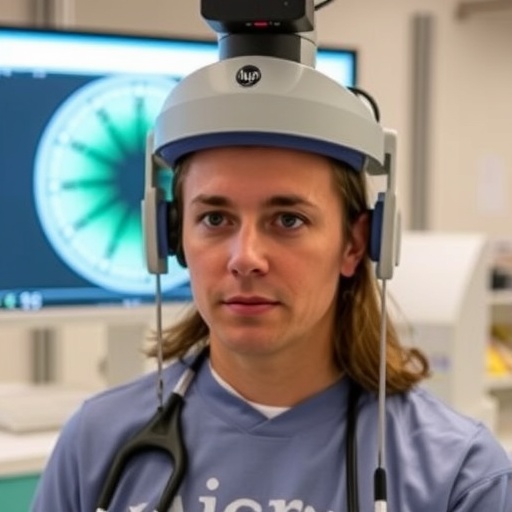
In a groundbreaking collaboration that bridges engineering precision and healthcare education, Mississippi State University at Meridian is pioneering the use of eye-tracking technology to revolutionize the training of future healthcare professionals. The initiative aims to dissect the visual attention, cognitive workload, and confidence levels of nursing students during high-stakes intrapartum and postpartum simulation-based training, promising transformative advances in clinical education and patient care.
The project, launched in 2025, harnesses sophisticated Tobii Pro 3 eye-tracking glasses to capture nuanced ocular metrics such as pupil dilation, fixation duration, and gaze pathways of participants engaged in simulated labor and delivery scenarios. By meticulously recording and analyzing these visual and cognitive indicators, researchers can elucidate the differences between novice students and experienced clinicians, thereby pinpointing critical areas where training can be optimized.
Assistant Professor Jessica Gonzalez-Vargas, from the Bagley College of Engineering’s Department of Industrial and Systems Engineering, leads the initiative, underscoring the interdisciplinary nature of this research. Her expertise integrates engineering methodologies with healthcare simulations to construct a robust framework for evaluating how healthcare practitioners visually process complex stimuli under pressure. This intricate understanding is vital for designing educational interventions that enhance clinical decision-making in real-world situations.
Senior industrial and systems engineering student Kayla Pigott is at the forefront of data collection, leveraging undergraduate research grants to execute an extensive observational study. Pigott’s role involves the real-time monitoring of eye movement patterns during dynamic simulation exercises, enabling a comprehensive appraisal of students’ cognitive engagement and procedural proficiency before advancing to clinical environments.
The quantified analysis of pupil size provides invaluable insight into cognitive workload, a key factor in understanding how stress and mental effort impact performance. Variations in fixation duration and saccadic movements reveal attentional distribution and information processing strategies, allowing educators to assess whether learners effectively focus on critical task elements or become distracted by peripheral stimuli during complex clinical procedures.
This fusion of human factors engineering and medical training is made possible by the state-of-the-art Interprofessional Simulation Center at MSU-Meridian. The center’s advanced simulation environment offers a fertile ground for precise experimental control and rich data capture, setting a new standard for healthcare education facilities in the region. Participants’ eye-tracking data can be correlated with performance metrics to establish evidence-based benchmarks for clinical competence.
Moreover, this research holds the promise of securing federal funding that would amplify the scope and impact of simulation-based training programs nationwide. By validating eye-tracking metrics as reliable indicators of readiness and decision-making efficiency, the project contributes to a broader paradigm shift towards data-driven educational models that enhance patient safety and care quality.
Clinical educators like Katherine Rigdon, an associate teaching professor of nursing, emphasize the profound pedagogical value of this technology. Eye tracking not only reveals students’ cognitive processes during critical moments but also informs targeted feedback, thereby accelerating the development of sound clinical judgment and boosting learners’ confidence as they transition into frontline healthcare roles.
The differentiation between expert and novice visual patterns elucidated by this research also offers compelling avenues for curriculum redesign. Insights gleaned can inform the development of tailored instructional strategies that cultivate the observational skills and cognitive resilience essential for managing emergent medical situations with precision and calm.
By visualizing and quantifying the way nursing students engage with simulated patient care scenarios, this innovative approach transcends traditional assessment methods that often rely heavily on subjective evaluations. Instead, it fosters an empirical understanding of the cognitive and perceptual demands of healthcare tasks, contributing to the creation of more effective, personalized training regimens.
The implications of this work extend beyond nursing education; the combined expertise of industrial engineering and healthcare simulation fosters a multidisciplinary research model with potential applications in various high-stress professional domains where visual attention and decision-making are paramount.
As this research progresses, MSU-Meridian’s Eye-Tracking Simulation Project serves as a beacon for institutions striving to merge technology and pedagogy in service of superior healthcare outcomes. The project exemplifies how universities can harness cutting-edge research to profoundly impact educational quality and, ultimately, patient lives.
For those interested in learning more about this transformative research and the educational programs facilitating its success, further information is available through the Mississippi State University Meridian School of Nursing and the Bagley College of Engineering.
Subject of Research: People
Article Title: Eye-Tracking Technology Unveils Cognitive Mechanics Behind Healthcare Training
News Publication Date: Not Provided
Web References:
– www.nursing.msstate.edu
– www.bagley.msstate.edu
– www.msstate.edu
Image Credits: Marianne Todd
Keywords
Nursing, Students, College students, Engineering, Systems engineering, Education, Education technology, Educational facilities, Research universities
Tags: clinical readiness improvement methodscognitive workload assessment in simulationsengineering and healthcare interdisciplinary researcheye-tracking technology in healthcare educationgaze pathway tracking for healthcare learnersintrapartum and postpartum simulation trainingMississippi State University Meridian healthcare innovationoptimizing clinical decision-making skillspupil dilation metrics in clinical educationsimulation-based training for nursing studentsTobii Pro 3 eye-tracking glasses applicationvisual attention analysis in medical training