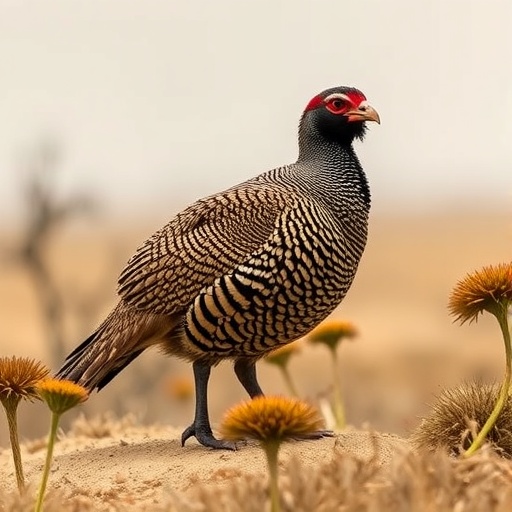
Across the Great Plains of North America, an alarming trend is emerging that threatens the delicate balance of grassland ecosystems and the unique wildlife they support. Historically expansive, these grasslands have undergone dramatic declines due to a variety of anthropogenic pressures, resulting in fragmented landscapes that struggle to maintain their ecological functions. Recently, the frequency and scale of wildfires have surged, exacerbating the vulnerability of these habitats and the species that rely on them. A groundbreaking study published in The Journal of Wildlife Management sheds new light on these dynamics, focusing on the lesser prairie-chicken, a prairie-grouse species facing steep population declines.
The study meticulously examines the habitat use patterns of lesser prairie-chickens before and immediately after a monumental wildfire event in 2017, classified as a megafire due to its unprecedented scale and intensity. This wildfire dramatically altered vast tracts of contiguous grasslands, which had historically served as prime breeding and foraging grounds for the species. Researchers observed that in the wake of the fire, these birds were compelled to vacate their optimal habitats, seeking refuge in smaller, isolated patches of grassland adjacent to cropland. These marginal landscapes offered suboptimal resources and increased exposure to environmental pressures, raising concerns about the long-term viability of the populations that relocated there.
Wildfires of the megafire category present a multifaceted threat to grassland-dependent species. Their intensity and scale can decimate large swathes of high-quality habitat in a relatively short period, leaving wildlife with limited functional refugia. However, as the researchers point out, the presence of key habitat patches—albeit in suboptimal areas—may provide critical lifelines enabling species persistence in altered landscapes. This finding underscores the importance of conserving these residual patches as strategic conservation priorities, particularly in regions where larger tracts are increasingly rare due to fragmentation and land-use changes.
Traditionally, discourse around megafires in the United States has centered on forested ecosystems, overshadowing the rising prevalence and ecological impact of such fires in grassland environments. The Great Plains experienced yet another record wildfire year in 2026, illuminating the urgency of reevaluating fire management and conservation strategies tailored specifically to grassland systems. Nicholas Parker, the study’s corresponding author and a PhD candidate at Colorado State University, emphasizes that understanding the ecological consequences of these fires on grassland wildlife is essential for developing informed management practices that can mitigate long-term biodiversity losses.
The study employed rigorous field surveys and spatial analysis tools to quantify changes in habitat use by lesser prairie-chickens across a gradient of burned and unburned areas. Before the megafire, the species primarily occupied large, contiguous native grasslands that provided abundant food resources, shelter, and breeding sites. Post-fire, the displacement patterns revealed a clear shift towards smaller, more fragmented grasslands typically interspersed with agricultural plots. This shift not only reflects immediate responses to habitat loss but also suggests potential behavioral and ecological stressors that could impair reproductive success and survival.
From an ecological standpoint, the displacement into suboptimal habitats likely increases the risk of predation, reduces forage availability, and disrupts social behaviors vital to the species’ mating systems. Lesser prairie-chickens are known for their lek mating displays, which depend on relatively open and contiguous grasslands. Fragmentation compromises these display sites and may inhibit effective mate selection, potentially weakening genetic diversity within populations. The study’s findings highlight these nuanced ecological consequences and call for conservation initiatives that prioritize connectivity and habitat quality restoration.
Importantly, the research also illustrates that not all habitat patches are equal in their conservation value. Patches located near cropland may face additional pressures such as pesticide exposure, increased human disturbance, and altered microclimates, further challenging the species’ adaptation. Hence, conservation efforts must adopt a multifaceted approach that incorporates habitat patch quality, size, spatial configuration, and landscape context to enhance resilience against future megafire events.
By shedding light on these complexities, the study contributes to a growing body of evidence that grassland conservation cannot rely solely on large habitat reserves but must also embrace strategies involving smaller, strategically managed patches. This paradigm shift is particularly critical as climate models predict increasing frequency and severity of wildfires in the Great Plains and other grassland regions globally. Adaptive management approaches that integrate fire ecology, landscape connectivity, and species-specific habitat requirements will be essential to sustaining grassland biodiversity in the face of mounting environmental challenges.
Moreover, the methodology utilized in this research serves as a model for interdisciplinary collaboration, combining wildlife biology, landscape ecology, and fire science. Such integrative approaches are pivotal in unraveling the cause-effect relationships linking megafires, habitat alterations, and wildlife responses. The study underscores the value of long-term monitoring and rapid post-disturbance assessments to capture temporal habitat dynamics and inform proactive conservation responses.
This research also has implications beyond the immediate focal species. Grasslands support a diverse array of flora and fauna, many of which have specialized adaptations to this ecosystem. The cascading effects of megafire-induced habitat shifts may ripple across trophic levels, altering predator-prey dynamics, plant community compositions, and nutrient cycling. By focusing on the lesser prairie-chicken as an indicator species, the study indirectly highlights broader ecosystem vulnerabilities warranting comprehensive management interventions.
In the broader context of conservation science, the findings align with global initiatives emphasizing the resilience of natural systems to increasingly frequent environmental disturbances. They advocate for landscape-scale conservation planning that anticipates and mitigates the impacts of megafires and other climate-driven phenomena. The case of the lesser prairie-chicken is a poignant example of how species-specific studies can inform larger frameworks aimed at sustaining biodiversity under rapidly changing conditions.
Finally, this study serves as a call to action for wildlife managers, policymakers, and researchers. Mitigation of megafire impacts on grassland ecosystems demands concerted efforts—including habitat preservation, fire management innovation, and sustainable land-use practices. Collaborative frameworks that embrace ecological research findings such as those presented here will be crucial to safeguarding the future of grassland biomes and the unique species they harbor in an era marked by unprecedented environmental change.
Subject of Research: Habitat use and displacement of lesser prairie-chickens following a megafire in the Great Plains.
Article Title: Megafire forces a declining prairie grouse into more marginal landscapes providing fine-scale habitat.
News Publication Date: 6-May-2026.
Web References:
– The Journal of Wildlife Management: https://wildlife.onlinelibrary.wiley.com/journal/19372817
– DOI Link: http://dx.doi.org/10.1002/jwmg.70205
Keywords: Grasslands, Lesser prairie-chicken, Megafire, Wildlife management, Habitat fragmentation, Conservation ecology, Fire ecology, Prairie-grouse, Great Plains, Habitat displacement, Grassland wildlife, Natural resource recovery.
Tags: anthropogenic pressures on prairiesgrassland habitat degradationgrassland wildlife conservationGreat Plains grassland fragmentationlesser prairie-chicken habitat lossmegafire ecological consequencesmegafires impact on prairie grousepost-wildfire habitat shiftsprairie grouse breeding habitatprairie grouse population declinewildfire effects on grassland ecosystemswildlife management in fire-affected areas