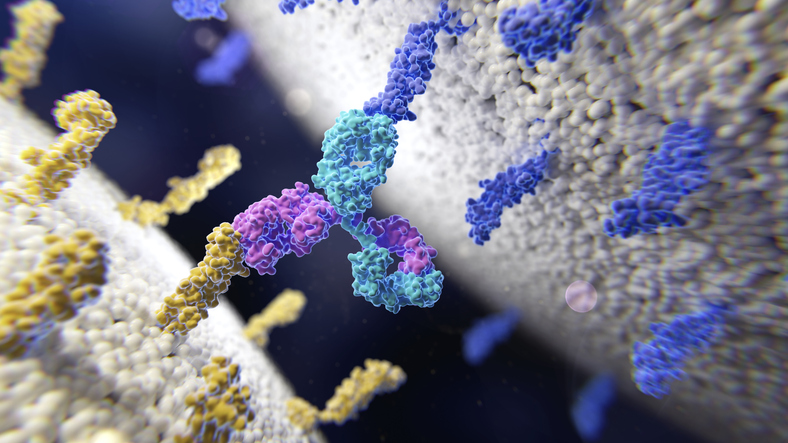
Bispecific antibodies (BsAb) were first approved in 2014. Since then, a total of 19 have been approved globally, and approximately 250 BsAbs are being developed by some 180 companies, according to a report from Research and Markets. As this therapeutic class moves out of the lab and into clinical and commercial sectors, manufacturing may be its biggest challenge.
These dual-targeting compounds are considered difficult to produce, especially at scale. With low yields, potential chain mispairing, stability and aggregation issues, and analytical characterization challenges, biomanufacturers are eager to find expedient solutions. “There is still significant work to be done in bioprocess engineering to substantially improve the efficiency of bispecific antibody design and manufacturing,” Laura A. Palomares, PhD, senior researcher, Universidad Nacional Autónoma de Mexico (UNAM), tells GEN.
To that point, rather than relying upon transient expression systems or evaluating various antibody sequences, Palomares and her team are identifying manufacturable BsAbs by correlating their architectures to growth, productivity, downstream recovery, production of product-related variants, and in vitro binding to Zika virus and transferrin receptor (TfR). They found BsAb architecture is crucial in terms of those manufacturing criteria.
Structure governs performance
Specifically, as much as a 70% difference in productivity was found between symmetric heavy-chain scFv fusion BsAbs—which performed like the parental antibody—and BsAbs that were designed as light-chain scFv fusion, dual-variable domain immunoglobulin (DVD), or asymmetric antibodies. That’s according to a recent study by Palomares, doctoral student Juan Carlos Rivera-Castro, and senior researcher Octavio T. Ramirez, PhD.
Asymmetric BsAbs had the worst culture performance and productivity of the BsAb architectures tested. Asymmetry created imbalanced chain expression and formed homodimeric and half-antibody by-products, they reported, which dropped purity to approximately 68% after protein A purification. They found that binding to the LC-scFV diminished the binding to Zika virus, and that DVD increases it. Also, binding to TfR varied according to BsAb valency and configuration.
In contrast, “Bivalent heavy-chain scFV formats show[ed] stronger apparent binding than monovalent formats,” they report.
For the best manufacturability, the team says, “Avoid the modification of the light chain and preserve symmetric assembly.” This strategy resulted in higher cell viability, productivity, and final purity.
“The construction and head-to-head comparison of various formats, including the effect of the formats on antigen binding, can guide those planning the design and production of BsAbs,” Palomares says, by understanding the relative tradeoffs of various architectures as they design and clone BsAbs for specific functionalities.
“Format selection should prioritize manufacturability, with complex designs reserved for cases with particular functional requirements,” the scientists conclude.
Next steps, Palomares says, are to “determine the in vivo functionality of the constructed formats to neutralize Zika virus after traversing the blood-brain barrier. The results of those experiments will also be useful to scientists interested in BsAb design.”