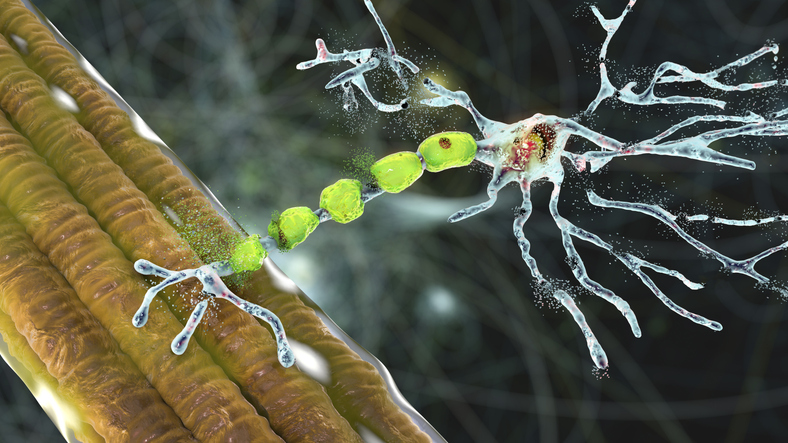

A new study from scientists at Northwestern University Feinberg School of Medicine sheds light on how amyotrophic lateral sclerosis (ALS) unfolds in the body. Specifically, they found that the disease proceeds through a “domino-like” sequence of events that begins with an early breakdown inside motor neurons that is followed by a damaging inflammatory response. Insights from this study could help explain why the disease worsens over time, why some patients progress faster than others, and how future treatments could be more personalized. Details of the work are available in a new Nature Neuroscience paper titled “Integrated single-cell and spatial transcriptomic profiling in ALS uncovers peripheral-to-central immune infiltration and reprogramming.”
On average, patients with ALS live three years after symptoms begin, although some can survive closer to 10 years. Exactly what drives these differences in survival is unclear. “This study reveals that ALS is not a single event but a domino-like cascade that begins inside motor neurons with TDP-43 pathology and is then amplified by a damaging immune response in the bloodstream and spinal cord,” said David Gate, PhD, director of the Abrams Research Center on Neurogenomics at Feinberg and co-corresponding author on the study.
Specifically, the study found that immune cells converge at sites of motor neuron loss and TDP-43 pathology with distinct inflammatory patterns depending on the type of ALS and how quickly the disease progresses. As Evangelos Kiskinis, PhD, an associate professor of neurology and neuroscience at Feinberg and a co-corresponding author on the study, explained it, “the intensity of spinal cord inflammation” determines “how fast the disease progresses and how long they survive.”
To gain these insights, the scientists analyzed blood and spinal cord samples from living and deceased patients with both genetic and non-genetic forms of ALS, as well as controls. As part of the study, they used single-cell RNA sequencing technology to analyze blood from 40 living ALS patients and used spatial transcriptomics to analyze spinal cord tissue from 18 deceased participants. They also compared patients with non-genetic ALS to those with the genetic form of the disease to assess how immune activity differs across ALS types and disease stages. Lastly, they examined RNA from postmortem samples of 237 ALS patients to better understand the inflammatory responses within the central nervous system.
Using these methods, “we found the immune cells we detected in the blood of people living with ALS were inflamed, and we found the genes that mediate their inflammatory response in the spinal cord at the site of motor neurons,” Gate said. “These inflamed immune cells were associated with ALS pathology, giving some credence to our theory that the immune system is detrimental. It’s responding to pathology, and it’s causing the disease to be worse.”
Additionally, patients whose disease advanced quickly had more activity in certain immune genes, while those with the genetic form of the disease had a different set of altered immune genes. In the spinal cord, these activated immune cells gathered directly at the locations of motor neuron loss and near the toxic protein buildups associated with ALS. “We saw that people with worse clinical ALS had more expression of complement genes, which are proteins that become activated as the body’s first-line immune defense against a pathogen or damage to the body,” Gate said.
Now that they have identified a direct link between the immune system and ALS, Gate and his lab plan to study samples from a wider pool of patients. “Our next step is to map exactly how this immune reaction spreads throughout the entire motor circuit: from the brain, down through the spinal cord and out to the muscles,” he said. “By profiling the motor circuit in depth, we’ll get a much clearer picture of where and when inflammation drives faster progression.”
Meanwhile, Kiskinis and his team will test for a causal relationship between TDP-43 dysfunction and inflammation. “We’re trying to really define what is the mechanism that links TDP-43 dysfunction in nerve cells with inflammatory reactions,” he said.