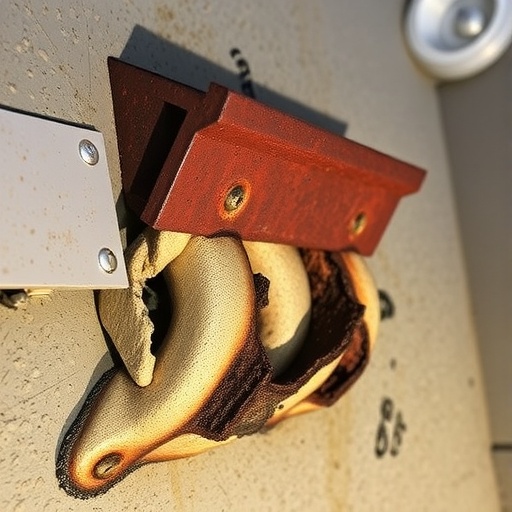
In a groundbreaking study poised to transform the field of pipeline integrity and infrastructure safety, researchers have delved into the complex dynamics governing the failure mechanisms of buried cast iron pipelines. These crucial conduits, often overlooked yet vital to urban and industrial frameworks, face a formidable threat from the interplay of corrosion and explosive forces. The latest scientific inquiry elucidates the nuanced ways in which these dual stresses coalesce to compromise structural stability, advancing our understanding of damage evolution in subterranean pipeline systems.
The study employs a multifaceted approach, integrating experimental observations with sophisticated numerical simulations to capture the progressive degradation of cast iron pipelines under coupled corrosion and blast loading. Cast iron, historically favored for its durability and ease of manufacture, paradoxically exhibits susceptibility to brittle fracture and material embrittlement when exposed to corrosive environments over prolonged periods. This intrinsic vulnerability is exacerbated by sudden shock waves generated by underground blasts—whether accidental or deliberate—which interact synergistically with existing corrosion damage, precipitating catastrophic failures.
Central to the research is the investigation of corrosion-blast coupling effects, a phenomenon where the mechanical impact of blast waves accelerates the deterioration initiated by electrochemical corrosion processes. Corrosion gradually reduces the effective thickness and mechanical properties of the pipeline walls, fostering micro-cracks and pits that serve as stress concentrators. Upon exposure to a blast, the compromised zones exhibit preferential failure, with damage propagating rapidly along weakened paths. This coupling effect fosters a non-linear progression of damage that defies traditional predictive models relying solely on independent corrosion or mechanical loading parameters.
The researchers have meticulously reconstructed the damage evolution trajectory, mapping out the initiation, propagation, and ultimate rupture of pipeline segments. Their findings demonstrate that prior corrosion states critically influence the severity and pattern of blast-induced fractures. Pre-existing pits and cracks act as nucleation sites, from which crack growth under dynamic loading accelerates significantly. Moreover, time-dependent corrosion kinetics modulate the material’s mechanical threshold, thereby dictating the blast resistance capacity of the pipeline. This dynamic interplay underscores the necessity of considering combined hazard scenarios in pipeline integrity management.
Advanced diagnostic techniques, including high-resolution imaging and acoustic emission monitoring, revealed intricate microstructural transformations within the cast iron matrix. Corrosion alters the microstructural homogeneity, promoting phase changes and carbide precipitations that embrittle the material. Under blast-induced strain rates, these microstructural evolutions exacerbate crack coalescence and propagation speeds. Consequently, the temporal window for damage detection and preventive maintenance narrows, raising urgent concerns for infrastructure resilience.
Numerical simulations utilizing finite element modeling (FEM) frameworks further shed light on stress distribution patterns and failure mechanisms. By simulating blast-wave interactions with corroded pipe geometries, the team identified critical stress intensifications around corrosion pits and wall thinning zones. These localized stresses surpassed the material yield and fracture thresholds far earlier than in pristine conditions. The simulations emphatically suggest that standard design codes, which assume uniform material properties and disregard corrosive degradation, may substantially underestimate the risk of sudden rupture under explosive loading.
The implications of these findings are profound for urban safety and resource management. Buried pipelines are indispensable for water supply, gas transportation, and sewage management, and their sudden failure can lead to severe public health hazards, economic losses, and environmental disasters. Understanding the synergistic effects of corrosion and blast events equips engineers and policymakers with robust frameworks to assess risk more realistically and design targeted inspection and remediation strategies.
Preventive strategies deriving from this study emphasize the early detection and mitigation of corrosion to retain the structural integrity of pipelines. The research advocates for the integration of corrosion monitoring systems with blast detection and response protocols to timely identify vulnerable segments. These systems, coupled with predictive maintenance leveraging real-time data analytics, could revolutionize pipeline management, reducing unplanned outages and enhancing safety margins.
Furthermore, the research opens avenues for developing novel materials and protective coatings tailored to withstand the combined assaults of chemical degradation and dynamic shock loading. Innovations in metallurgy and nanotechnology could yield cast iron composites or alloys with enhanced resistance to microstructural embrittlement and improved toughness, ultimately extending service life even in hostile environments. Coupled with smart asset management, such materials could redefine standards in underground pipeline infrastructure.
The study also emphasizes the environmental considerations associated with pipeline failure. Release of hazardous substances due to structural breaches can contaminate soil and groundwater resources, posing long-term ecological risks. By elucidating the mechanistic pathways of damage, the research informs better containment and risk mitigation practices that protect surrounding ecosystems while maintaining essential service continuity.
In context, this investigation emerges at a critical juncture where aging infrastructure and increasing urbanization demand resilient engineering solutions. The convergence of corrosion and blast hazards represents a pressing challenge, especially in regions prone to industrial accidents or sabotage. By decoding the intricate damage evolution mechanisms at play, the researchers provide a scientific foundation for future regulatory frameworks and engineering guidelines tailored to modern infrastructure risks.
In sum, this pioneering research substantially advances the understanding of how buried cast iron pipelines deteriorate under the simultaneous pressures of corrosion and explosive forces. Through a seamless blend of experimental validation and computational analysis, it delivers a paradigm-shifting perspective on damage evolution, challenging conventional assumptions and fostering innovation in pipeline safety. The insights garnered hold the promise of safer, more reliable urban utilities and a model for interdisciplinary collaboration in tackling complex engineering problems.
As cities worldwide wrestle with the challenges posed by aging infrastructure, this research stands as a beacon of progress, illuminating paths toward more durable and responsive pipeline systems. The fusion of material science, mechanical engineering, and environmental considerations encapsulated in this work embodies the future of infrastructure resilience. It underscores the imperative of proactive, science-driven approaches to safeguarding the lifelines that sustain modern society.
Subject of Research: Dynamic damage mechanisms in buried cast iron pipelines under combined corrosion and blast stress conditions.
Article Title: Dynamic damage evolution mechanism of buried cast iron pipeline under corrosion-blast coupling effects.
Article References:
Yuqing, X., Nan, J., Yingkang, Y. et al. Dynamic damage evolution mechanism of buried cast iron pipeline under corrosion-blast coupling effects. Sci Rep (2026). https://doi.org/10.1038/s41598-026-54155-2
Image Credits: AI Generated
Tags: blast loading effects on pipeline integrityburied cast iron pipeline failure mechanismscombined corrosion and blast damagecorrosion impact on buried cast iron pipelinescorrosion-blast coupling effects on cast ironcorrosion-induced brittle fracture in cast ironelectrochemical corrosion in buried pipelinesexperimental analysis of pipeline damageinfrastructure safety in buried pipelinesnumerical simulation of pipeline degradationpipeline structural stability under dual stressesunderground pipeline catastrophic failure