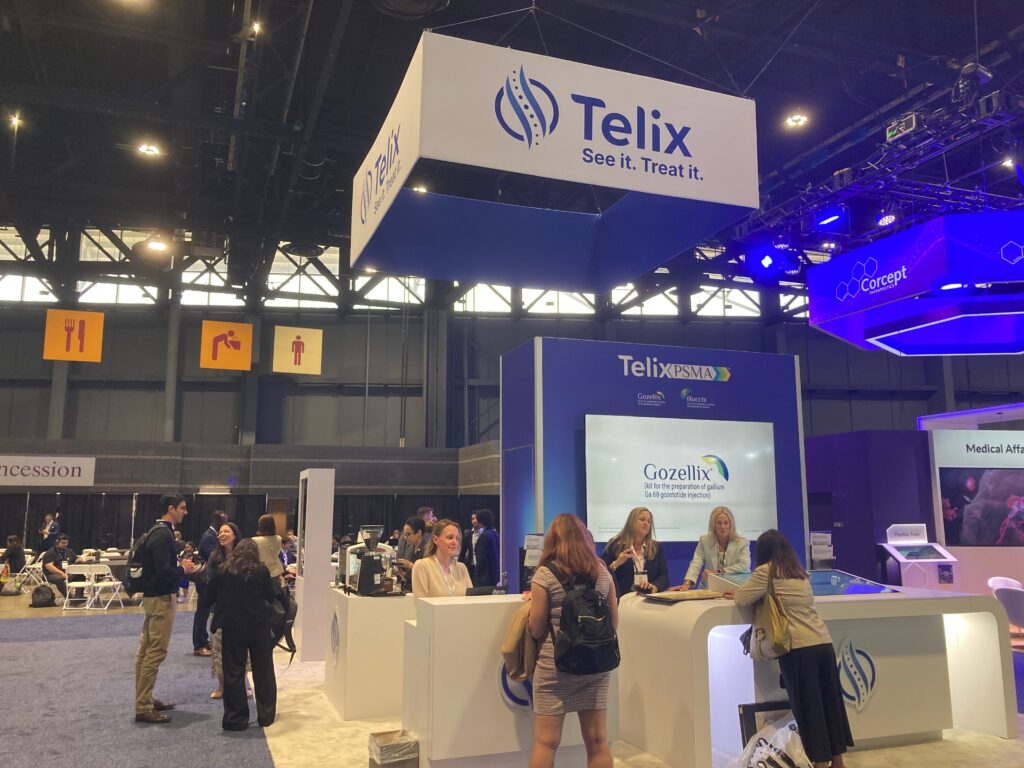
David Cade, the chief medical officer of Melbourne-based Telix Pharmaceuticals, traveled a long way to the American Society of Clinical Oncology meeting in Chicago with a singular goal in mind: spread the word about Telix’s pivotal trial for a potential challenger to Novartis’ Pluvicto.
The radiopharmaceutical outfit today presented data from the first part of the phase 3 ProstACT trial, which focused on safety and measuring the radiation delivered by the antibody-drug conjugate TLX591 in patients with metastatic castration-resistant prostate cancer. Part two, which focuses on efficacy, has been allowed to proceed by a number of countries but not yet by the FDA.
Overall, the results show no new safety signals and support moving ahead with the next part of the trial, according to Telix’s presentation.
“We want to execute that trial as quickly as possible,” Cade told Fierce at ASCO. Telix is meeting with the FDA “in the next month or so,” he said, to get the go-ahead to start the trial’s next phase in the U.S.
The patients in ProstACT have all been previously treated with other therapies, and during the trial, investigators are free to choose which therapy to pair with TLX591—either Astellas and Pfizer’s Xtandi, Sanofi’s Taxotere or abiraterone. This design is meant to be “pragmatic,” Cade said, allowing physicians to choose a combination based on their country’s guidelines and local practice.
Like Novartis’ blockbuster Pluvicto, TLX591 uses an isotope of lutetium to douse cancer in destructive radiation. But while Pluvicto uses a small molecule to shepherd the lutetium to its target, TLX591 takes an antibody approach. This should enable just two doses to be given, fewer than Pluvicto’s up to six, and grant the therapy a gentler safety profile, Cade outlined to Fierce.
“That impact on quality of life is very low with an antibody compared to a small molecule,” the Telix exec said. Because of that edge, TLX591 should be highly competitive if it posts similar survival measures as Pluvicto in part two of its trial, he added.
Telix should have the first data from part two by the end of this year or early 2027, Cade said, and if TLX591 ultimately scores an FDA nod, it will be the first approved therapeutic for the Australian company. Telix currently boasts two approved imaging agents.
The rest of Telix’s pipeline isn’t far behind. The biotech is also running two other phase 3 trials, one for another lutetium-binding antibody called TLX250 in relapsed or recurrent clear cell renal cell carcinoma and another for the glioblastoma candidate TLX101. TLX101 uses a small molecule to shuttle a radioactive isotope of iodine into the brain.
“We haven’t had a new agent in glioblastoma meaningfully for about 20 years,” Cade said. “It’s not a drug development graveyard like Alzheimer’s—it’s been a drug development desert.”
Should these three medicines be approved, Telix hasn’t committed to commercializing them alone—all options remain on the table, Cade told Fierce.
The radiopharma also feels that its pipeline leaves a lot of “white space on the canvas,” he added, a swath of possible cancer targets that would be impossible for the biotech to tackle alone. This is what prompted a recent partnership with Regeneron, potentially worth as much as $2.1 billion.
Telix found Regeneron’s noted antibody expertise appealing, and will now take charge of chemically linking the New York pharma’s molecules to radioactive isotopes.
From there, the pair plan to work together to push the molecules through the clinic and commercialize them, Cade said, though Telix can also opt out and let Regeneron take the wheel for a smaller payout. The deal centers on four solid tumor programs, with lung cancer likely to be first up.
After abandoning plans for a Nasdaq IPO back in 2024, Telix made a concerted effort to bolster its radiopharma prowess, inking a $13.6 million acquisition of Texas-based CDMO IsoTherapeutics and an $82 million purchase of ARTMS and its cyclotron-based isotope production platform.
Now, with the Regeneron team-up, Telix is looking to spread its wings and fly into new frontiers.
“Only neuroendocrine and prostate cancers have been attacked by radioligand therapy,” Cade explained. The Regeneron deal, he said, “really enables us to rapidly go beyond that.”