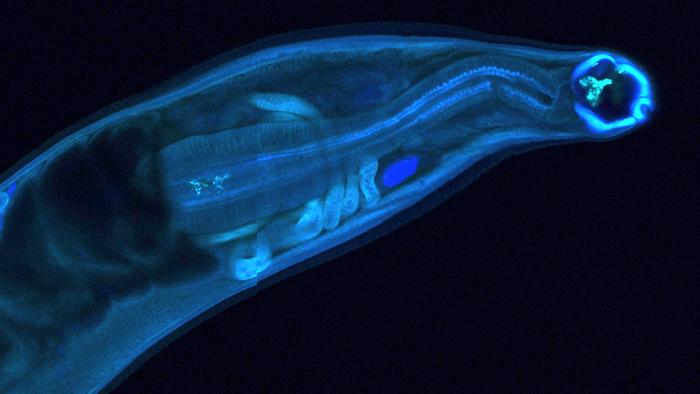
![WashU Medicine researchers genetically modified hookworms to produce and deliver a therapeutic antibody inside a host, a proof-of-concept that could lead to long-lasting treatments for chronic disease or exposure to toxins in remote settings. [Courtesy of Makedonka Mitreva]](https://www.genengnews.com/wp-content/uploads/2026/06/Low-Res_hookworm-featured-image.jpg "Low-Res_hookworm featured image")
Hookworms, intestinal parasites that infect hundreds of millions of people in under-resourced tropical regions around the globe, have evolved to survive inside the human gut for years, secreting molecules that enable co-existence with their hosts. Now, researchers at Washington University School of Medicine in St. Louis have harnessed that biological mechanism for potential human benefit, engineering a human hookworm parasite, Ancylostoma ceylanicum, to produce and deliver a drug within a living host.
Headed by Makedonka Mitreva, PhD, the Gordon R. Miller Professor in the John T. Milliken Department of Medicine’s Division of Infectious Diseases at WashU Medicine, the investigators report what they say is the first successful genetic modification of the human hookworm, which they engineered to produce an antibody that neutralizes tetrodotoxin (TTX), a deadly neurotoxin produced by pufferfish and other marine animals. The team’s preclinical study demonstrated that the modified hookworms colonized an animal host, and secreted the antitoxin into the host bloodstream, partially inactivating the toxin. They say the findings demonstrate that this drug production and delivery approach could potentially offer a long-term solution for multiple indications, including continuous treatment for chronic conditions, or for exposure to toxins in remote settings.
“The hookworm has spent millions of years perfecting how to assure long-term survival inside a human host and how to get molecules out of its body and into ours,” said Mitreva. “We asked: What if we could add one more molecule to the roughly 1,000 things the worm already secretes, something therapeutically useful to people? This study shows that’s not just a concept. It works.”
Mitreva and colleagues reported on their study in Nature Communications, in a paper titled “Transgenic hookworm secretes anti-tetrodotoxin human single chain antibody.” In their paper the team concluded that their achievement, “… represents a critical step towards the development of a transgenic human hookworm pharmaceutical biofactory platform with the potential to continuously, safely, and effectively deliver biologics in situ within patients.”
“Hookworms have evolved to survive for years within the human host while minimally disrupting host homeostasis, and controlled human infections with hookworms are safe and well-tolerated in clinical settings, bolstering their potential for utility as pharmaceutical biofactories,” the authors wrote.
Hookworms have already been studied as treatments for inflammatory bowel diseases such as ulcerative colitis, based on evidence that the anti-inflammatory molecules the worms secrete can dampen the immune responses that drive those conditions. Mitreva’s team set out to build on that foundation by engineering the worm to secrete a therapeutic of the researchers’ choosing, rather than relying solely on what the parasite produces naturally.
The appeal of hookworms as a long-term drug production and delivery platform stems from a quirk of their biology. When a person is infected with a controlled number of hookworm larvae, which can be administered orally as a pill or through the skin like a lotion, the worms migrate to the small intestine and take up residence, often for years. Because they cannot multiply inside the host, the number of worms stays fixed, and the infection remains controlled. If the infection ever needs to be cleared, a single dose of an oral anti-parasitic drug eliminates the hookworms within 24 hours.
To adapt hookworms for therapeutic use, Mitreva and her team drew on more than two decades of hookworm genomics research conducted at WashU Medicine. This depth of data helped them understand the organism’s biology from the cellular to the genetic level, allowing them to locate a viable site in the genome to insert the new gene carrying instructions for making the new antitoxin. The antibody selected for the team’s reported proof-of-concept study neutralizes tetrodotoxin, a paralyzing and potentially lethal toxin with no antidote.
The project presented significant technical hurdles: gene-editing tools that work in other organisms had not been adapted for hookworms, and no one had previously achieved stable genetic modification in the species. Critically, they had to ensure the insertion wouldn’t disrupt surrounding gene activity and would prompt the worm to secrete the antitoxin out into the host.
The team reported that blood collected from hamsters infected with the genetically modified hookworms partially neutralized tetrodotoxin, whereas blood from animals infected with unmodified worms had no neutralizing capability. Mitreva noted that the level of neutralization achieved in this initial study, while significant, likely represents only a fraction of what the platform can ultimately deliver. They wrote in summary “Here, we report on methodological, technical, and conceptual advances, demonstrating successful bioengineering of a human hookworm, Ancylostoma ceylanicum, to produce and secrete a human single-chain antibody, s16-HuScFv, that neutralizes tetrodotoxin (TTX).”
Several components of what she calls a “configurable chassis” are still being optimized to increase the amount of therapeutic protein produced and secreted. Because the worm resides in the gut and a substantial portion of what it secretes remains there, rather than entering the bloodstream, the researchers expect that concentrations of therapeutic molecules in the intestine may be substantially higher than what was detected in circulation in this study, making the platform suitable for gut-directed therapies.
In their paper the team wrote, “Building on the foundation that experimental human hookworm infection has been shown to be safe and well tolerated, here we present technological, methodological, and conceptual advances that have enabled the establishment of a genetically modified and tractable model system that can produce and deliver biologics … Taken together, this transgenic human hookworm platform highlights a promising approach in biotechnology that has the potential to significantly advance how we conceptualize disease treatment and prevention. Technologically, it also constitutes a notable advance in functional genomics for hookworms and helminths more broadly.”
Mitreva added, “What we demonstrated here is that the concept works end to end—you can insert a gene, the worm produces the protein, the protein gets out of the worm, and it is functionally active in the host. From that starting point, we can optimize the platform and think carefully about which diseases stand to benefit most from a delivery system that is continuous, targeted and long-lasting. That’s a fundamentally different kind of pharmaceutical biofactory platform, and we think it opens possibilities that are very hard to achieve with any other platform.”
Gut inflammatory diseases, including Crohn’s disease and ulcerative colitis, and food allergies are among the conditions Mitreva sees as strong candidates for future development. Diseases requiring small but sustained therapeutic concentrations, where compliance with repeated injections or infusions is a barrier, may also be well-suited to the platform. “Given the availability of controlled human infections, our disease-agnostic bioengineered hookworm platform offers a next-generation approach to address a suite of chronic human diseases, and with a single-dose administration, could potentially produce and deliver biologic medicines within the human host for years,” the authors wrote.
Although natural hookworm infection may cause only mild digestive symptoms in healthy adults, chronic infection with large numbers of hookworms can be dangerous for children, pregnant people and malnourished or otherwise vulnerable individuals. Infection can lead to anemia, poor growth and development, pregnancy complications and, in extreme untreated cases, heart problems or death.
This underscores the importance of keeping the infection strictly controlled for therapeutic use, Mitreva noted, which is possible because of the worms’ inability to reproduce without spending part of their life cycle in soil. “… as research progresses, it will be essential to ensure that these transgenic organisms do not have unintended ecological or human health impacts, maintaining a balance between innovation and safety,” the authors stated.
Mitreva noted that biocontainment strategies, such as engineering the worms to be unable to produce eggs, are under consideration to protect hosts and their environments as the platform advances. “Future studies can also address biocontainment of the genetically modified organism (GMO) by engineering suicide genes and/or inducible promoters into the transgene,” the team suggested.