The race to commercialize cell therapies is forcing bioprocessing innovators to confront one of the field’s most persistent manufacturing bottlenecks: isolating fragile hematopoietic stem cells (HSCs) without compromising their therapeutic potential. “HSCs are extremely rare and extremely delicate,” says Sophie He, PhD, vice president of cell therapy and head of mergers and acquisitions at Bracco. “Trying to isolate HSCs while preserving their therapeutic function is extremely difficult.”
The challenge begins with biology itself. CD34+ hematopoietic stem and progenitor cells typically account for just one to three percent of mobilized apheresis collections and one to four percent of bone marrow populations, while the most primitive long-term HSCs can represent less than one-tenth of a percent of total marrow cells. That rarity means every processing step matters.
For manufacturers scaling autologous and allogeneic therapies, the result is a difficult balancing act between purity and yield. Conventional enrichment workflows often sacrifice one to achieve the other. “To get higher purity, traditionally one gets lower yield,” He explains. “Every wash or transfer step in the isolation process results in cell loss.” The problem is magnified by the fact that HSCs rely on preserving self-renewal, multipotency, and engraftment capability—functions that can easily be disrupted during processing, ultimately reducing clinical effectiveness.
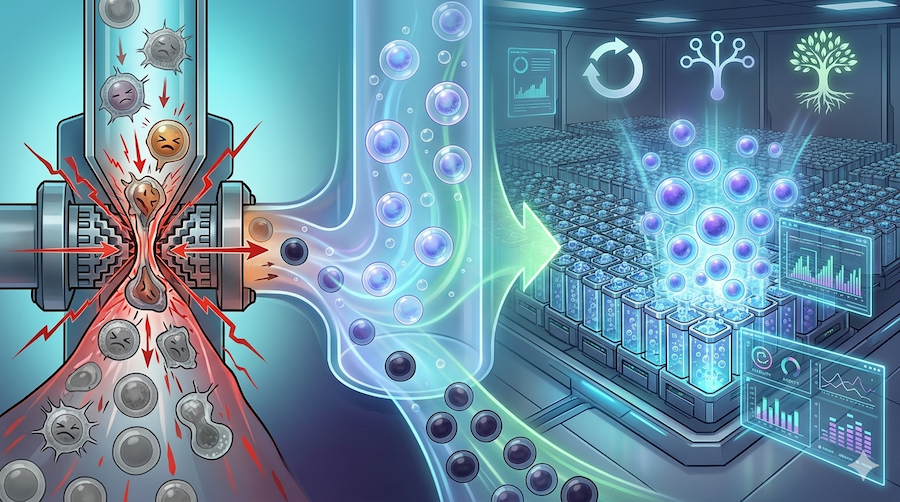
As developers move toward commercial-scale manufacturing, traditional magnetic separation systems are facing growing scrutiny. According to He, magnetic columns can expose HSCs to damaging shear forces, compression, and membrane stress because of their fragile membranes and cytoskeletons. Processing times can also become a major operational burden. “Magnetic columns can require more than 10 hours to completely process larger mobilized apheresis starting material,” she says. “That could lead to apoptosis and metabolic stress.” The lengthy workflows create additional challenges for scalability and reproducibility across manufacturing sites, particularly as companies transition from small clinical batches to commercial production runs.
Newer approaches are gaining attention for their ability to handle cells more gently while supporting larger-scale workflows. Among them, microbubble-based separation uses buoyancy rather than magnetic force to isolate HSCs. He says the technology reduces mechanical stress on cells while also minimizing concerns about residual materials left behind during processing. The broader industry goal, however, extends beyond replacing one technology with another. Developers are searching for a platform simultaneously capable of delivering high purity, high yield, preserved cell functionality, and proven scalability.
He describes the search for an ideal HSC isolation platform as “the holy grail” for cell-therapy bioprocessing at a commercial scale. In addition to biological performance, future systems must reduce operator dependency, integrate efficiently into manufacturing workflows, and support reproducibility across donors, sites, and operators. Regulatory clarity will also be essential before any technology can achieve widespread adoption. As regenerative medicine advances toward broader commercialization, the ability to isolate healthy stem cells consistently and at scale might determine which therapies successfully transition from experimental promise to industrial reality.