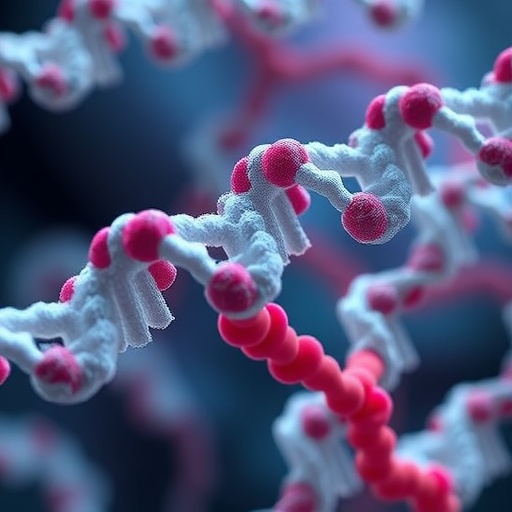
A groundbreaking study from the University of Tokyo has unveiled striking insights into the evolutionary dynamics of self-replicating RNA molecules, shedding light on the possible environmental conditions that could have influenced the dawn of life on Earth. This research demonstrates that the fate of primitive replicating systems, whether thriving toward complexity or succumbing to extinction, is profoundly shaped by the frequency of molecular mixing within their environment.
Life’s origins trace back to an era dominated by simple molecular systems, primarily RNA and proteins, long before the intricate cellular machinery we observe today. Understanding how these primordial molecules evolved from rudimentary replicators into complex living systems remains one of science’s most tantalizing puzzles. To probe this question, researchers employ experimental evolution—artificially accelerating molecular mutation and replication processes to simulate possible prehistoric scenarios of molecular evolution.
Professor Norikazu Ichihashi and his team have previously pioneered evolutionary experiments involving RNA molecules capable of self-replication mediated by proteins they encode themselves. A pivotal discovery in these prior studies was the spontaneous emergence of parasitic RNA species — sequences lacking protein-coding capacity yet exploiting host replication machinery for their amplification. The interplay between parasitic and host RNAs drove diversification, suggesting that the conflict between replicators may have been a key driver in evolving molecular complexity.
This newly published study pivots by utilizing an automated flow reactor system to examine how variations in environmental mixing affect the evolutionary trajectory of these self-replicating RNAs. While former experiments facilitated stable diversification and sustained replication across more than 240 generations, the flow reactor induced a surprisingly divergent outcome: a precipitous loss of RNA diversity culminating frequently in molecular extinction.
Central to these results is the concept of compartmentalization — the physical segregation of replication reactions within microscopic droplets suspended in oil. This spatial structure is crucial because it provides refuge for host RNAs amid parasitic pressure, enabling survival by dispersing molecules upon droplet fusion and division events. Both experimental setups maintained this compartmentalized architecture; however, the distinction lay in the mixing regimen.
In previous manual experiments, the researchers periodically transferred 20% of the reaction volume to fresh media every five hours, ensuring relatively infrequent mixing. Conversely, the automated flow reactor continuously circulated and gently stirred the components, generating substantially more frequent and thorough mixing of RNA molecules between compartments.
The study elucidates that this difference in mixing frequency critically influences host-parasite dynamics. Well-mixed conditions facilitate parasitic dominance and inhibit host RNA replication, causing the overall RNA concentration to plummet. This reduction in population density enhances the role of genetic drift, allowing deleterious mutations to accumulate unchecked. Such mutational load further debilitates the replication vigor of host RNAs, accelerating decline toward extinction rather than diversity.
These findings implicate that the microenvironment surrounding primitive replicators—especially the degree of isolation versus mixing—may have been decisive in steering molecular evolution either toward complexity and life or toward barren extinction. The results underscore a delicate balance: while some host-parasite interplay fosters evolutionary innovation, excessive mixing that disrupts compartmental refuges can doom replicating systems.
Beyond revealing fundamental evolutionary principles, this research opens new investigative avenues for origin-of-life studies. It suggests that early Earth niches promoting moderate compartmentalization and controlled molecular exchange might have been crucial for the persistence and diversification of proto-life forms. This insight also informs synthetic biology efforts aiming to engineer self-replicating molecular systems for biotechnological applications.
Moreover, the study highlights the role of genetic drift in small molecular populations, paralleling forces that shape biodiversity in macro-organisms. The interplay between selection, mutation accumulation, and spatial structure emerges as a universal theme governing biological evolution from the molecular to the ecosystem scale.
In addition to the scientific import, these experiments innovate methodologically by integrating automated flow systems with precise compartmentalization, bringing unprecedented control over replication environments. Such technological advances will empower researchers to systematically dissect parameters influencing molecular replication fidelity, diversity, and evolutionary trajectories.
Ultimately, the University of Tokyo team’s work provides compelling evidence that the environmental architecture surrounding replicators can profoundly influence their survival and evolutionary potential. This paradigm-shifting perspective enriches our understanding of how life could have emerged from chemical beginnings and underlines the complex interplay between ecological context and evolutionary innovation.
As the quest continues to unravel life’s origins, this study reminds us that not only genetic and molecular factors but also physical and environmental conditions played pivotal roles in determining whether primitive molecules took the critical evolutionary steps toward living systems or faded into oblivion. Refined experimental systems like those pioneered here will be instrumental in retracing these ancient evolutionary pathways.
Subject of Research: Evolutionary dynamics of self-replicating RNA molecules and their dependence on environmental mixing frequency.
Article Title: Experimental evolution toward extinction in a molecular host-parasite system
News Publication Date: 8-May-2026
Web References:
https://www.c.u-tokyo.ac.jp/eng_site/
http://dx.doi.org/10.1093/molbev/msag084
References:
Ichihashi, N., et al. (2026). Experimental evolution toward extinction in a molecular host-parasite system. Molecular Biology and Evolution. DOI: 10.1093/molbev/msag084
Image Credits: Graduate School of Arts and Sciences, College of Arts and Sciences, The University of Tokyo
Keywords: origin of life, RNA replication, molecular evolution, host-parasite dynamics, experimental evolution, genetic drift, compartmentalization, flow reactor, extinction, molecular complexity
Tags: evolutionary conflict in molecular systemsevolutionary dynamics of RNA moleculesexperimental evolution of RNAmolecular evolution simulationmolecular mixing in primordial environmentsorigins of life researchparasitic RNA species emergenceprimitive replicator extinctionRNA replication and complexityRNA-mediated replication mechanismsRNA-protein self-replication systemsself-replicating RNA and protein interactions