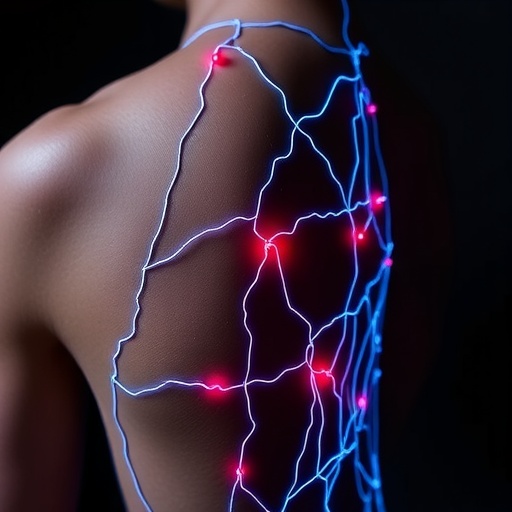
In a striking leap forward for biomedical technology, researchers have unveiled a novel method to monitor deep-tissue physiological processes through non-invasive means, directly from the skin’s surface. This breakthrough addresses persistent challenges in bioelectrical recording that have long plagued clinical diagnostics and physiological monitoring. Traditional electrodes often suffer from high contact impedance and mechanical mismatch, causing significant signal attenuation and motion artifacts during dynamic body movements. By circumventing these limitations, the new technique promises to elevate continuous health monitoring to unprecedented levels of precision and comfort.
The core innovation hinges on the direct application of biocompatible two-dimensional nanosheet inks sprayed onto the human body. Upon deposition, these inks spontaneously organize into microscopically thin van der Waals films, forming electrically functionalized layers that conform exquisitely to the skin. Unlike conventional rigid or gel-based electrodes, these films are intrinsically stretchable and adapt mechanically to the body’s contours, including uneven, hairy, and moving surfaces. This conformality reduces contact impedance significantly, thereby enhancing signal fidelity and mitigating motion-induced artifacts which often compromise data integrity in existing systems.
This electrically functionalized skin interface effectively transforms the body surface into a highly sensitive platform capable of capturing robust bioelectrical signals. The research demonstrates that the coatings maintain their structural and electrical integrity even during intense muscle contractions and routine movements. Data collected include nuanced bioimpedance modulations and biopotential variations correlated with deep-tissue activities beneath the skin, such as blood circulation, muscle engagement, and even cortical brain activity. Such capabilities have heretofore required invasive or cumbersome monitoring apparatuses, limiting the scope of continuous, real-world health assessments.
One of the standout features of this technology is the dramatic reduction in extrinsic motion artifacts. Conventional wearable electrodes struggle to maintain stable contact during bodily motion due to their rigidity or poor skin adherence, leading to noisy and unreliable recordings. The van der Waals thin films exhibit a degree of compliance and skin-like mechanical properties that preserve electrical connectivity with the epidermis. This mechanical congruence permits continuous monitoring without the need for adhesives or external supports, thus improving user comfort and expanding practical utility beyond controlled clinical environments.
The approach employs a scalable spray-coating process that can be deployed rapidly and non-invasively on diverse skin areas. This ease of application is critical because the human body surface is continuously changing due to mechanical deformation, sweating, and hair growth. The nanosheet inks’ biocompatibility ensures long-term safety and minimizes skin irritation—a notorious drawback of many wearable biosensors. Moreover, the ultrathin nature of the films enables natural skin respiration and does not impede tactile sensation, making them effectively imperceptible to wearers.
In terms of signal acquisition, the electrically functionalized surface outperforms many existing commercial electrodes. Comparative studies reveal substantially lower contact impedances and enhanced sensitivity to subtle physiological signals originating from deep tissues. This enhancement allows clinicians and researchers to monitor dynamic biological phenomena in real time with high temporal resolution, such as blood flow dynamics relevant for cardiovascular health, muscle contraction patterns pertinent to rehabilitation, and even brain activity signals indicative of neural function and cognitive states.
The wide-ranging implications of this technology extend to both healthcare and fundamental biomedical research. Continuous, high-fidelity monitoring of deep-tissue physiology could revolutionize the management of chronic diseases by providing real-time data on internal organ function and musculoskeletal health. Additionally, its non-invasive nature combined with robustness to motion artefacts opens novel avenues for at-home diagnostics, telemedicine, and personalized medicine, enabling patients to receive accurate health feedback outside hospital settings and thus reducing healthcare burdens.
Furthermore, the technology may play a transformative role in neuroscience. Electrical recordings of brain activity are traditionally limited by skull barriers and require invasive setups or cumbersome helmets. The capability to detect brain-related electrical signals from the skin surface, enhanced by the electrically functionalized films, could markedly improve non-invasive brain-computer interface development. This, in turn, paves the way for new therapies, neuroprosthetics, and cognitive monitoring tools, all integrated seamlessly into everyday life without discomfort or stigma.
The versatility of the nanosheets also hints toward integration with other bioelectronic systems. Coupled with wireless transmission modules and embedded data analytics, these films could constitute a cornerstone of future wearable health technologies, fusing advanced materials science with artificial intelligence for smart, adaptive monitoring platforms. Their chemical and mechanical robustness ensure long operational lifetimes without degradation, tackling a key hurdle faced by many bioelectronic devices vulnerable to environmental exposure.
Crucially, the researchers emphasize the scalability and cost-effectiveness of this approach. Spray-coating methods are already widespread in industrial settings, which means the path toward commercialization and widespread adoption may be direct and economically viable. As the global demand for next-generation, non-invasive healthcare solutions continues to grow, electrically functionalized body surfaces offer a compelling example of material innovation meeting urgent clinical needs.
Besides technological achievements, this research underscores the importance of intimate collaboration between materials science, engineering, and biomedical disciplines. By designing nanosheet inks that interact gently yet effectively with the dynamic, textured human skin, the team surmounted fundamental interface challenges. Their work redefines what is possible in wearable bioelectronics and establishes a platform on which future innovations in personalized health monitoring can be constructed.
Looking ahead, ongoing studies seek to refine and expand the scope of this invention, including exploring multi-modal sensing capabilities that might simultaneously track electrical, chemical, and biomechanical signals from the body surface. Such integration could afford comprehensive physiological profiling in a single, wearable film, dramatically enriching the data set available for health diagnostics, athletic performance optimization, and early disease detection.
In summary, the electrically functionalized body surface developed through spray-coating biocompatible nanosheet inks presents a groundbreaking modality for deep-tissue bioelectrical recording. By overcoming the limitations of traditional electrodes, this technology offers a highly conformal, stretchable, and mechanically adaptive interface that enables precise, stable, and continuous monitoring of vital physiological signals. Its ability to suppress motion artifacts, reduce contact impedance, and conform to complex skin geometries heralds a new era in non-invasive biomedical monitoring with profound clinical and commercial implications.
As these electrically functionalized films begin to permeate clinical and consumer health systems, they promise to significantly improve patient outcomes by facilitating more accurate diagnostics, earlier intervention, and enhanced quality of life. Their inherent compatibility with routine body motions ensures that health insights become seamlessly embedded into daily life rather than confined to laboratory settings. This research elegantly illustrates the power of nanoscale materials engineering in unlocking the full potential of human health monitoring through the simplest interface—the skin.
Subject of Research: Electrically functionalized body surface for deep-tissue bioelectrical recording
Article Title: Electrically functionalized body surface for deep-tissue bioelectrical recording
Article References:
Zhang, D., Zhao, G., Zhang, Y. et al. Electrically functionalized body surface for deep-tissue bioelectrical recording. Nat. Biomed. Eng (2026). https://doi.org/10.1038/s41551-026-01663-1
Image Credits: AI Generated
DOI: https://doi.org/10.1038/s41551-026-01663-1
Tags: advanced biomedical diagnosticsbiocompatible nanosheet inkscontinuous health monitoring technologydeep-tissue bioelectrical recordingdynamic body movement signal fidelityelectrically functionalized skinflexible skin-mounted sensorslow contact impedance electrodesmotion artifact reduction in biosensorsnon-invasive physiological monitoringstretchable bioelectronic interfacesvan der Waals thin films