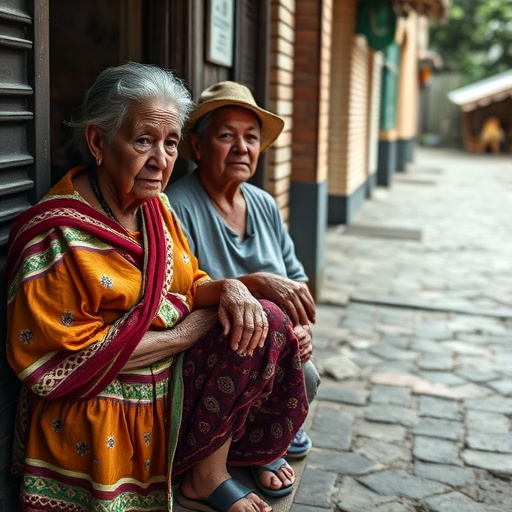
In an era where the aging global population is rapidly increasing, the quest to understand the intricate factors influencing elderly mortality has gained unprecedented urgency. Recent groundbreaking research emerging from Colombia has illuminated a critical, yet often underestimated, component of elder health: social frailty. This phenomenon, characterized by diminished social resources and connectivity, has been linked as a potent predictor of mortality among older adults, reshaping perspectives on geriatric care and public health interventions.
The study, conducted across four diverse Colombian departments, leverages data from the SABE survey—a comprehensive databank designed to evaluate health, well-being, and aging in Latin America. Through meticulous analysis, the researchers discerned that social frailty significantly exacerbates mortality risks, independent of traditional clinical indicators such as chronic illnesses or physical frailty. This revelation propels social frailty from a background concern to a forefront determinant necessitating urgent scientific and policy attention.
Social frailty is a multifaceted construct that encompasses the reduction or absence of critical social interactions, support networks, and participation in community life. Unlike physical frailty, which manifests in declining physiological robustness, social frailty erodes the social fabric that sustains psychological resilience and access to resources. Older adults experiencing social isolation, loneliness, and inadequate social engagement exhibit deteriorations in mental and physical health that cumulatively contribute to heightened vulnerability.
Methodologically, the Colombian inquiry employed advanced statistical modeling to isolate social frailty as an independent variable influencing mortality outcomes. The SABE survey’s robust dataset, drawn from heterogeneous rural and urban populations, enabled nuanced assessments across socioeconomic strata and cultural contexts. This approach ensured that social frailty’s predictive power was not confounded by location-specific variables or healthcare disparity factors, thereby underscoring its universal relevance.
One of the most compelling aspects of this research is its challenge to traditional biomedical paradigms, which tend to prioritize biological markers in prognostic assessments. The findings advocate for an integrated geriatric model where social determinants of health are enshrined as core criteria. This shift compels medical practitioners and policymakers alike to envisage interventions that transcend pharmaceuticals and physical rehabilitation, incorporating social connectivity enhancement and community engagement strategies.
The implications extend beyond Colombia’s borders. As nations grapple with aging populations and stretched healthcare systems, recognizing social frailty’s role could revolutionize preventative health strategies worldwide. Early identification of socially frail individuals could facilitate timely, non-invasive interventions such as social prescribing, community-building programs, and technology-facilitated communication enhancements, thereby potentially reducing mortality rates at a population level.
Furthermore, the study accentuates the importance of culturally sensitive approaches to combating social frailty. Latin America’s unique social dynamics, intergenerational living arrangements, and community solidarity traditions offer both challenges and opportunities for tailored interventions. Understanding local context is paramount, as the manifestation and impact of social frailty vary across cultural settings, necessitating adaptable frameworks.
Importantly, this research also highlights the intricate interplay between social frailty and mental health outcomes. Social isolation is a well-documented precursor to depression and cognitive decline among the elderly. By quantifying social frailty’s direct association with mortality, the study implicates these psychological dimensions as critical mediators, demanding integrated mental health support within geriatric care paradigms.
From a technical standpoint, the use of longitudinal data and rigorous regression analyses in this study sets a new benchmark for geriatrics research. The researchers incorporated control variables including age, sex, comorbidities, and functional status, ensuring robust causality inference. Additionally, sensitivity analyses reinforced the stability and credibility of the results, providing a reliable foundation for clinical practice guidelines.
This work dovetails with emerging global health initiatives emphasizing the social determinants of health, supporting the World Health Organization’s call for holistic aging strategies. By concrete demonstration of social frailty’s impact, the study galvanizes support for integrating social health metrics into electronic health records, facilitating routine screening during clinical encounters.
The pathway forward will require multidisciplinary collaboration, harnessing expertise from social work, epidemiology, psychology, and gerontology. Technology will also play a pivotal role; digital platforms enabling virtual social interactions offer promising avenues to mitigate frailty among geographically or physically isolated elders. Innovative devices, apps, and community portals could foster engagement and real-time monitoring of social health parameters.
Moreover, policymakers are urged to consider social infrastructure investments as healthcare priorities. Enhancing access to community centers, transportation, and affordable communication tools represent tangible measures capable of diminishing social frailty. Legislative frameworks promoting age-friendly environments and social inclusion can serve as scaffolds preventing frailty progression.
In sum, the Colombian study provides a clarion call to reimagine aging care through a social lens. Mortality among older adults is not dictated solely by biological vulnerability; social connections—or the lack thereof—bear profound consequences for survival. Addressing social frailty requires holistic strategies that valorize human relationships and community integration as essential components of health.
As the world’s demographic landscape tilts toward older populations, integrating social frailty assessments and interventions will be imperative. The Colombian evidence underscores a universal truth: human beings thrive not just through health systems, but through social ecosystems. Investing in these ecosystems may be the key to unlocking longer, healthier, and more fulfilling lives for the elderly.
In the coming years, further research expansion will be critical to unravel the complex mechanisms linking social frailty to mortality. Longitudinal studies, interventional trials, and cross-cultural comparisons will deepen understanding and refine approaches. However, the message is unequivocal—social frailty is a tangible, quantifiable risk factor demanding equal focus as biological and physical health domains.
Ultimately, this body of work offers hope by elucidating actionable targets for reducing mortality risks among elders. Strengthening social ties, fostering inclusion, and embracing holistic health views have the potential to transform aging experiences globally. It is time to elevate social frailty from academic discourse to practical priority in health policy and clinical practice.
Subject of Research: Social frailty as a predictor of mortality among older adults
Article Title: Social frailty as a predictor of mortality among older adults in four Colombian departments: evidence from the SABE survey
Article References:
García-Botina, HD., Curcio, CL., Calderón-Larrañaga, A. et al. Social frailty as a predictor of mortality among older adults in four Colombian departments: evidence from the SABE survey. BMC Geriatr (2026). https://doi.org/10.1186/s12877-026-07731-0
Image Credits: AI Generated
Tags: aging population health risks Colombiacommunity participation and elder survivalgeriatric social health factorsimpact of social isolation on older adultsloneliness effects on elderly mortalitypredictors of mortality in aging populationspublic health interventions for social frailtySABE survey Colombia aging studysocial connectivity and elder well-beingsocial determinants of health in geriatricssocial frailty and elderly mortalitysocial support networks in older adults