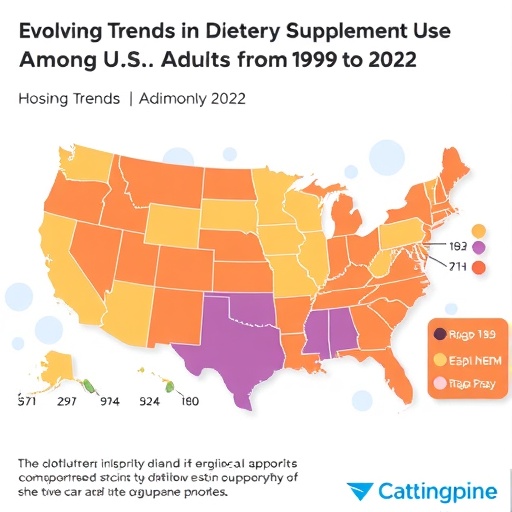
In recent years, the landscape of dietary supplement consumption among U.S. adults has undergone a significant transformation, as revealed by a comprehensive analysis spanning over two decades. Researchers analyzing repeated cross-sectional data from the National Health and Nutrition Examination Survey (NHANES) from 1999 through 2023 have identified not only an increase in overall supplement use but also a decisive trend toward diversification in the kinds of supplements consumed. This evolution reflects broader shifts in public health priorities, consumer behavior, and scientific understanding of nutrition and wellness.
Historically, the use of dietary supplements was heavily centered around traditional multivitamin-multimineral formulations, aimed primarily at preventing nutrient deficiencies across populations. However, the new data highlights a robust expansion beyond these generic products to a dynamic assortment of supplements tailored to specific physiological functions and health concerns, including immune function, anti-inflammatory effects, gut microbiome support, skin health, and joint maintenance. This diversification underscores a more targeted approach to supplementation that mirrors the intricate nature of chronic disease management and longevity strategies.
One of the study’s pivotal findings is the pronounced increase in supplement consumption among older adults, a demographic segment that traditionally exhibits a higher burden of chronic illnesses and comorbidities. This rise could signify a growing recognition within this population of the role that nutritional support plays in mitigating age-related decline and enhancing quality of life. With aging populations globally, this trend may have profound implications for public health policies and clinical recommendations.
The investigation leverages the strength of NHANES, a program renowned for its rigorous collection of health, dietary, and nutrient intake data using a representative sample of the U.S. population. By employing repeated cross-sectional surveys, the analysis captures temporal trends and shifts in supplement categories, providing critical insights into evolving consumer patterns. These insights are invaluable for health professionals, policymakers, and industry stakeholders aiming to align supplement availability and guidance with population health needs.
This paradigm shift in supplement use aligns with a burgeoning scientific discourse emphasizing personalized nutrition. Advances in genomics, metabolomics, and microbiome research have illuminated the variability in nutrient requirements and responses among individuals and subpopulations. Consequently, consumers and healthcare providers are increasingly gravitating toward supplements that address precise biological pathways, such as inflammation modulation, immune resilience, and gut-brain axis optimization, rather than one-size-fits-all multivitamins.
Immune support supplements have gained prominent traction, particularly in the wake of recent global health challenges. Ingredients like vitamin C, vitamin D, zinc, and various botanicals have experienced surges in consumption, fueled both by emerging scientific evidence and heightened consumer awareness. The study’s findings corroborate these market trends, offering epidemiological confirmation of heightened public interest in immune health.
Similarly, supplements targeting inflammatory processes are now more widely used, reflecting the growing recognition of chronic inflammation as a central mechanism in numerous diseases, from cardiovascular conditions to neurodegenerative disorders. Nutraceuticals such as omega-3 fatty acids, curcumin, and various polyphenols have become staples in many supplement regimens aimed at curtailing systemic inflammatory responses.
Gut health has emerged as a pivotal area of supplement innovation and utilization, grounded in a vast body of research linking the gut microbiota to overall health status, including immune function, mental health, and metabolic regulation. Probiotics, prebiotics, and synbiotics have entered the mainstream supplement market, supported by scientific studies demonstrating their potential to restore microbial balance, enhance barrier functions, and mitigate gastrointestinal disorders.
Skin and joint health supplements have also witnessed increased popularity. Collagen peptides, hyaluronic acid, and antioxidants tailored for skin rejuvenation, alongside glucosamine, chondroitin, and methylsulfonylmethane for joint comfort and mobility, exemplify this trend. These products are often adopted proactively for aging populations seeking to maintain physical function and aesthetics.
Such diversification away from generic multivitamins towards specialized supplements demands robust regulatory oversight and ongoing research to ensure efficacy and safety. The heterogeneity of supplement formulations, varying bioavailability of active ingredients, and differences in individual metabolism require that future studies incorporate mechanistic evaluations alongside population-wide assessments.
Critically, as the supplement market proliferates and evolves, continuous monitoring of consumption patterns, alongside rigorous clinical investigations, is indispensable. This ongoing surveillance facilitates the identification of potential public health impacts, ingredients with robust evidence bases, and emerging risks related to overconsumption or interactions with pharmaceuticals. It also informs educational campaigns that guide consumers toward evidence-based choices.
The study’s author, Dr. Chun Sing Lam, emphasizes that while current trends offer optimism regarding increased access to and use of targeted nutritional supplements, the complexity of human biology necessitates adaptive research frameworks. These frameworks should integrate epidemiological data with emerging omics technologies and clinical trial evidence to refine supplement recommendations for different demographic and health status groups effectively.
Moreover, this longitudinal perspective from NHANES elucidates how societal factors such as aging demographics, health awareness, and possibly even the influence of social media and direct-to-consumer advertising contribute to dynamic shifts in supplement use. The interplay between consumer knowledge, healthcare provider guidance, and regulatory environments shapes supplement trends in a continuously evolving matrix of influences.
The implications of these findings are multifaceted. From a healthcare system perspective, integrating nuanced supplement use data into clinical practice could potentially enhance preventive care strategies and chronic disease management. On a population level, understanding supplement use can help identify nutritional gaps and disparities, supporting targeted public health interventions.
This comprehensive analysis not only charts the trajectory of dietary supplement consumption over more than two decades but also signals a move towards a precision nutrition era where supplements are components of personalized health regimens. As the supplement landscape continues to evolve, collaboration among scientists, clinicians, regulators, and industry will be crucial to fully harness their potential benefits while safeguarding public health.
To this end, ongoing research efforts and surveillance initiatives like NHANES remain indispensable tools for capturing real-world supplement use trends, assessing their impacts, and guiding future policy and practice. The study reinforces the notion that supplements are no longer niche products but integral elements of contemporary health strategies, reflecting broader shifts in how society approaches nutrition and wellness.
The taken insights, especially regarding the rapid growth in supplement diversity and usage among older adults, provide a critical foundation for future research exploring causality, optimal dosing, and long-term outcomes related to nutrient supplementation. Such knowledge will be vital for optimizing healthspan and addressing the complex nutritional needs of aging populations in the coming decades.
This evolving supplement usage pattern invites further interdisciplinary research to unravel mechanistic underpinnings, validate health claims, and translate scientific advancements into actionable, evidence-based guidance for consumers worldwide.
Subject of Research: Trends and diversification in dietary supplement use among U.S. adults from 1999 to 2023.
Article Title: Not provided.
News Publication Date: Not provided.
Web References: Not provided.
References: Not provided.
Image Credits: Not provided.
Keywords: Vitamins, dietary supplements, multivitamin-multiminerals, immune health, anti-inflammatory, gut health, skin health, joint health, NHANES, aging, public health, nutrition trends.
Tags: anti-inflammatory dietary supplementschronic disease management with supplementsdietary supplement trends in the USevolving consumer behavior in nutritiongut microbiome health supplementsimmune support supplementsjoint health supplements usagelongitudinal study on supplement usemultivitamin consumption patternsNHANES dietary supplement dataskin health supplementation trendssupplement use in older adults