Biopharma development has long trended toward specialized and personalized therapies such as cell and gene therapies, antibody-drug conjugates, and monoclonal antibodies (mAbs), among others. More recently, those small-batch products have coincided with demand for GLP-1 drugs, vaccines, and biosimilars that require large-scale manufacturing.
Regardless of product, the regulatory complexity, supply chain fragility, and fluctuating patient demand requires both sponsors and their CDMO partners to adapt on a dime. When a sponsor needs to push up a timeline to hit the market first or secure the next funding round, the industry is trending towards expecting the CDMO to have the flexibility to say yes.
Rigid manufacturing operations that are locked into fixed suite configurations, dedicated equipment, and siloed expertise hinder a service provider’s ability to accommodate client needs. CDMOs designed for flexibility adapt with modular facilities, cross-trained teams, and a partnership mentality that embraces sponsors’ ever-changing priorities.
“For the large pharma partners we work with, flexible means being adaptable and collaborative with their technical and quality teams to bring their processes to our site efficiently and with high quality. It’s also important to have the capacity and capability to scale those processes,” said Kyle Kissick, MSAT lead at the Cincinnati, Ohio, site for Resilience, a CDMO with biologics drug substance, cell-based therapies, and aseptic drug product manufacturing facilities across North America. “It’s about being able to respond to their needs quickly, while proactively bringing our experience to the table to find the best solutions together to ultimately serve patient needs. This is true from initial tech transfer through to continuous improvement once processes are established.”
Nick Van-Gemert is a senior manager of manufacturing for Resilience at the Toronto, Canada facility. The site, which focuses on process development, GMP manufacturing for mAbs and recombinant proteins, and other complex molecules, says emerging biotechs require a different type of flexibility.
“Our definition of flexibility focuses on being agile for the client” he said. “Early-phase programs have tight timelines and shifting priorities, facilitating the need for development and manufacturing activities to happen in parallel, which can go almost up to the date of GMP manufacturing. It’s important for us to respond to those changes to help the client maintain timelines to the clinic. Information from process development will determine critical process parameters and materials, and it’s up to us to get that done quickly in order to keep them on track without compromising quality.”
How equipment facilitates flexibility
Equipment selection enables flexibility, and CDMOs with deep process knowledge can adapt existing equipment to meet early development, clinical, and commercial requirements.
The single-use bioreactor and processing equipment at the Resilience Toronto facility is designed to accommodate almost all mammalian cell culture products. Single-use equipment eliminates sterilization and changeover time required by fixed stainless-steel systems, and because the facility is designed for maximum flexibility, all process equipment is portable and reconfigurable based on client requirements.
Each Resilience facility has adopted platforms that enable flexibility. “Where possible, we utilize single-use formulation and dosing systems,” said Kissick. “Single-use systems often provide the opportunity to closely replicate client processes and leverage existing data rather than repeating costly and time-consuming studies. Our Cincinnati site has strong relationships with a number of vendors who help us develop and optimize these systems quickly. We are highly skilled at mixing and matching what is required to meet clients’ needs.”
Resilience Cincinnati recently stood-up a fully integrated drug delivery, device assembly, and packaging platform in less than 18 months to support rapid scale-up for a client experiencing unprecedented global market demand . The program combined accelerated technology transfer, commercial-scale sterile fill/finish operations, proprietary prefilled syringe (PFS) device assembly, packaging, serialization, and supply chain readiness into a single coordinated manufacturing solution. In parallel, Resilience established new commercial vial and PFS fill lines while building a proprietary high-volume PFS assembly operation capable of supporting rapid market expansion.
Flexibility through automation
With fully automated facilities, Resilience can scale up or down rapidly as needed, as well as adapt to shifting modality demands to enable rapid production changes from preclinical through to commercial.
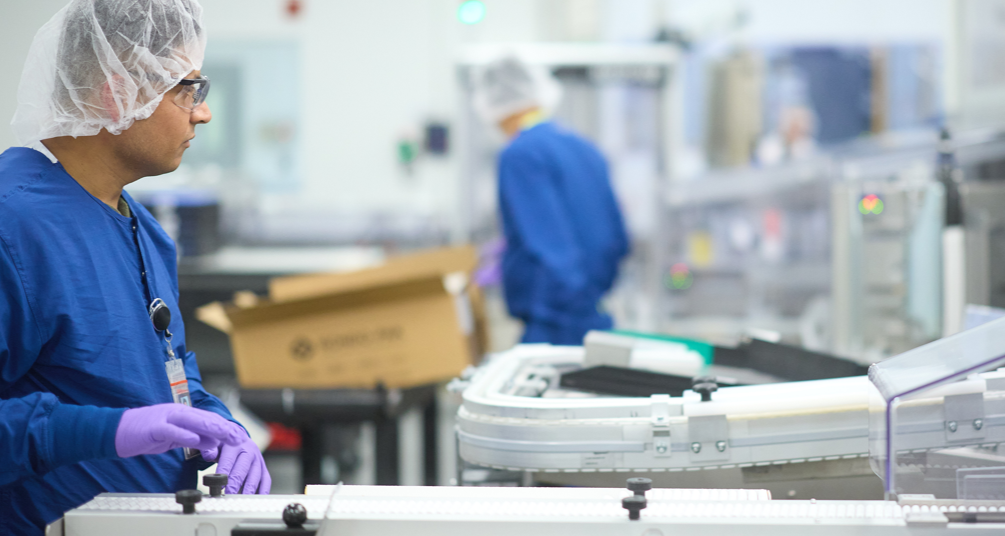
“At the Cincinnati facility, all fill, assembly, and packaging lines are fully automated, with a plant-wide historian that captures and trends operational data to support both continuous process improvement and rapid investigation if issues arise,” said Kissick. “We’re integrating lean manufacturing tools such as Vorne and Seeq with the facility’s technology platform to help operations teams track and minimize downtime, improving capacity for clients. Isolator-based containment across production lines supports aseptic processing compliance while maintaining the flexibility to handle a range of product types.”
A flexible, technology-first CDMO
Resilience was designed to meet the needs of emerging biotech and large pharma alike using a combination of advanced technology, established quality systems, tested scalable processes, and a flexible manufacturing approach. This combination drives efficiency without compromising quality or regulatory compliance.
“Patient needs have always driven demand for solution providers,” said Nick, “but the ability to offer flexible solutions in an environment that is constantly shifting due to new breakthroughs and developments, continuous improvement, and changing geopolitical requirements is becoming a required trait in a CDMO partner.”