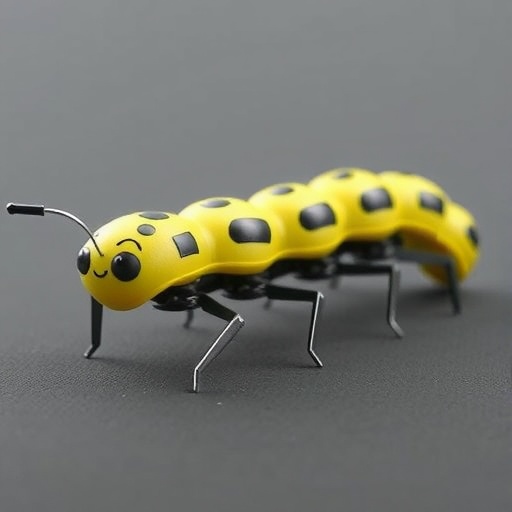
In a groundbreaking leap forward for soft robotics, researchers at the University of Gothenburg have developed a revolutionary inchworm-inspired robot that can navigate complex environments without relying on rigid components. This innovative design, described in a recent experimental study, harnesses the unique properties of flexible materials to mimic the natural movements of an inchworm, opening new frontiers not only in industrial inspection but also in extraterrestrial exploration. The implications of this technology extend far beyond traditional robotics, showcasing the potential to revolutionize how machines function in unpredictable and challenging terrains.
Soft robotics aims to imitate the remarkable versatility and adaptability found in biological organisms by utilizing soft, flexible materials rather than rigid mechanical parts. This approach allows robots to perform operations in environments that would typically be inaccessible or damaging to hard-bodied machines. The inchworm robot leverages a sophisticated interplay of polymer layers interspersed with carbon electrodes. When electrical voltage is applied, the polymer undergoes expansion, akin to the contraction and relaxation of a natural muscle fiber, producing a smooth and controlled movement.
The core innovation lies in the fabrication of a multi-layered artificial muscle approximately as thin as a human hair. Researchers achieved this by alternating five layers of polymer and carbon, engineering a delicate yet powerful system capable of flexing dynamically. This thin sheet was carefully rolled into a cylindrical form, mimicking the inchworm’s characteristic locomotion pattern. The robot’s rhythmic expansion and contraction, driven by alternating voltage signals, generate a forward crawling motion that propels it across uneven surfaces with remarkable agility.
Crucially, a flexible plastic arch was integrated between the cylinder’s ends, acting as a mechanical anchor that allows the robot to grip ribbed surfaces effectively. This design enables the robotic inchworm to advance steadily on grooved textures by exploiting friction in a manner closely resembling the biological counterpart’s locomotion. The prototype demonstrated the ability to elongate by around 10% when energized and reliably return to its original shape when the current ceased. This dynamic movement was consistent across various orientations relative to the surface grooves, confirming the robustness of the motion mechanism.
One of the most exciting potential applications for this soft robotic platform is autonomous inspection of pipeline systems. Equipped with a miniature camera and sensors, the crawler could traverse narrow and intricate sewage pipes, providing real-time diagnostics without the need for human entry or complex machinery. Its lightweight and soft structure would enable it to maneuver through constricted spaces without risk of damage to the infrastructure or itself, offering a significant advancement in maintenance technology for urban utilities.
Beyond earthly applications, the inchworm robot’s design features also hold promise for space exploration, particularly on planets like Mars where terrain complexity and environmental hazards pose considerable challenges. The robot’s motor incorporates no moving mechanical parts, drastically reducing failure risks in extreme conditions. Throughout prolonged testing periods—running multiple hours daily over several months—the robot maintained consistent performance, underscoring its durability and reliability.
A particularly noteworthy advancement is the protective role played by carbon nanotubes enveloping the robot. These nanotubes not only shield the soft device from physical damage but also confer resilience against cosmic radiation encountered in space missions. Experimental demonstrations involved piercing the robot’s body with needles, yet the electrical pathways remained intact due to the conductive network formed by the carbon nanotubes circumventing damaged regions. This feature ensures continued functionality even after sustaining micro-impact damages, a critical factor for long-distance robotic explorers.
The biological inspiration behind the inchworm robot underscores the growing interdisciplinary synergy between nature and technology. By decoding the mechanics of natural organisms, engineers can design machines that operate with enhanced efficiency and adaptability. This approach not only minimizes the complexity and weight of robotic systems but also harnesses the principles of soft matter physics to achieve motion patterns previously unattainable with conventional robotics.
Further development plans aim to customize the robot’s design to optimize its locomotion and gripping capabilities for varied surface types, tailoring it for different practical scenarios. As research progresses, integrating sensory arrays and communication modules could transform these soft robotic worms into autonomous agents capable of performing inspection, monitoring, and exploration tasks with minimal human intervention.
The inchworm-inspired soft robot stands at the forefront of a transformative shift in robotics, where flexibility, resilience, and biomimicry combine to overcome traditional technological barriers. Its demonstrated endurance, graceful locomotion, and adaptability position it as a promising candidate for both terrestrial and extraterrestrial applications. This pioneering work marks a crucial milestone in the journey toward nature-inspired machines capable of exploring our planet and beyond with unprecedented dexterity and survivability.
As this line of research unfolds, the broader implications for robotics, materials science, and space technology come into sharper focus. Soft robots such as this inchworm design highlight an emerging paradigm where machines are no longer confined by rigid frameworks but instead emulate the fluid dynamics of living organisms. This fusion of biology and engineering signals an exciting future in which robots operate harmoniously with their environments, advancing human capabilities in exploration, maintenance, and disaster response.
In sum, the University of Gothenburg’s soft insectoid crawler embodies a visionary leap in soft robotics, combining material innovation with biological mimicry and robust engineering. Its potential to autonomously inspect pipelines on Earth and ultimately wriggle across the Martian landscape defines a new chapter in the pursuit of resilient, adaptable, and intelligent robotic systems designed to thrive in dynamic and unpredictable settings.
Subject of Research: Soft robotics development inspired by inchworm locomotion for adaptive movement and exploration
Article Title: Soft Robotic Platforms for Dynamic Conditions: From Adaptive Locomotion to Space Exploration
News Publication Date: 23-Mar-2026
Image Credits: Hari Prakash Thanabalan
Keywords
soft robotics, inchworm robot, artificial muscle, polymer-carbon layers, biomimicry, flexible robot, robotic crawler, pipeline inspection, Mars exploration, carbon nanotubes, radiation resistance, adaptive locomotion
Tags: bioinspired robot designcarbon electrode actuatorsflexible material robotsflexible soft robot fabricationindustrial inspection soft robotsmulti-layer polymer actuatorsnon-rigid component roboticspolymer-based artificial musclerobots for extraterrestrial explorationsoft robot navigation in complex environmentssoft robotics for unpredictable terrainssoft robotics inchworm movement