Human pluripotent stem cells (hPSCs) have long been viewed as one of regenerative medicine’s most promising raw materials. Now, as more than 100 clinical trials evaluate hPSC-derived therapies for diseases ranging from Parkinson’s disease to heart failure and type 1 diabetes, attention is turning toward a crucial challenge: how to manufacture these cells reliably and economically at industrial scale.
According to Kevin Cyrys and Robert Zweigerdt, PhD, both of Hannover Medical School in Germany, the field has entered a new phase. Rather than simply demonstrating that stem cells can be grown in bioreactors, researchers are increasingly focused on creating robust production platforms that can deliver consistent quality across facilities and patient populations.
“Human pluripotent stem cells can serve as an unlimited, renewable ‘raw material’ for essentially any therapeutic cell product,” the authors wrote, highlighting the technology’s potential to overcome limitations associated with donor-derived tissues and organs.
The manufacturing challenge is substantial. While some therapies, such as treatments for age-related macular degeneration, require only tens of thousands of cells per dose, others may demand billions of cells for a single patient treatment. Conventional laboratory-scale methods are unlikely to meet such requirements efficiently.
To address this gap, developers are increasingly adopting three-dimensional suspension cultures in bioreactors. Compared with traditional two-dimensional cell culture systems, bioreactors provide tighter control over temperature, oxygen levels, pH, and carbon dioxide while supporting automated, closed-system manufacturing compatible with good manufacturing practice (GMP) standards.
The field has already demonstrated notable progress across multiple therapeutic areas. Researchers have developed scalable processes for producing cardiomyocytes, pancreatic islet cells, hepatocyte-like cells, neural tissues, and immune effectors derived from hPSCs. Some cardiac manufacturing platforms have reported production of billions of cardiomyocytes in liter-scale bioreactors, while immune-cell manufacturing programs have successfully expanded induced pluripotent stem cell-derived natural killer cells in 1–10 L systems while maintaining product quality.
Yet scaling production involves more than increasing cell yields. “Industrial-scale success depends on more than headline totals,” Cyrys and Zweigerdt note, citing the importance of volumetric productivity, production time, reproducibility, and integration of expansion, differentiation, and downstream processing into a coherent GMP-ready workflow.
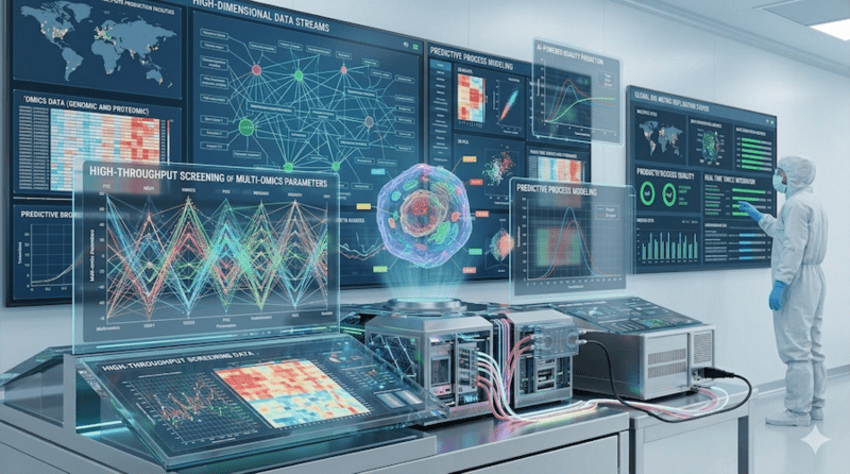
Looking ahead, Cyrys and Zweigerdt argue that the next generation of stem-cell manufacturing will be defined by data-driven process control. They predict that AI-enabled systems will help move the industry from retrospective quality analysis toward real-time decision support, ultimately improving comparability between batches and strengthening product definitions across manufacturing networks.
Despite ongoing challenges involving cost, quality control, and regulatory compliance, the authors conclude that stem-cell bioprocessing has already crossed an important threshold. Scalable culture systems are no longer the primary obstacle. Instead, the focus has shifted toward engineering reliable industrial processes capable of transforming complex stem-cell biology into reproducible therapeutic products.