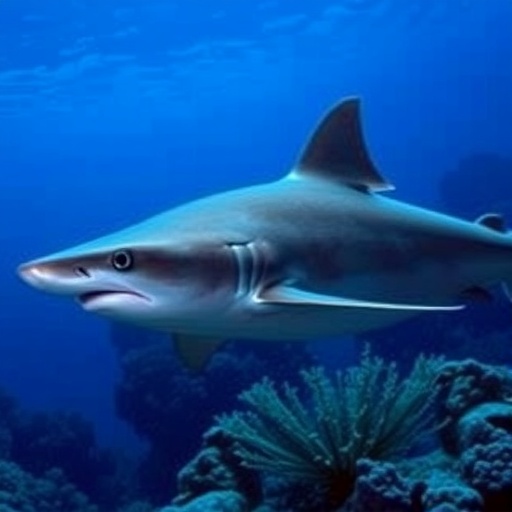
In a groundbreaking discovery that expands our understanding of viral diversity in marine ecosystems, researchers have identified a novel adomavirus associated with proliferative skin lesions in the broadnose sevengill shark (Notorynchus cepedianus). This study, recently published in the prestigious journal npj Viruses, presents the first comprehensive characterization of an adomavirus infecting elasmobranchs, a group of cartilaginous fishes that includes sharks, rays, and skates. The findings offer novel insights into the evolution, host specificity, and pathogenic mechanisms of adomaviruses, a relatively understudied family of DNA viruses with complex replication strategies.
Adomaviruses are circular double-stranded DNA viruses that have been mostly described in bony fish species and a few amphibians, but reports of their presence in elasmobranchs have so far been lacking. The discovery of this new viral entity in the broadnose sevengill shark marks a significant extension of the known host range of the family and raises intriguing questions about the evolutionary trajectories of these viruses in aquatic environments. Researchers employed a multidisciplinary approach combining high-throughput metagenomics, histopathology, and electron microscopy to unveil the viral genome and its biological impact on its shark host.
The study began with the identification of unusual proliferative skin lesions observed on several wild-caught broadnose sevengill sharks during routine health assessments. These lesions presented as irregular, raised nodules that contrasted with the normally smooth integument of the sharks. Histological analysis revealed epidermal hyperplasia and inclusion bodies suggestive of viral infection. Given the lack of previously reported viral pathogens capable of causing such lesions in elasmobranchs, the team sought to isolate and sequence the underlying causative agent using advanced nucleic acid screening methods.
By extracting DNA directly from the lesion tissue and applying targeted viral enrichment protocols, the researchers generated high-quality sequencing libraries for metagenomic analysis. Bioinformatic pipelines tailored to viral genome assembly identified a circular DNA virus with hallmark ORFs typical of adomaviruses, including genes encoding a replicative helicase, a major capsid protein, and various transcriptional regulators. Comparative genomics showed that this virus shares approximately 60% genome-wide nucleotide identity with the closest known adomavirus species but possesses distinct structural protein variants consistent with host adaptation.
Intriguingly, phylogenetic reconstruction places the newly discovered adomavirus on a distinct evolutionary branch within the family, suggesting a lineage that diverged early to colonize elasmobranch hosts. This finding enriches the viral tree of life by defining a shark-specific adomavirus clade and supports the hypothesis that adomaviruses have co-evolved with diverse aquatic vertebrates over hundreds of millions of years. Moreover, the research highlights the potential role of these viruses in marine vertebrate health and ecology, emphasizing how viral infections may contribute to skin disease dynamics in sharks.
At the microscopic level, electron microscopy revealed icosahedral virions approximately 60 nanometers in diameter within the infected epidermis. These virus particles were observed budding from keratinocytes, suggesting active replication and horizontal spread within the skin tissue. The presence of viral inclusion bodies and virion assemblages coincided with cellular atypia and proliferative tissue changes, establishing a direct link between viral activity and lesion formation. These pathological observations provide crucial evidence that the adomavirus is not a benign commensal but a potential pathogen exerting measurable effects on shark integument.
Beyond clinical pathology, the study also explored the molecular biology of replication and gene expression using RNA sequencing of lesion tissues. The virus exhibits a temporal pattern of transcript accumulation consistent with other well-studied adomaviruses: early expression of replication-associated genes is followed by late expression of structural proteins critical for virion assembly. This tightly regulated gene expression program underscores the sophisticated viral machinery adapted for persistence in a complex vertebrate host environment. Insights into these mechanisms offer promising avenues for understanding virus-host interactions in marine species.
Regarding transmission dynamics, the researchers hypothesize that the virus spreads through direct contact or environmental exposure in the shark’s coastal habitat, where individuals aggregate for feeding and mating. The detection of viral DNA in lesion-free skin samples from some individuals suggests that subclinical infection or viral latency might occur, facilitating maintenance of the virus in the population. Elucidating transmission pathways is essential for gauging the ecological impact of the virus and developing potential management strategies, particularly given the conservation status of broadnose sevengill sharks in certain regions.
This discovery holds significant implications for marine wildlife virology and shark conservation biology. The skin lesions, while not immediately life-threatening, could impair barrier function and sensory inputs, potentially increasing vulnerability to secondary infections and environmental stressors. Considering that sharks play key roles as apex predators in marine ecosystems, understanding factors that affect their health is critical. The identification of this adomavirus expands the catalog of infectious agents of elasmobranchs, encouraging further surveillance and research into viral diseases of cartilaginous fishes.
From an evolutionary standpoint, the findings support the idea that adomaviruses underwent intricate co-divergence with vertebrate hosts, with host-switching events shaping their current diversity. The unique genomic features detected in the shark adomavirus, including novel protein motifs and regulatory elements, highlight the plasticity of viral genomes in adapting to distinct cellular environments. Such genomic innovations may reflect selective pressures in the marine milieu, where virus-host interactions are influenced by factors like temperature fluctuations, salinity, and host immune defenses.
Furthermore, the technological advances showcased in this work demonstrate the power of integrated omics and microscopy approaches for virus discovery in understudied species. The combination of targeted viral genomic enrichment with high-resolution imaging offers a template for future studies aiming to identify emerging pathogens in wildlife. This is particularly relevant in light of increasing anthropogenic impacts on marine biodiversity, where novel pathogens may have unforeseen consequences on vulnerable populations.
Ongoing investigations will aim to experimentally determine the pathogenicity of the virus through challenge studies and to elucidate the immunological responses elicited in infected sharks. These data will be critical for understanding the balance between viral persistence and host defense, which ultimately shapes disease outcomes. Additionally, characterization of viral protein functions at the biochemical level is expected to yield new molecular targets that could inform antiviral strategies should interventions be warranted.
The broader scientific community now has cause to rethink the ecological significance of viral entities in ocean health. Viruses are the most abundant biological agents in seawater and play essential roles in nutrient cycling, microbial population control, and shaping host genome evolution. Identifying viruses that specifically infect higher vertebrates like sharks adds a vital piece to this complex puzzle, with implications for marine disease ecology, evolutionary biology, and conservation medicine.
In sum, this seminal discovery of a novel adomavirus in the broadnose sevengill shark serves as a testament to the hidden diversity of the ocean’s virome and the intricate interplay between viruses and their vertebrate hosts. As virus discovery accelerates through technological innovation, the marine virology field stands poised for transformative insights that will deepen our understanding of life beneath the waves and the emerging challenges facing marine wildlife in a rapidly changing world.
Subject of Research: Novel adomavirus infecting broadnose sevengill shark (Notorynchus cepedianus) skin lesions
Article Title: A novel adomavirus from proliferative skin lesions of a broadnose sevengill shark (Notorynchus cepedianus)
Article References:
Gordon, L.M., Sevigny, J.L., Buck, C.B. et al. A novel adomavirus from proliferative skin lesions of a broadnose sevengill shark (Notorynchus cepedianus). npj Viruses (2026). https://doi.org/10.1038/s44298-026-00210-8
Image Credits: AI Generated
Tags: adomavirus host specificityadomavirus in elasmobranchsbroadnose sevengill shark virologyDNA viruses in cartilaginous fisheselectron microscopy of marine viruseshigh-throughput metagenomics in virologymarine virus evolutionnovel adomavirus discoverypathogenic mechanisms of adomavirusesproliferative skin lesions in sharkssevengill shark skin tumorsviral diversity in marine ecosystems