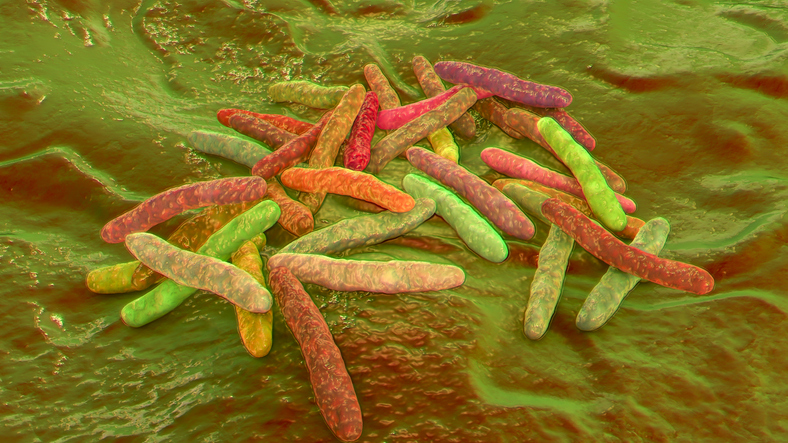
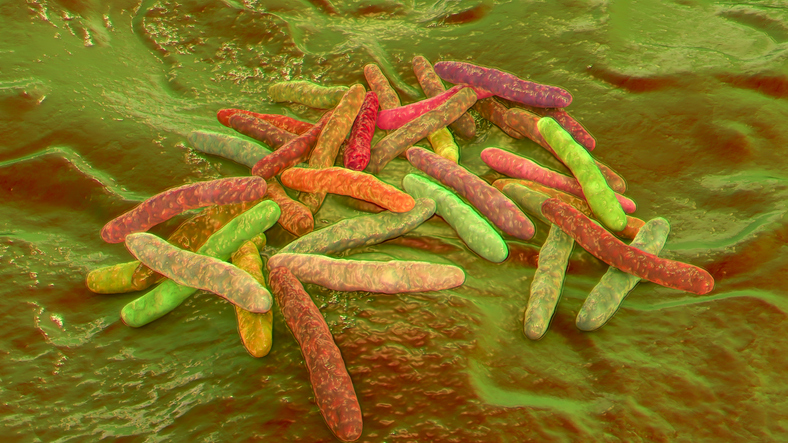
According to the World Health Organization (WHO), tuberculosis, caused by the bacterium Mycobacterium tuberculosis (Mtb), is the world’s deadliest single-agent caused infection, responsible for 1.23 million deaths in 2024. The bacterium’s outer cell membrane is difficult hard to penetrate, making few drugs effective in treating the disease.
In a new study published in Nature Microbiology titled, “Identification of chemical features for improved outer membrane permeation in mycobacteria using machine learning,” researchers from University of Massachusetts (UMass) Amherst have developed new methods to measure which chemical compounds can cross the outer bacterial membrane.
“Mtb is unique,” said Sloan Siegrist, PhD, associate professor of microbiology at UMass Amherst. “Not only does it have two membranes that protect the cell from antimicrobial chemical compounds that we might use to kill it, its outer membrane is unlike any other biological barrier out there.”
Siegrist’s lab specializes in finding vulnerabilities in the mycomembrane to develop drugs that can effectively treat tuberculosis. However, traditional drug discovery has relied on low throughput experimental screens. In 2023, Siegrist, in collaboration with Marcos Pires, PhD, professor of chemistry at the University of Virginia, published Peptidoglycan Accessibility Click-Mediated AssessmeNt (PAC-MAN), a method that can test many compounds in parallel.
“Marcos and I wanted to harness measurements of known chemicals to predict compound uptake for unknown chemicals, so we brought in computational biologists and chemists, including my colleague Anna Green, PhD, from UMass Amherst’s Manning College of Information and Computer Sciences,” said Siegrist.
Green uses computation to understand patterns in biological compounds. “Small molecules can be particularly difficult to analyze computationally,” she says. “Because they come in all different sizes with a wide range of molecular connections, you can’t describe them with a single measurement, by weight, say, or size.”
Green and colleagues designed a machine learning model, the Mycobacterial Permeability neural Network (MycoPermeNet), trained on the PAC-MAN screening data. The model can predict how readily a compound permeates the mycomembrane from its chemical structure alone and points to the physical properties that help a compound penetrate Mtb’s defenses.
“The mycomembrane lets some molecules through and keeps others out,” says Green. “There must be something about this membrane, and about the chemistry of each molecule, that decides which ones get in—and our combined tools help us figure out which ones can get through, and why.”