Novartis has agreed to acquire Myricx Bio, a London-based developer of next-generation antibody-drug conjugates (ADCs), for up to $1.5 billion in a deal designed to bolster the buyer’s oncology pipeline with a next-generation ADC payload platform designed to fight cancer.
Privately-held Myricx specializes in developing ADCs that use N-myristoyltransferase inhibitor (NMTi) payloads, an approach designed to deliver a differentiated cancer-killing payload directly to tumor cells. Myricx says its ADC approach holds the potential to address limitations of TOPO-1 inhibitors, tubulin inhibitors, and other commonly used ADC payload classes—ranging from toxicity to healthy cells, to tumor resistance, to dose-limiting adverse events.
The acquisition deal is designed to combine Myricx’s two lead ADC assets and next-generation first-in-class NMTi payload platform with Novartis’ expertise in developing cancer therapies.
According to Myricx Bio, preclinical data suggests that its NMTi payload may have broad activity across multiple solid tumors, including TOPO-1-resistant models, and may enable more effective use of ADCs in settings where existing payload classes have limitations. NMT is an enzyme responsible for the addition of myristic acid, a 14-carbon fatty acid, to the N-terminus of multiple proteins that are crucial for cancer cell survival.
“ADCs have become an important part of cancer treatment, but there remains a clear need for new payload mechanisms to overcome resistance and expand their impact for patients,” Fiona Marshall, PhD, Novartis’ president of biomedical research, said in a statement. “Myricx Bio has developed a promising NMTi payload platform with a differentiated mechanism that could broaden the use of ADCs across multiple tumor settings.”
Marshall added that the Myricx Bio acquisition “reflects our strategy to scale innovative platforms, as we have with radioligand therapies, to deliver more durable, transformative treatments for patients.” In February, Novartis announced plans to build a 46,000-square-foot radioligand therapy (RLT) manufacturing site in the Dallas-Fort Worth suburb of Denton, TX.
Novartis investors reacted by sending its shares traded on the SIX Swiss exchange down 2% Monday, from CHF 127.92 ($157.69) to CHF 125.10 ($154.22). Novartis’ American Depositary Shares (ADSs) traded on the New York Stock Exchange dipped 3%, from $159.90 to $155.08 as of 10:13 a.m. ET
Until now, Myricx has said little about its two lead NMTi-ADC candidates, except to disclose on its website that it is prioritizing one that targets B7-H3 and the other, HER2, “based on compelling preclinical efficacy and safety data across multiple solid tumor-associated antigens and cancer cell types.”
Novartis agreed to shell out $1.1 billion cash upfront plus up to $400 million tied to achieving milestones. The transaction is expected to close in the second half of this year, subject to satisfaction or waiver of customary closing conditions, including regulatory approvals.
“Transformative promise”
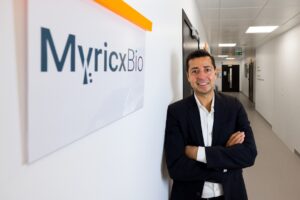
“We are delighted that Novartis recognizes the transformative promise of our NMTi-ADC platform to deliver this next-generation of potential first-in-class, highly differentiated ADC therapeutics,” stated Mohit Rawat, Myricx Bio’s CEO. “Together with Novartis, we look forward to building upon our work to transform the landscape of cancer treatment.”
Rawat joined Myricx last year with the goal of steering the company through preclinical development and its next stage of growth.
Founded in 2019, Myricx Bio was spun out from Imperial College London and the Francis Crick Institute by Ed Tate, PhD; Roberto Solari, PhD; and Andrew Bell, PhD, with support from Cancer Research UK, as well as seed investment from Brandon Capital and Sofinnova Partners.
Myricx’s co-founders and their collaborative teams discovered that NMT played a vital role in maintaining multiple critical, diverse cellular processes in cancer cells, including vesicle trafficking, growth factor signaling, cancer cell survival, mitochondrial biogenesis, and cancer cell metabolism.
Under CTO Robin Carr, PhD, Myricx Bio raised £90 million ($114 million) in a Series A financing in mid-2024 led by Novo Holdings and Abingworth, joined by British Business Bank, Cancer Research Horizons, Eli Lilly, and existing investors. This enabled the company to scale its operations and expand the team to rapidly advance its pipeline.
The planned acquisition of Myrocx Bio is Novartis’ third major deal this year focused on boosting its cancer pipeline.
On June 24, Antares Therapeutics announced it would receive $105 million upfront from Novartis through a strategic collaboration to discover, develop, and commercialize small molecule therapies against promising but historically undruggable oncology targets. Novartis also committed to paying Antares up to $1.8 billion tied to achieving additional option exercise, development, regulatory, and commercial milestones, as well as tiered royalties on global net sales.
And in March, Novartis committed up to $2 billion upfront toward acquiring Pikavation Therapeutics, a subsidiary of Synnovation Therapeutics that specializes in developing PI3Kα inhibitor programs designed to treat forms of cancer. Novartis also agreed to pay up to $1 billion in payments tied to achieving development, regulatory, and commercial milestones.