Synthetic oligonucleotide therapeutics are now validated for treating a wider range of diseases and, as companies move to larger-scale development, they should become familiar with the Chemistry, Manufacturing, and Control (CMC) aspects of their workflow.
That’s the view of Bao Zhang Cai, PhD, vice president of oligonucleotide CMC at GondolaBio. Cai will be giving a talk about CMC strategies for oligonucleotide therapies at the upcoming Bioprocessing Summit in Boston.
“The trend is very clear. Oligonucleotide therapies are becoming increasingly popular, as they tackle the root causes of diseases, not just the symptoms, and I can confidently say they’re now a validated therapeutic modality,” he says.
“But to achieve their potential, you need the right development strategy at the right time—you don’t want to apply late commercial staging to early development.”
According to Cai, synthetic oligonucleotide therapeutics have seen significant development over the last decade. They started as therapies for rare or ultra-rare diseases, but their applications have now widened.
With more patients needing treatment, a growing number of drugs are reaching the later phases of clinical trials and, as a result, CMC is increasingly important.
Cai suggests that product purification is important to consider, as it is often [genetic] sequence-dependent.
“You need to think about it upfront or as early as possible,” he says. “This is why, in general, it helps to identify and take advantage of an existing platform.”
An oligo-specific challenge, he explains, is that these products consist of a hydrophobic element conjugated to a water-soluble section.
“These two extremes put together generate unique challenges during purification, and you need to find the best route—do you want to perform the conjugation in solution or on a solid support?” he explains.
Finally, he says, as synthetic oligonucleotides are a relatively new product type, the critical quality attributes and product specifications can typically start quite broad. A focus on CMC can help manufacturers collect the data to narrow these specifications over time.
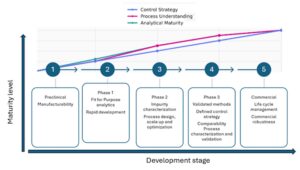
“Better process understanding can mean that, in the early phase, you have a poorly resolved method, and you get, say, 90% purity. But, later, you have a better method, and the purity will drop, and that’s a tough case to explain to the regulator,” he says.
“But, if you have process knowledge and understanding, you can demonstrate the product quality remains the same, and the purity level only looks lower because your methods have improved.”