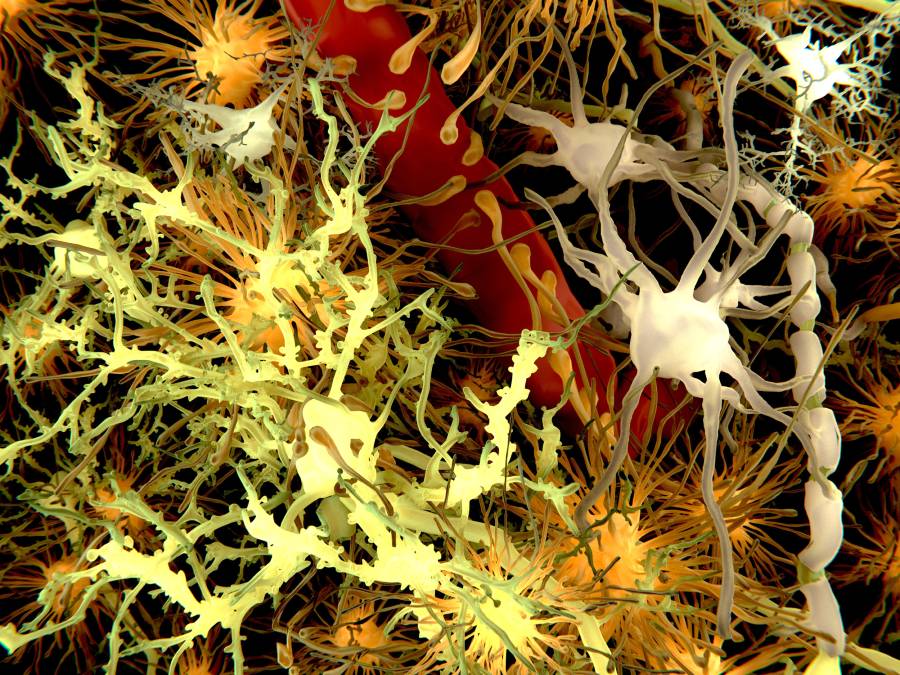

Although scientists have long studied how memories are formed in the brain, how certain memories persist over time for learning and cognitive function remains unclear.
A new study published in Nature Communications titled, “Astrocytic ankyrin-2 enables memory persistence in the mouse hippocampus,” suggests that astrocytes play a critical role in long-term memory through the regulatory protein ankyrin-2 (Ank2).
Removing Ank2 function led to significantly impaired memory in mice after after two weeks. Under normal conditions, these mice showed standard locomotion, sociability, and recent memory immediately after learning.
Astrocytes lacking Ank2 formed significantly less physical contacts with nearby engram neurons, the specialized neurons for memory storage. Additionally, the maintenance of long-term potentiation (LTP) was impaired while normal synaptic transmission remained intact. The findings suggest that astrocytes stabilize the neural circuits required for preserving memories long after they are formed.
On the molecular level, researchers found that Ank2 is required for brain-derived neurotrophic factor (BDNF) signaling through the astrocytic TrkB.T1 receptor and IP3R2-mediated calcium signaling. In the absence of Ank2, calcium signaling weakened, astrocytes failed to undergo normal structural remodeling, and showed reduced ability to maintain contacts with memory-encoding neurons.
The researchers further demonstrated that hippocampal BDNF infusion normally strengthens long-term memory persistence, but this effect disappeared when astrocytic Ank2 was deleted, showing that Ank2 is essential for BDNF-dependent memory stabilization.
To determine whether astrocytic BDNF signaling alone is sufficient to enhance memory, the team developed an optogenetic tool called Opto-T1. Activation of this pathway promoted astrocyte remodeling, maintained long-term potentiation, and significantly enhanced remote memory without affecting recent memory.
“Our findings show that astrocytes are not passive support cells, but active regulators that determine how long memories last,” said Wuhyun Koh, PhD, senior research fellow at Institute for Basic Science (IBS) and corresponding author of the study. “By identifying Ank2 as a key regulator of astrocyte remodeling and BDNF signaling, we have uncovered a new mechanism that helps stabilize long-term memories and opens new avenues for understanding and potentially treating memory disorders.”
The researchers indicate the study provides a new framework for understanding how astrocytes contribute to neurological diseases.