
Virtual cell models that enable the prediction of cell behavior across scales and biological contexts are rapidly emerging at the forefront of drug discovery.
Tom Sercu, PhD, vice president of AI and engineering at Biohub, points to a clinician-scientist studying a rare autoimmune disease as an example of how AI models could reshape translational medicine. Starting from a patient’s genome, researchers could use virtual cells to predict how major immune cell types behave in disease versus healthy states. The result offers an invaluable tool across target and mechanism-of-action discovery, patient stratification, toxicity prediction, and therapeutic development.
Yet, building a virtual cell is not an easy feat.
“Transformative AI in biology does not come from algorithms alone, but when models are trained on large-scale, high-quality, openly accessible datasets,” says Sercu. To capture complex biology, such data must span model systems and organisms, interventional and observational methods, and diverse cellular states.
To support this mission, Biohub announced a $500 million commitment to the Virtual Biology Initiative in April. The five-year campaign will accelerate the generation of technologies and multi-modal datasets needed to power virtual cell models.
Similar to how more than 253,000 experimentally determined molecular structures in the Protein Data Bank (PDB), assembled over five decades, became foundational training data for modern AI protein-structure prediction, Sercu sees an analogous moment for cellular biology.
“We do not yet have the equivalent of the PDB for cells,” he emphasized. “The Virtual Biology Initiative seeks to change that.”
Today’s virtual cell developers reflect on what’s needed for these models to predict complex biology and overhaul drug discovery.
Single or bulk
Much of the industry has defined the virtual cell as transcriptome models that predict how perturbations alter gene expression across cellular contexts.
Among the increasingly crowded ecosystem, Arc Institute’s first-generation virtual cell model, STATE, predicts how stem cells, cancer cells, and immune cells respond to drugs, cytokines, or genetic perturbations. In March, billion-dollar-backed, Xaira Therapeutics unveiled X-Cell, the first scaling law demonstrator in the virtual cell domain, sizing up to a whopping 4.9 billion parameters. These models aim to generalize to unseen biological contexts by training on causal single-cell RNA sequencing (scRNA-seq) data.
To train X-Cell, Xaira has spent its initial years building what the company describes as “the largest genome-wide CRISPRi Perturb-seq dataset ever reported.” Named X-Atlas/Pisces, the dataset is composed of 25.6 million cells across seven screens and 16 biological contexts.
Ginkgo Datapoints, the AI platform division of Ginkgo Bioworks, looks toward bulk transcriptomics rather than a single-cell approach.
“Just like how models benefit from diversity in training data, we as an industry benefit from having diversity of approaches,” said John Androsavich, PhD, general manager at Ginkgo Datapoints. The Datapoints team applies high-throughput automation to create diverse biological datasets, including cell perturbations, antibody developability, and ADME small molecule developability data, to support AI model training for life science partners.
In March, Ginkgo Datapoints delivered the first data release of the Virtual Cell Pharmacology Initiative (VCPI). Approximately 2,280 small molecules were profiled in full dose response using DRUG-seq, a scalable arrayed transcriptomics assay measuring chemical perturbations.
In contrast to scRNA-seq, which covers approximately 1,500 genes per cell, DRUG-seq captures nearly 10,000 genes per condition with higher signal-to-noise to optimize insights for pharmacology. Notably, VCPI has exclusively focused on THP-1, a human monocytic cell line widely used across immunology, oncology, and inflammatory disease research, to understand drug action.
Across space
While the crowding around scRNA-seq has largely been driven by the pursuit of scale, “a cell is not only its RNA,” tempers Hani Goodarzi, PhD, core investigator at Arc Institute. He emphasizes that cells are complex systems shaped by multiple layers of biology beyond gene expression alone, including protein abundance, chromatin state, spatial organization, metabolism, and post-translational regulation.
A useful analogy comes from large language models (LLMs), which became powerful as text provided an exceptionally scalable substrate for training trillions of tokens. Yet, text alone is an incomplete representation of human communication.
“The lesson is not that one modality is sufficient forever,” says Goodarzi, “but that a single high-quality, scalable modality can support general representations when the training corpus is large.”
Emma Lundberg, PhD, co-founder and CSO at GenBio AI, is worried about the “streetlight effect.”
“We’re scaling what we can and not necessarily what we should,” she says.
GenBio AI seeks to develop world models that cross multiscale biology. Instead of concentrating on one data modality, the company’s so-called “AI-Driven Digital Organism” grows expertise in embedding, tokenizing, and training models across scales, from the molecular layer to regulatory networks. Rather than undergo internal data generation, GenBio AI focuses on public data and partnerships to power the company’s models.
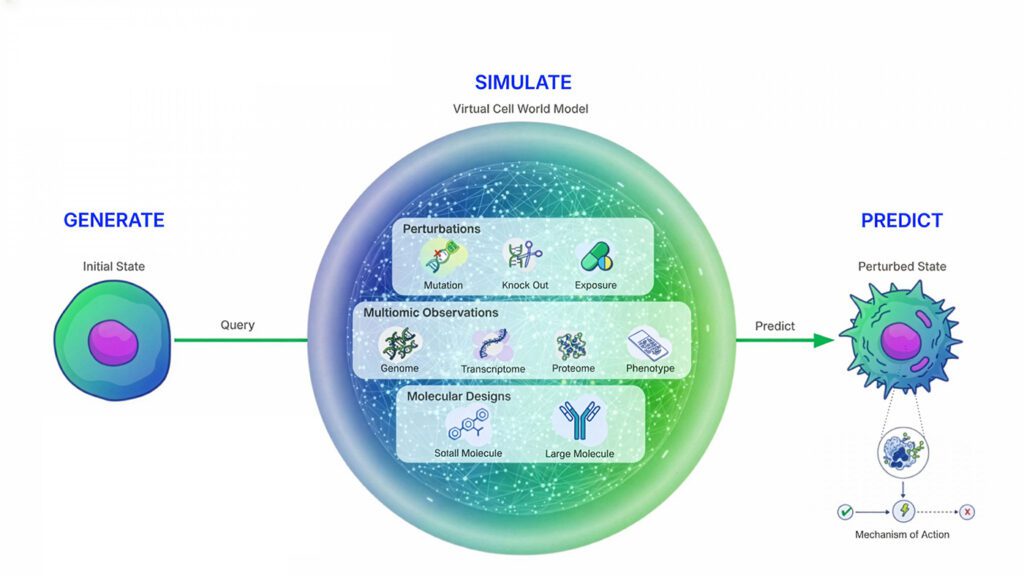
Lundberg, who is also associate professor of bioengineering and pathology at Stanford University, argues that models can guide the field to which data modalities to pursue. As an example, models that incorporate biological priors, such as protein-protein interactions, can achieve noticeable improvements in predictive performance.
Spatial and temporal data also capture critical dimensions of biological function that sequence data alone cannot resolve. According to the Human Protein Atlas, roughly 60% of human genes encode proteins that localize to multiple cellular compartments, often carrying out distinct functions depending on context.
In a May preprint posted on bioRxiv, Lundberg and colleagues introduced ProtiCelli, a deep generative model that visualizes the spatial organization of nearly the entire proteome within individual cells. By training on 1.23 million images from the Human Protein Atlas, the model simulates microscopy images for 12,800 human proteins while also generalizing to unseen cell types and drug perturbations absent from training.
Through time
Cellular Intelligence is developing a universal virtual cell signaling model designed to simulate cell-state transitions over time, with the goal of expanding the possibilities of regenerative medicine. By learning the underlying “grammar” through which sequences of signaling cues drive cell differentiation, these models aspire to enable the on-demand generation of any cell type.
Less than one percent of known human cell types can be reliably produced for downstream applications in cell therapy. As only 20 fundamental molecular signaling pathways give rise to thousands of cell states, researchers face an unfathomably large search space when engineering a particular cell type.
“Every cell that we discover or optimize opens a slew of potential applications,” said Micha Breakstone, CEO and co-founder of Cellular Intelligence. “One could spend a decade and tens of millions of dollars on painstaking trial-and-error to differentiate a new cell type, or solve this problem in one fell swoop, much like AlphaFold for the protein folding challenge.”
The company’s platform leverages a semi-permeable capsule technology, which selectively retains cells and large analytes while being freely accessible to media, enzymes, and reagents. The method enables high-throughput assays combining live-cell culture with genome-wide readouts. Millions of time-varying signal combinations are tested on human stem cell differentiation in parallel, providing 1,000 times higher efficiency than traditional methods.
In May, Cellular Intelligence advanced as a Phase II-ready clinical company after entering an agreement with Novo Nordisk to acquire STEM-PD, an allogeneic cell therapy program for Parkinson’s disease with Fast Track Designation. The deal comes six months after Novo announced its strategic exit from the cell therapy space. The start-up’s AI cell signaling models will address protocol development, one of the biggest obstacles preventing cell therapies from clinical impact.
“Novo selected Cellular Intelligence as the right partner because the next major challenge for complex cell therapy programs is not only the biology,” says Breakstone. “It is manufacturing scale-up, comparability, clinical logistics, and commercial readiness.”
As the diversity of virtual cell models targets new dimensions of complex biology, every approach takes another step closer toward clinical impact.