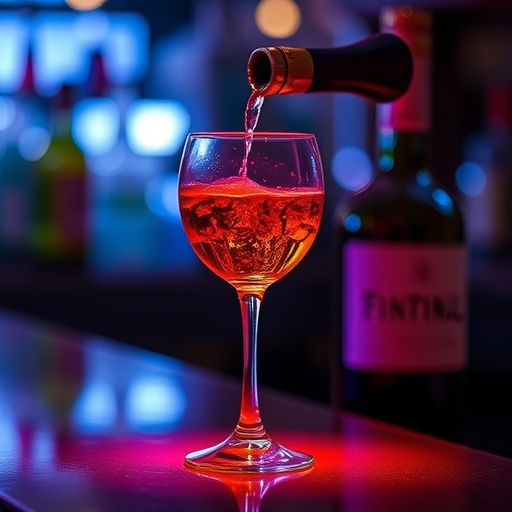
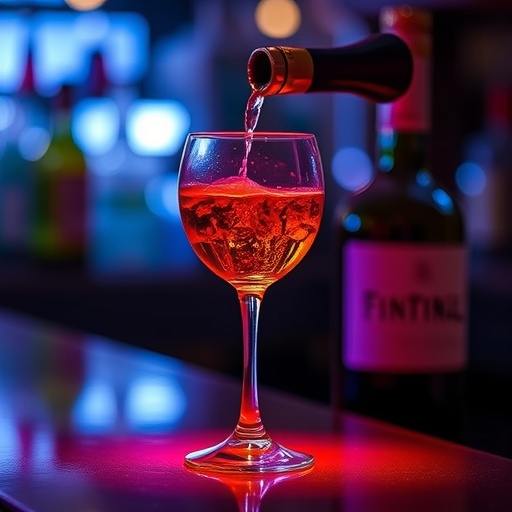
A laser-based sensing system developed at Adelaide University could help authorities detect deadly counterfeit alcohol, verify wine authenticity, and flag hazardous substances in sealed bottles without ever opening them. The approach is built on newly published research conducted at the University of St Andrews in collaboration with Adelaide University, focusing on the challenge of identifying toxic contaminants hidden behind coloured packaging.
At the center of the method is Raman spectroscopy, a technique that reads the distinctive molecular “fingerprint” of a liquid. Instead of relying on conventional sampling and laboratory workflows, the system interrogates the contents through the bottle’s material and label, extracting chemical information from how light is scattered.
Detecting methanol in real-world spirits is difficult because bottle glass and colourants introduce optical interference. To overcome this, the researchers combine two advanced optical strategies: they reshape the laser beam to improve how light interacts with the sample, and they modulate the laser’s wavelength during measurement. Together, these changes suppress background signals and enhance sensitivity to the weak Raman signature of methanol.
The published study demonstrates that methanol can be detected in unopened whisky and other spirits even through coloured glass. Performance is described as reaching concentrations around ten times lower than internationally recognised safety limits, meaning the system can identify levels well below thresholds associated with human harm.
Methanol poisoning remains a major global health issue, causing hundreds of deaths each year and leading to long-term injury and blindness. Because counterfeit alcohol is often indistinguishable from authentic product by sight or smell, non-destructive screening could shift detection from slow lab testing to rapid field-ready inspection.
Adelaide University physicist Dr Ralf Mouthaan says the work is a stepping stone toward devices that operate in practical environments such as customs checkpoints and quality assurance facilities. The goal is to move the technology out of the lab and into places where immediate verification matters.
Beyond alcohol safety, the same optical principles could extend to food and consumer products. The team has already shown the feasibility of capturing an optical fingerprint of wine through a bottle, offering a potential countermeasure against wine fraud. They are also exploring trace pesticide detection in olive oil, authentication of perfumes, and the identification of hazardous chemicals in sealed containers for law enforcement.
Finally, the technology is poised to support Australian industry, including agriculture. Adelaide University is planning a research program exceeding $10 million with collaborators at the University of Technology Sydney and Murdoch University, applying related laser sensing methods to help the grain sector.
Subject of Research: Non-invasive Raman spectroscopy for quantifying methanol in bottled spirits
Article Title: Non-invasive Raman spectroscopy with wavefront shaping and wavelength modulation to quantify methanol in bottled spirits
News Publication Date: 25-Jun-2026
Web References: https://iopscience.iop.org/article/10.1088/2515-7647/ae6c78
References: DOI: 10.1088/2515-7647/ae6c78
Image Credits: Adelaide University
Keywords
Lasers; Applied physics; Optical devices; Photonics
Tags: accuracy of non-destructive testing for beverage safetyadvanced laser beam shaping for improved chemical analysiscollaboration between Adelaide University and University of St Andrews on sensingdetection of methanol in spirits through coloured glassinnovative methods to combat counterfeit alcoholLaser-based sensing for counterfeit alcohol detectionnon-invasive alcohol authenticity verificationoptical interference mitigation in Raman spectroscopyoptical techniques to detect toxic contaminants in sealed bottlesRaman spectroscopy for liquid fingerprintingreal-time hazardous substance identification in sealed containerswavelength modulation in laser spectroscopy