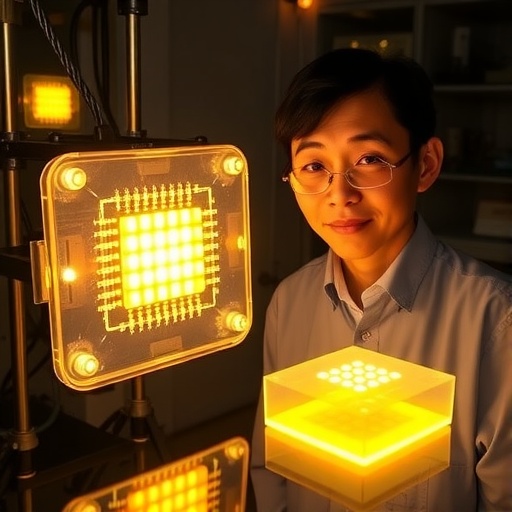
Seoul National University (SNU) and the University of Cambridge have unveiled a vapor-deposited perovskite light-emitting diode (PeLED) that delivers standout performance, combining world-leading external quantum efficiency with unusually pure color emission. The advance hinges on an emitter design that can hold a luminescence-favorable perovskite phase in place during the vacuum-deposition process, rather than letting the film crystallize in uncontrolled ways.
Vacuum deposition is already entrenched in OLED manufacturing, which makes perovskite LEDs attractive for next-generation displays. But conventional vacuum processing brings a core problem: multiple precursor reactions occur at once on the substrate, and crystallization proceeds too rapidly for thermodynamic rules to guide uniform growth. The result is often phase mixing, non-uniform films, lower efficiency, and reduced color purity.
To solve this, the team engineered a new X-type quasi-two-dimensional perovskite emitter. The key innovation is the use of X-type spacer organic molecules that strongly coordinate with lead ions, suppressing disordered crystal formation and steering the system toward the most energetically stable phase during deposition.
The researchers also created a nanoscale hetero-scaffold by chemically bonding X-type spacer molecules with lithium fluoride (LiF). This scaffold acts as a more uniform, chemically defined template, helping prevent random nucleation and promoting consistent phase development across the growing film.
With the improved crystallization pathway, the perovskite films achieved photoluminescence quantum yields above 85%. In device tests, the PeLEDs reached an external quantum efficiency of 21.9% and an emission linewidth of 16.8 nm, indicating high color purity alongside high brightness potential.
Crucially, the team demonstrated that the approach is compatible with scaling steps that matter for product realities. They report successful fabrication on large-area substrates, flexible platforms, and patterned structures, addressing a recurring barrier between lab-scale demonstrations and display-relevant manufacturing.
The work was published in Nature Nanotechnology on July 1, 2026, and is framed as more than a materials tweak. By designing a spacer that actively governs the formation pathway, the strategy offers a route toward thermodynamically controlled perovskite crystallization using vacuum deposition.
If validated at industrial scales, the technique could strengthen perovskite display manufacturing by reducing the need for entirely new equipment while enabling high performance at extremely small pixel sizes. That could expand use cases ranging from ultra-high-resolution panels to AR/VR microdisplays and emissive color-conversion architectures.
Subject of Research: Experimental study
Article Title: Halide-site-substituting spacer creates quasi-two-dimensional perovskites for vapour-deposited light-emitting diodes
News Publication Date: 1-Jul-2026
Web References: http://dx.doi.org/10.1038/s41565-026-02208-y
References: Nature Nanotechnology (DOI: 10.1038/s41565-026-02208-y)
Image Credits: © Nature Nanotechnology, originally published in Nature Nanotechnology
Keywords
perovskite LEDs, vapor deposition, quasi-two-dimensional perovskites, X-type spacer, thermodynamic phase stabilization, phase control, external quantum efficiency, color purity
Tags: high color purity in perovskite LEDsnanoscale hetero-scaffold for uniform film growthorganic spacer molecules in LED manufacturingperovskite light-emitting diodesphase control in perovskite film fabricationquasi-two-dimensional perovskite emittersstable perovskite phases during vacuumsuppression of crystal disorder in PeLEDsvacuum deposition in display technologyvapor-deposited perovskite LEDsworld-leading quantum efficiency in PeLEDs