Flower color is often treated like an aesthetic detail, but new research shows it can be the product of intense evolutionary fine-tuning. In snapdragons, subtle shifts in pigment patterning determine how effectively flowers recruit bees—and that difference can influence gene survival.
Researchers from the John Innes Centre and international collaborators examined yellow flower variation in wild populations of Antirrhinum majus. Their focus was not merely on color, but on the way developmental chemistry translates genes into spatial “paint” on petals.
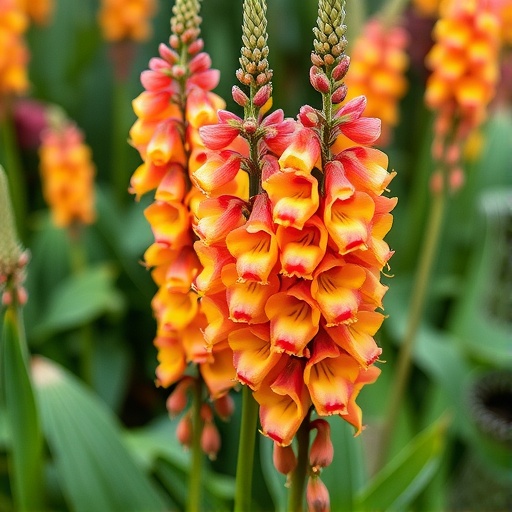
The study used a rare natural laboratory: a hybrid zone in the Pyrenees where two snapdragon varieties meet. One variety displays yellow petals with a magenta spot marking a bee entry point, while the other reverses the pattern—magenta petals with a yellow spot.
Because the two varieties interbreed in a narrow geographic band, the region where alleles mix remains only about 1 kilometer wide. That restriction lets scientists estimate how strongly natural selection acts on each genetic component rather than averaging effects across broad populations.
At the genetic level, the color difference is controlled by seven interacting genes. Three contribute to the production or placement of magenta pigment (“the magenta paintbrush”), while four govern the yellow component (“the yellow paintbrush”). Together, these loci regulate gradient formation, not simply on/off pigment presence.
Within the hybrid zone, mixing produces a spectrum of intermediate phenotypes, including orange and white. Yet many hybrids are less attractive to bees, so selection actively preserves the most bee-rewarding gradient configurations.
The team demonstrated that four of the paintbrush genes cooperate to shape a yellow gradient. In one variety, the gradient is steep, concentrating yellow into a spot; in the other, it is shallow, producing a broad blush.
Crucially, the study shows how small genetic effects can be nearly invisible to humans while remaining detectable to bees. Those bee-sensitive differences provide a pathway for selection to operate on multiple loci with different effect sizes.
Overall, the work offers a mechanistic explanation for how natural selection sculpts molecular gradients, with implications ranging from insect wing patterns to developmental processes in other organisms. The findings are published in Science Advances.
Subject of Research: Not applicable
Article Title: The Shaping of developmental gradients through selection on multiple loci in Antirrhinum
News Publication Date:
Web References: http://dx.doi.org/10.1126/sciadv.adx2011
References: 10.1126/sciadv.adx2011
Image Credits: Annabel Whibley
Keywords: evolutionary genetics, evolutionary ecology, molecular gradients, natural selection, hybrid zone, phenotypic variation, pollinator behavior, plant genetics, genetic mapping, developmental patterning
Tags: Antirrhinum majus color variationbee attraction in plantsdevelopmental chemistry of flower pigmentsevolutionary fine-tuning of flower traitsgene interactions controlling flower huegenetic basis of flower colornatural selection in hybrid zonespigment patterning and reproductive successplant-pollinator co-evolutionsnapdragon flower pigmentationspatial gene expression in petalswildflower color evolution