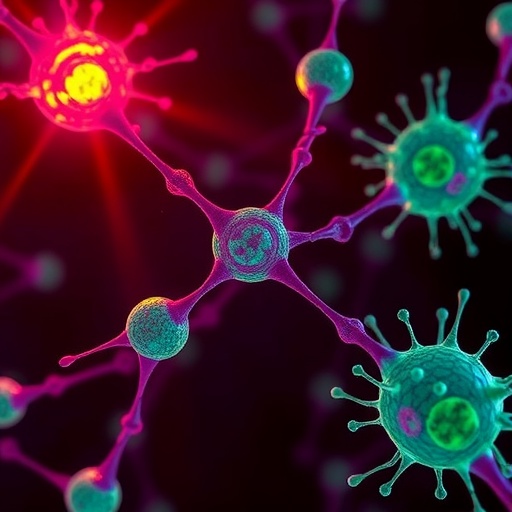
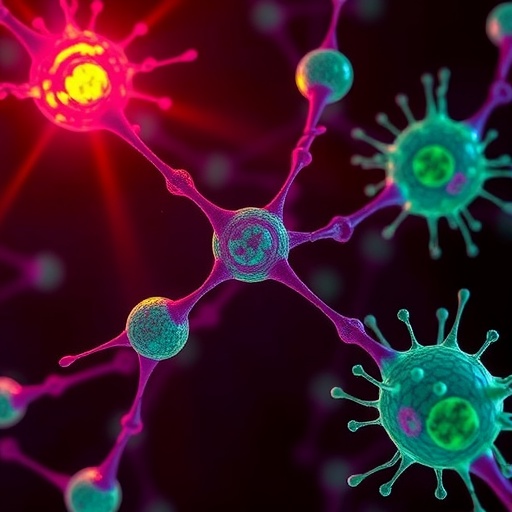
Stem cells in the Drosophila intestine continuously generate new cells, but their division must be precisely limited to preserve tissue balance. Left unchecked, overproliferation can destabilize epithelial organization and mirror the early logic of tumorigenesis. A new study now traces how differentiated progenitor cells help enforce this brake—using a molecular system better known for physically sticking cells together.
Researchers at the National Institute for Physiological Sciences report an unexpected role for smooth septate junction (sSJ) proteins in controlling growth-related signaling during intestinal differentiation. sSJ proteins, previously characterized as adhesion components, are shown to regulate the spatial dynamics of aPKC, a kinase that promotes proliferation.
The team focused on intestinal progenitor cells, which arise from stem cells and mature into functional epithelial cells. By following normal differentiation, they found that sSJ proteins accumulate at the apical region of progenitors. At the same time, the proliferation-driving enzyme aPKC is progressively removed from this same apical zone, establishing a “junction-linked” zoning pattern.
This positioning is lost when sSJ proteins are absent. In progenitor cells lacking sSJ, aPKC remains persistently localized at the apical cortex. The researchers then asked whether this mislocalization is causal for stem cell behavior rather than merely correlated with differentiation.
Using targeted manipulation to maintain apical aPKC, they were able to trigger excessive intestinal stem cell proliferation. The experiment demonstrates that not only signaling activity, but also its subcellular location within progenitor cells, is essential for keeping stem cell homeostasis intact.
Mechanistically, persistent apical aPKC was found to suppress Kibra, an activator of the Hippo signaling pathway. Normally, Hippo signaling acts to restrict growth and prevent overexpansion. When aPKC occupies the apical cortex, Kibra function is dampened, effectively disabling the proliferation restraint.
The study therefore links cell-cell junction architecture to growth control: sSJ-dependent clearance of aPKC preserves Kibra activity, maintains Hippo-mediated limits, and prevents stem cells from entering an unchecked division program. In effect, differentiated progenitors send a molecular “don’t grow” cue derived from junction proteins.
“Our findings show that differentiating progenitor cells actively regulate stem cell proliferation through cell-cell junction proteins,” said Associate Professor Yasushi Izumi. “This reveals an unexpected signaling role for adhesion molecules beyond connecting neighboring cells.”
While the work was performed in fruit flies, the underlying logic—how adhesion-dependent polarity shapes Hippo/Kibra-driven growth control—may inform broader understanding of epithelial maintenance and cancer development in higher organisms.
Subject of Research: Cells
Article Title: aPKC exclusion from the apical cortex in enteroblasts maintains stem cell homeostasis in Drosophila.
Web References: http://dx.doi.org/10.1083/jcb.202509240
References: 10.1083/jcb.202509240
Image Credits: Yasushi Izumi
Keywords: Cell junctions; Progenitor cells; Stem cells; Drosophila