“Today, let’s stand up for science!” cried Harold Varmus, MD, Nobel laureate, former NIH director, and professor of medicine at Weill Cornell Medicine to the hundreds of people gathered in Washington Square Park, on Friday, March 7, at the Stand up for Science Rally in NYC.
Varmus was one of over a dozen scientists to speak on the podium at the rally. He and the other speakers, including another Nobel laureate Martin Chalfie, PhD, Turing laureate Yann LeCun, PhD, and recent NIMH director, Joshua Gordon, MD, PhD, spoke about the importance of science, the lasting impacts that varied fields have on society, and the need to maintain funding and trust in science.
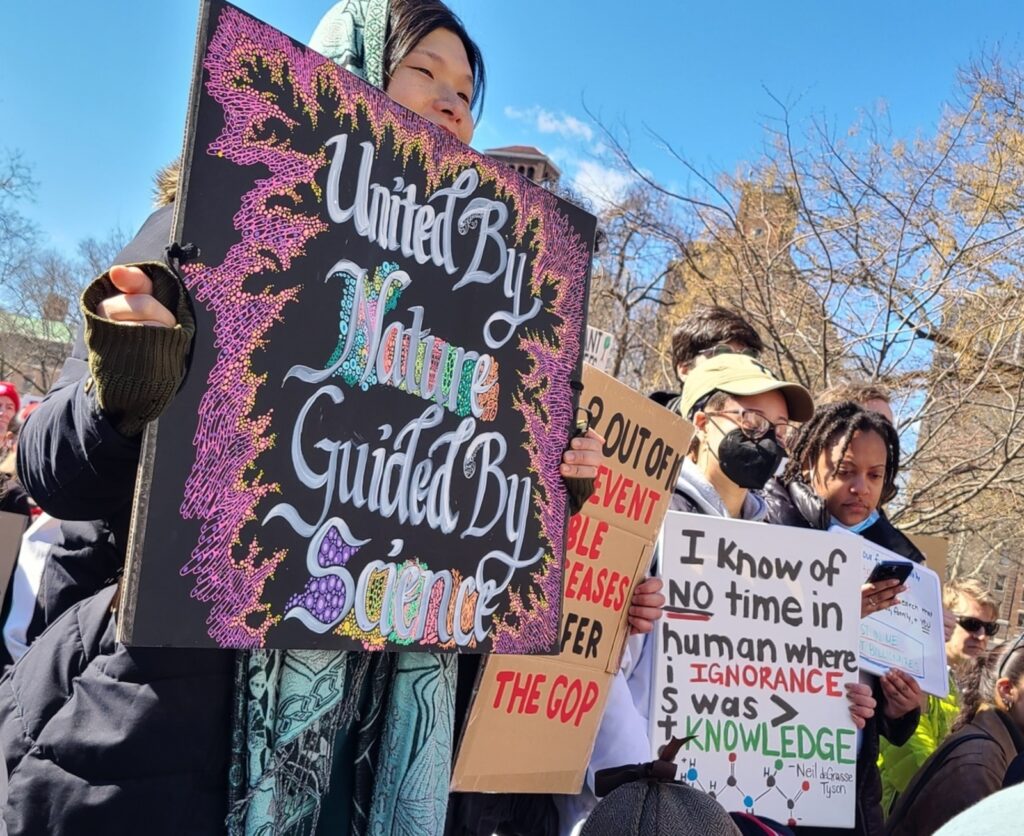
The rally in NYC, and the rallies at over 30 other locations across the United States and France, were a primary call to action by scientists and science supporters who are concerned about the recent anti-science actions by the current federal administration. These actions include mass lay-offs and cuts to DEI programs and government funding sources and caps to indirect costs of NIH grants. Many invited speakers and attendees expressed anger and frustration at the administration’s actions both verbally and through the posters within the crowd.

New generation of activism
In a modern homage to the 2017 March for Science, five early career scientists stepped forward to bring the latest plight of American scientists to light, organizing what they initially imagined as a small demonstration in Washington, DC. Not long into planning, the rally grew with organizers in dozens of other cities stepping up to the plate.

In NYC, Rohini Guin, a third-year MD PhD student at Stony Brook University and Cold Spring Harbor Laboratory took the lead, organizing an event in Washington Square Park, a central location in downtown Manhattan, steps away from NYU. The event was held in the middle of the park, the Washington Arch towering behind the event. The arch itself was designed with iconography of war and peace, an appropriate backdrop for the speakers at a peaceful protest of what many view as a war on science.
“I think we really wanted to have a show of force. Get people out here,” Guin told GEN before the rally, while bending down to pick up a piece of flying debris that the wind caught during set up. She continued, saying that she had a registration list of nearly 1,500 people but expected many more since she surmised that some people may attend but be hesitant to share contact information through pre-registration.
Once the rally was in full swing, it became clear that Guin’s expectation of the number of attendees was fulfilled. A crowd of over 1,500 people, many who are scientists and others who are supporters of science and scientists, came together at the center of the park, facing north toward the bright white arch and speaker stage. Hundreds of signs were held aloft before and during the speeches, most of which could be categorized as depicting either support for science or disdain for the current administration.
“[We need to] continue to put pressure to say ‘We are here, we are ready, and we are willing to protect science’ because as people who benefit from it and contribute to it, it’s super important to our group,” commented Guin.

She was excited about the speaker line up: “It will be a good show of the spectrum of scientists that are affected and the spectrum of experience that they have.” Guin and the other organizers collected over a dozen speakers with specialties ranging from physics to medicine, and work experience levels from current graduate students to Nobel laureates.
Gathering people together to support a shared cause is the first step in a larger agenda. Guin shared her thoughts on the impact of the rally: “Hopefully it serves as a meeting point for folks to connect with other like-minded individuals, to commiserate, to strategize and brainstorm, and also then, look into ways that we can actually engage our representatives, make meaningful change and protect science because we all are like-minded people who believe in its utility for society and its benefit for the globe.”
Though she seemed optimistic, Guin noted that this rally’s deeper reason for existing is to bring to light what she considers to be an attack on science. “I think science being under attack has been framed primarily through an American focus lens and while that is an issue, it’s not uniquely an issue when you consider science being under attack globally.”
Defund or defend science?
Gordon gave voice to this last sentiment in his speech: “This administration threatens the very foundations of the United States, its technological and economic strength, when it threatens American science.”
“We rely on federal funding to do the work that supports healthcare, that supports development of technology, that keeps the United States at the forefront of the world in science,” Jess Santangelo, PhD, professor of biology at Hofstra University shared with GEN. She attended the rally with three colleagues, each holding signs supporting science and research.

“To have that threatened not only impacts us personally with respect to the projects that we work on but threatens our country’s place in the world,” she continued.
Peter Daniel, PhD, also a professor of biology at Hofstra, shared, “I want to support the young faculty and researchers that are starting in the field, like my two colleagues right here. They’re just starting out, and it’s going to be really difficult to recruit scientists and nurture them if our funding is completely dissolved.”

Student researchers are starting to also feel the direct impacts of reduced funding. Laurel Kastner is a pediatric oncology researcher who hopes to start graduate school this summer. She discussed how in the last few weeks she’s seen small steps taken by her institution that are impacting the students on campus. She and her lab mates are worried about whether their shared departmental research equipment will be the next to be cut.
“If we continue to de-fund science, we will not only fall behind the rest of the world, but people will die. People will be affected,” Kastner said. “I work in pediatric cancer [research]. Children will die from cancer that could have been saved.”
“My biggest reason for being here is I just don’t understand how you can freeze funding that’s literally saving lives,” shared Kastner’s sister, Chloe. “So, I’m here to take a stance on that. We cannot be freezing money that is saving lives every single day.”
Researchers at other institutions are noting other consequences of reduced funding. “I have seen research funds that were allocated for minority students that were completely eliminated,” commented Xenia Freilich, PhD, of Queens College and LaGuardia College, CUNY, echoing a similar comment by Gordon about laid-off NIH researchers in his speech.
“[They are attacking] all kinds of research that are aiming at curing diseases. That is at risk. If that is not enough, I don’t know what is enough.”
Speaking of science
The rally was not centered solely on the lack of funding for science or the worry over public perception. It also featured scientists who spoke about the need to increase representation and diversity.

For example, Caitlin Williams, PhD, a postdoctoral researcher in the pediatrics department at Weill Cornell Medicine, described her struggles during her undergraduate years as not only the only mother but the only woman, in her department. She shared how she had no role model who she resonated with until later in her educational path and that she wants to see a world full of the diversity in science that she didn’t experience until later.
“Little girls interested in science can see that not only are there women in STEM, but there are mothers, first-generation scientists, and people that are just like them,” she proclaimed.
Claire Pomeroy, MD, president and CEO of the Albert and Mary Laskar Foundation began her speech by describing how the Laskar Foundation supports medical research. She highlighted how Maurice Hilleman was given the Laskar Award in 1983 for his development of the MMR vaccine which led to the near eradication (until recently) of measles in the United States.
“We are truly living through the Golden Age of science and medicine,” began Erik Bottcher, NYC Council member when he took the stage. “We may look back years now and be astounded at the medical advancements that we’ve made—that all of you have made during our time.” He spoke of the progress that science has made and about his hopes for the future of scientific advancements that “are far beyond what we’re even acknowledging today.”

Following the addresses of over a dozen speakers, the rally ended with a series of chants led by one of the volunteers. The crowd was loud and energized, speaking in one unified voice with a major message: “Science, not silence.”
Though she spoke in the middle of the rally, the words of Pomeroy seemed to fill the mind of this author as I left the park and rally behind:
“Now is the time to be audacious, now is the time to imagine more, now is the time to celebrate science and in doing so now is the time to ensure that science creates a better, healthier, and more just world for all.”