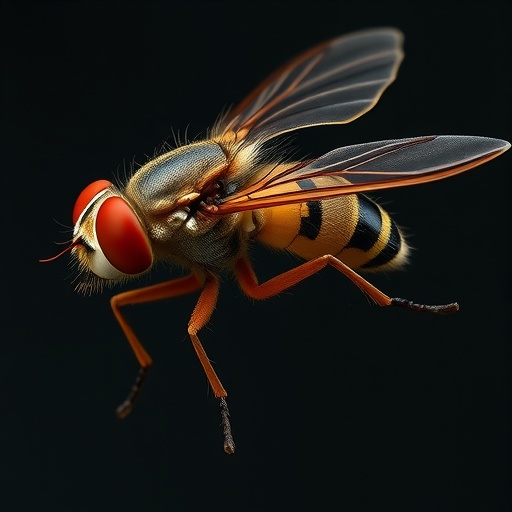
An embryo’s first great decision is directional: which end will become the head, and which will become the tail? In many animals, this body-axis blueprint is established within hours of fertilization, before the embryo has developed recognizable tissues or organs. For decades, scientists have relied heavily on the fruit fly Drosophila melanogaster to understand this process. Now, research on an obscure relative—the moth fly Clogmia albipunctata, commonly seen around drains and damp plant pots—has revealed how evolution can repeatedly reinvent the molecular machinery that gives an embryo its sense of direction.
In fruit flies, the anterior, or head-forming, end is specified by a gene called bicoid. The gene produces a protein that forms a concentration gradient across the early embryo. High levels at one end activate genes needed for head development, while lower concentrations farther away help establish progressively more posterior regions. This system has become one of developmental biology’s classic examples of how a molecular signal can translate position into form. Yet bicoid is not present in most fly species, raising a fundamental evolutionary question: how do different insects accomplish the same developmental task without the same genetic trigger?
A team led by researchers at the University of Chicago has been investigating that question across fly lineages. Earlier work showed that several unrelated genes have been recruited during evolution to perform the role occupied by bicoid in fruit flies. The phenomenon is an example of developmental systems drift, in which the underlying genetic circuitry changes while the final body plan remains recognizable. In their latest study, published in PLOS Biology, the researchers examined the mechanism used by the moth fly’s anterior determinant, a gene known as odd-paired.
The discovery is striking because odd-paired is not a specialized head-patterning gene in the conventional sense. In both moth flies and fruit flies, it helps regulate the formation of the correct number of body segments later in embryonic development. However, moth fly females also activate a distinct odd-paired transcript during egg formation. This alternative transcript produces a nearly identical protein, but it appears earlier and in a localized region corresponding to the future head. By changing when and where the gene is expressed, evolution has effectively repurposed an existing developmental component as an embryonic compass.
The researchers found that the moth fly protein initiates anterior patterning by changing the physical state of chromatin, the complex of DNA and associated proteins that packages the genome inside the nucleus. When chromatin is tightly compacted, regulatory regions of DNA are difficult for transcription factors and other molecular machinery to reach. When it becomes more open, genes can be activated. In the moth fly embryo, odd-paired is associated with asymmetric chromatin accessibility, making selected regions of the genome more available for transcription at the future anterior end.
This mechanism resembles one important aspect of bicoid activity, even though the two determinants are evolutionarily unrelated. Both proteins help open regulatory DNA and activate genes that launch head development. The similarity illustrates how natural selection can arrive at comparable molecular solutions through different starting materials. Rather than directly encoding an entire head-to-tail pattern, the anterior determinant appears to unlock portions of the genome, allowing a downstream network of genes to interpret the embryo’s position and build the appropriate structures.
The targets of the two systems, however, are not identical. In fruit flies, bicoid directly activates dozens of genes, including the well-known gene hunchback. In moth flies, the evidence indicates that odd-paired may not activate hunchback at all. Instead, it opens and activates regulatory regions near genes called homeobrain and sloppy-paired. These genes are involved in the earliest stages of anterior patterning and may serve as the first molecular links between the localized maternal signal and the broader network that organizes the embryo.
The findings suggest that evolutionary change can occur at several levels simultaneously. A gene can acquire a new transcript, be expressed in a new place, and connect to different downstream targets while preserving the same broad biological outcome. In this case, moth flies still produce a segmented larva with a defined head and tail, but the molecular route to that result differs substantially from the route used by fruit flies. The work therefore challenges the assumption that a familiar model organism’s developmental program is universal among related species.
The researchers emphasize that the moth fly may be only one example in a much larger collection of evolutionary experiments. With roughly 150,000 described fly species, the order Diptera contains enormous diversity in embryonic development. Some species may use other genes as anterior determinants, while others may retain different combinations of regulatory interactions. Comparing these systems could reveal which parts of developmental networks are flexible and which are constrained by the demands of building a viable body plan. It may also help scientists understand how new gene functions evolve without disrupting essential development.
For developmental biologists, the study offers a detailed view of how a single gene can be redeployed to solve a critical problem. For evolutionary biologists, it provides evidence that the architecture of life is more adaptable than the familiar textbook examples suggest. And for anyone who has noticed a tiny, hairy moth fly near a sink, the insect offers an unexpected lesson: even a species associated with damp drains can illuminate one of biology’s deepest questions—how embryos transform an initially symmetrical mass of cells into an organized animal with a head, a tail, and a precise genetic address system.
Subject of Research: Animals
Article Title: Asymmetric chromatin accessibility underlies anterior-posterior axis specification in moth fly embryos
Web References: https://journals.plos.org/plosbiology/article?id=10.1371/journal.pbio.3003896; https://www.uchicagomedicine.org/forefront/biological-sciences-articles/how-different-species-of-flies-repurpose-genes-to-determine-which-end-is-up
References: DOI: 10.1371/journal.pbio.3003896
Image Credits: Maxwell Devine
Keywords: moth fly, Clogmia albipunctata, odd-paired, bicoid, embryonic development, anterior-posterior axis, chromatin accessibility, developmental systems drift, evolutionary biology, gene regulation
Tags: bicoid gene functioncomparative developmental biologyDrosophila melanogaster vs. Clogmia albipunctataEmbryonic body-axis determination in insectsevolution of head and tail developmentevolutionary biology of body plan formationevolutionary diversification of developmental pathwaysfruit fly genetic mechanismsgene gradients in early developmentinsect embryogenesismolecular basis of embryonic polaritymolecular machinery in embryo patterning